


Private or State School in Tashkent: Which Is Better for Your Child?
 Author: Eldor Sattorov⏱ 15 min read
In short
There is no single “better”. A state school is free under the Constitution and close to home, but a class may have up to 35 pupils. A private school offers a small class and a full day, for a fee. In the 2025/26 school year Tashkent had 503 schools, 145 of them non-state. The teacher, the class atmosphere and family involvement matter more than the type of school.
In this article
- Private or state school: which is better?
- How many schools Tashkent has, and how many are private
- Point-by-point comparison: the table
- Specialised state schools and lyceums
- Do private schools really teach better?
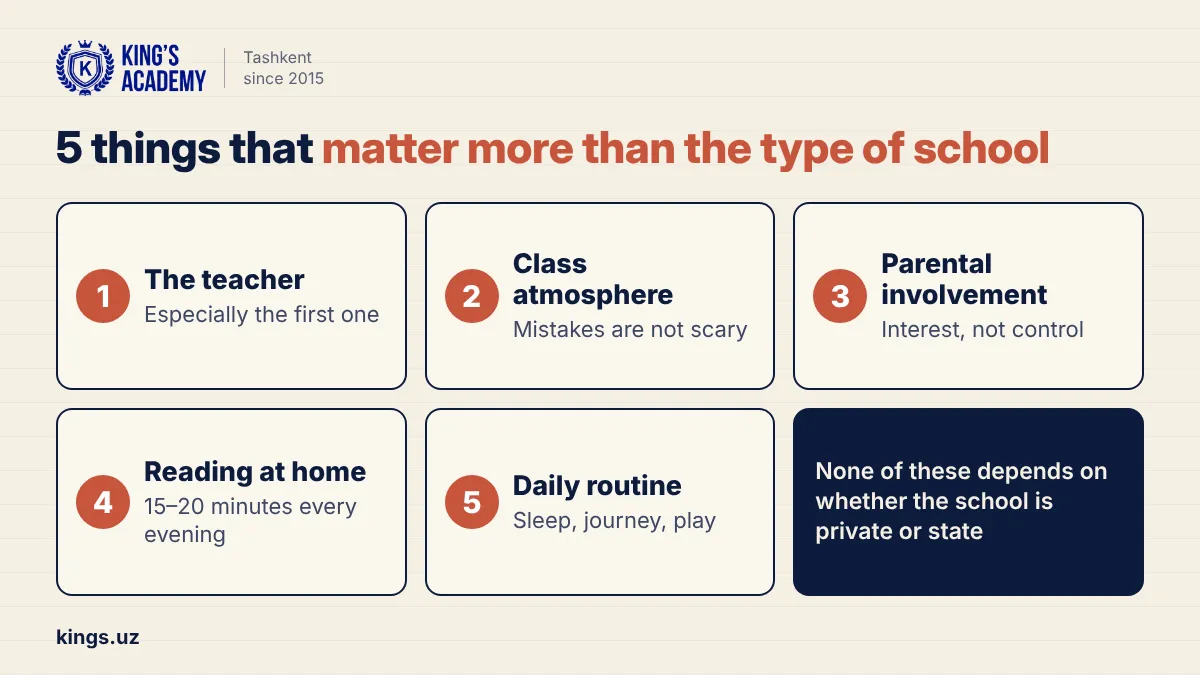
- What matters more than the type of school
- Who usually benefits from each
- Tool: which fits your family?
- How to choose: five steps
- A state school plus extra classes
- Common mistakes
Your child is six, and the same conversation keeps coming back at the dinner table. The school across the road is free, but the neighbours say there are more than thirty children in a first-grade class. A private school in another district promises fifteen per class and English every day — and a bill to pay for eleven years.
Both sides have a point. This guide does not choose for you. It shows how the options really differ, what the law and the statistics say, and which questions to ask a school before you sign an application or a contract.
Private or state school: which is better?
The better school is the one that fits your particular child and the way your family lives. The type of school — private or state — does not guarantee quality: there are strong and weak schools in both groups.
A state school wins on cost, on being close to home, and on your child growing up among the children of the neighbourhood. A private school wins on class size, a longer day and attention to each pupil. After that, details decide: who exactly will teach, how many children are in the class, and how much time you have yourselves.
How many schools Tashkent has, and how many are private
According to a press release of the National Statistics Committee dated 31 March 2026, Uzbekistan had 11,118 general education schools at the start of the 2025/26 school year, of which 551 were non-state. That is roughly one school in twenty. As of 13 November 2026, no newer official figures for 2026/27 have been published.
Tashkent looks different: 503 schools, 145 of them non-state. The capital has 562.1 thousand pupils and 34.1 thousand teachers. The country as a whole has 6,870.5 thousand pupils and 577.7 thousand teachers. The press release does not say how many children study in private schools specifically.
Point-by-point comparison: the table
The table contains only what is written in law or follows from how schools are organised. Exact figures for private schools differ from school to school, so the last column tells you what to ask.
| Criterion | State school | Private school | What to check |
|---|---|---|---|
| Cost | Free: guaranteed by Article 50 of the Constitution | Fee-paying, by contract; confirm fees with the school | The full yearly total: meals, uniform, transport, extra fees |
| Class size | Limit under the Regulation: 35 pupils | Set by the school; usually smaller | How many children are in the class now, not “planned” |
| Teachers | State pay scale and appraisal; workload depends on the school | Pay and conditions set by the school | The teacher’s experience and years at this school |
| Curriculum and languages | State curriculum; Uzbek-medium or Russian-medium classes | State, international (Cambridge, IB) or both | The language in which core subjects are taught |
| School day | Lessons in one of the shifts; extended-day group if the school runs one | More often a full day with meals and clubs | What time you actually have to collect your child |
| Admission | Grade 1 without competition, by micro-district | By the school’s own rules: interview, test, contract | Application dates and how the contract can be ended |
| Leaving document | State-form certificate (attestat) | Depends on licence, accreditation and programme | The licence and the document issued after grades 9 and 11 |
Data checked: 13 November 2026. Rules and fees change — confirm them with the school itself and on official websites before you decide.
Cost
Article 50 of the Constitution of Uzbekistan is direct: the state guarantees free general secondary education, and it is compulsory. Schooling lasts eleven years, grades I to XI, under Article 9 of the Law “On Education” (text in Russian).
Private schools operate under a licence and charge fees by contract. Fees in Tashkent vary widely and change every year, so we do not quote them here. Verified fees and terms are collected in a separate guide, Private Schools in Tashkent 2026/27.
Class size
The Regulation on General Secondary Education (Cabinet of Ministers Resolution No. 140 of 15 March 2017, text in Russian) does not allow more than 35 pupils in a class. If a class has 25 or more children, it may be split into two groups for foreign-language lessons, provided teachers are available.
In practice the limit is not kept everywhere. According to Ministry of Preschool and School Education figures reported by Kun.uz in April 2026, about 13,500 of the country’s 259,636 classes have more than 35 children. That is around 5% of classes: not the rule, but not rare in new, densely built districts.
There is no general figure for private schools: each sets its own class size. Ask to see a working class, not a brochure.
Teachers: workload and pay
In a state school, a teacher’s pay and category are set by the state, while workload depends on the school: in overcrowded schools a teacher has more classes and more exercise books to mark. A private school sets its own pay and requirements. There are no open, comparable statistics on pay in private schools, so generalising would not be honest.
It is more useful to ask about the actual person: how many years they have taught, how long they have been at this school, and how often teachers change here. High teacher turnover is a warning sign in any type of school.
Curriculum and languages
State schools follow the state curriculum, and the language of instruction is Uzbek or Russian, depending on the class. Before admission the school announces which classes it opens and in which languages. English is taught as a separate subject.
Private schools differ: some follow the same state curriculum with extra hours of English, some run international programmes, and some combine both. This is the main question to put to a private school, and the answer should be in writing.
School day, homework and tutors
Many state schools work in two shifts. By the ministry’s estimate, the country needs at least 850,000 more pupil places to move every school to a single shift. The Regulation allows extended-day groups, but not every school has them — ask at yours.
For two working parents this is often the deciding point. A private school usually takes on the whole day: lunch, homework, clubs. A state school leaves the afternoon to the family, and it has to be filled with something — a grandmother, a sports club, courses. That is where spending on tutors comes from, and an honest calculation adds it to the “free” school.
Facilities
Here the differences between individual schools are bigger than between types. According to the same ministry figures, more than 1,900 state schools in the country have no assembly hall or sports hall, and 934 need full renovation. At the same time Tashkent has new, well-equipped state schools as well as private schools in converted buildings. Look with your own eyes: the gym, the canteen, the toilets, the yard.
Admission and the micro-district
Children are admitted to the first grade of a state school without competition and regardless of how well prepared they are, in the year they turn seven. Each school has an assigned area — the micro-district (mikrouchastok). First, from 20 June to 31 July, families living in the micro-district apply; in August, families from other areas apply if places remain. At the same time, as the guidance on the gov.uz portal says, living in another area is not in itself grounds for refusal.
A step-by-step walkthrough with dates and applying through my.gov.uz is in the guide First-Grade Enrolment in Tashkent. Private schools admit by their own rules and on their own dates, sometimes all year round.
Specialised state schools and lyceums
Between “ordinary state” and “private” there is a third path: selective state schools. Article 38 of the Law “On Education” allows competitive admission to Presidential, creative and specialised schools.
- Presidential Schools. Entry to grade 5 after finishing grade 4, by competition. We covered how the exam works and how to prepare without overload in Presidential Schools in Uzbekistan.
- Specialised schools with in-depth study of particular subjects. Entry grades, exams and dates differ — check each school’s official website.
- Academic lyceums. Two years of study after grade 9; by law this is secondary specialised education, and it is also free.
Do private schools really teach better?
On average, private school pupils score higher, but mostly because they come from better-off and better-educated families. When children from similar families are compared, the difference almost disappears.
That is the conclusion of the OECD brief Private schools: Who benefits? (PISA in Focus No. 7, 2011, based on PISA 2009 data). Across the OECD area, private school students scored 30 points higher in reading. But once the socio-economic background of families and schools was accounted for, the advantage was no longer apparent in 13 of the 16 OECD countries that had shown it. The brief also notes that countries with a larger share of private schools do not perform better.
The caveats matter. These are OECD-country data, and fairly old. We found no separate public comparison of private and state schools in Uzbekistan, so the conclusion cannot be transferred directly.
There is also an interesting local fact. In PISA 2022, Uzbekistan’s first, 19% of 15-year-olds reached the baseline Level 2 in mathematics, against an OECD average of 69%. Yet family socio-economic status explained only 2% of the variation in mathematics results, compared with 15% across the OECD. In other words, in our schools a child’s result depends much less on the parents’ wallet than in many countries. And more on what happens in the lesson and at home.
What matters more than the type of school
- The teacher. Especially the first one. A good primary teacher in an ordinary school gives more than a mediocre one in an expensive school.
- Class atmosphere. Whether a child is unafraid to make mistakes, ask questions and answer at the board.
- Parental involvement. Not doing homework for the child, but taking an interest: what happened today, what went well, what is hard.
- Reading at home. Fifteen to twenty minutes every evening, aloud and together while the child is small. A paper book, not a screen.
- Routine. Sleep, the journey, time to play. A tired child learns poorly in any school.
None of these can be bought together with a contract. And none of them is lost because a school is free.
Who usually benefits from each
A state school more often suits families whose micro-district school is close and well regarded by neighbours, where an adult is at home in the afternoon, where the child is independent and sociable, and where the family prefers to spend money on specific things — a language, maths or sport.
A private school more often suits families where both parents work until evening, where the child struggles in a large group, where an international programme or English-medium teaching is needed, and where the fee does not put other important spending at risk for all the years of study.
A specialised school or lyceum suits a child who is clearly drawn to maths, languages or science and is personally ready for selection and a heavy workload.
Tool: which fits your family?
Eight neutral questions about budget, your child’s temperament, the journey and your plans. At the end you get the option closest to your answers, with three reasons why.
Which fits your family?
8 questions, about two minutes. Pick the answer closest to your life right now.
This tool needs JavaScript. In short: a state school with one or two extra classes suits families who have time for their child and a school nearby; a private school suits those who need a small class, a full day or an international programme; a specialised school or lyceum suits keen, independent children.
How to choose: five steps
- Start with your micro-district school. Go to an open day or simply to the deputy head. Find out how many children are in the first-grade classes and who is taking a class this year.
- Make an honest budget for eleven years, not one. For a state school, add clubs and courses; for a private school, add meals, transport and the yearly fee increase.
- Visit two or three schools of different types. Ask to sit in on an ordinary lesson. Watch the children: are they busy, are they afraid of the teacher?
- Ask the same questions everywhere: class size, language of instruction, the teacher’s experience, the daily timetable, the leaving document. At a private school, ask for the licence and the contract in advance.
- Ask your child. Where did they feel calmer, and where would they like to go back?
Signs that a school fits your child
- They go to school in the morning without tears or a “sore tummy”.
- They talk about school on their own, not only when questioned.
- They have made at least one friend in the class.
- The teacher knows what your child does well and what they find hard, and can say so specifically.
- Homework is manageable, and there is time left for play and sleep.
If most of these signs are missing after six months, you can change school. The rules allow a child to be transferred to another school during the school year.
A state school plus extra classes: how to combine them sensibly
The most common model in Tashkent is a school near home and classes after lessons. It works if you keep a sense of proportion.
- One or two goals, not five. Most often a foreign language and something for the body: swimming, wrestling, dance.
- A small group. The point of extra classes is for the child to get the attention that is missing in a class of thirty.
- Free days. At least two days a week with nothing after school.
- A check every six months. Is there a result, and is your child tired? Signs of overload are covered in Tutors, Burnout and Your Child.
We wrote in detail about telling a strong learning centre from a weak one in How to Choose a Learning Centre for Your Child in Tashkent. At King’s Academy, for example, English for children aged 6–12 is taught in groups of up to 10 with printed books — to complement school, not duplicate it.
The same logic applies to older pupils. The state school certificate is accepted by universities in Uzbekistan, while international and foreign universities usually also require an English certificate, which can be earned alongside any school. If your child already has one, you can check IELTS results online.
Common mistakes
- Choosing by price. An expensive school is not necessarily strong, and a free one is not necessarily weak.
- Looking at the building, not the teacher. A child learns from a person, not from the interior.
- Not reading the contract. What the fee includes, how it rises, how money is refunded if you leave.
- Not checking the leaving document. Find out in advance whether your child will receive the state certificate.
- Treating the decision as final. Schools can be changed, and sometimes that is the right decision.
Whatever the school, find out the real level of English
The free test shows where to start. Then you can use the course finder and look at the timetable. The first trial lesson at King’s Academy is free.
Frequently asked questions
Is state school in Uzbekistan really free?
Yes. Article 50 of the Constitution guarantees free general secondary education, and it is compulsory. Schooling lasts 11 years, grades I to XI.
How many pupils can a state school class have?
No more than 35, under the Regulation on General Secondary Education (Cabinet of Ministers Resolution No. 140 of 15 March 2017). In practice some schools exceed it: by ministry figures from April 2026, about 13,500 of 259,636 classes.
How many private schools are there in Tashkent?
At the start of the 2025/26 school year, 145 of the city’s 503 schools were non-state. Nationwide it was 551 of 11,118. These are National Statistics Committee figures dated 31 March 2026.
Is a private school in Tashkent worth it?
It is, if you need a small class, a full day or an international programme and can afford the fee for all the years of study. If the main reason is “they teach better there”, compare the actual teachers first: the type of school alone does not guarantee results.
Can a state school refuse a child from outside its micro-district?
Families in the micro-district apply first, from 20 June to 31 July. Others apply in August for the remaining places. According to gov.uz guidance, living in another area is not in itself grounds for refusal.
Does a private school issue the state certificate?
It depends on the school. By law, graduates of accredited organisations receive a state-form document. Ask to see the licence and confirm which document is issued after grades 9 and 11.
Sources: Constitution of the Republic of Uzbekistan, Article 50 — lex.uz · Law “On Education” No. ZRU-637 — lex.uz · Regulation on General Secondary Education, Resolution No. 140 — lex.uz · National Statistics Committee — general secondary education, 31.03.2026 · gov.uz — admission to general secondary school · OECD — PISA 2022 country note: Uzbekistan · OECD — Private schools: Who benefits? (2011) · Kun.uz — ministry figures on class sizes
Author: Eldor Sattorov — founder and director of King’s Academy, MA TESL, former Vice-Principal of a Presidential School in Tashkent, teaching since 2010.
What's next?
Take the first step — it's free or takes 2 minutes:
Other articles
Daily useful articles

Job interview in English: 15 questions and how to answer them
The 15 most common job interview questions in English, with short sample answers, the STAR method and the mistakes Uzbek and Russian speakers make.

What an IELTS Speaking Examiner Really Listens For (and What They Ignore)
A former IELTS examiner explains what really affects your Speaking score: accent, opinions, memorised answers, plus a simple plan for this week.

Offline vs Online IELTS Preparation: Why a Real Classroom Still Wins in 2026
Offline or online IELTS preparation? See the honest comparison, a step-by-step plan, and why Tashkent students reach 7.0+ in class at King’s Academy.
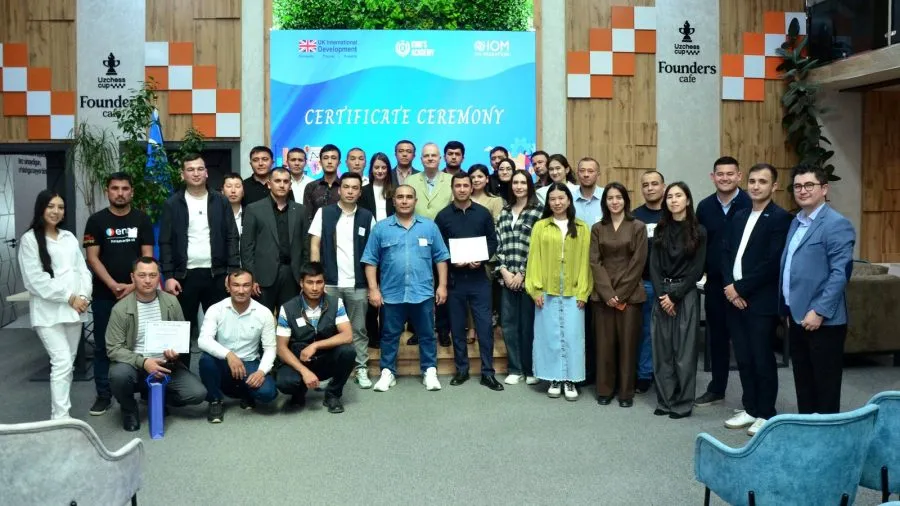
King’s Academy and IOM: English for Uzbek Seasonal Workers Going to the UK, 240 Video Lessons and Financial Literacy for Migrants
Over 5 months, King’s Academy taught English to more than 120 Uzbek migrants preparing for seasonal work in the UK, in cooperation with IOM, the UN Migration Agency, with support…

How Long Does It Take to Learn English from Zero to IELTS?
How long does it take to learn English from zero to IELTS 6.0–7.0? Realistic timelines by level, free tools, and King’s Academy courses in Tashkent.

IELTS 9.0: how to get it, and do you even need it? An honest guide
The "niner" craze in Uzbekistan: do you need IELTS 9.0 for university, how parents can help without pressure, and a realistic roadmap to 9.0.
Submit a request
Do you want to sign up for classes or become part of our team?
Request submitted
We will contact you within the working day.