


What an IELTS Speaking Examiner Really Listens For (and What They Ignore)

In short
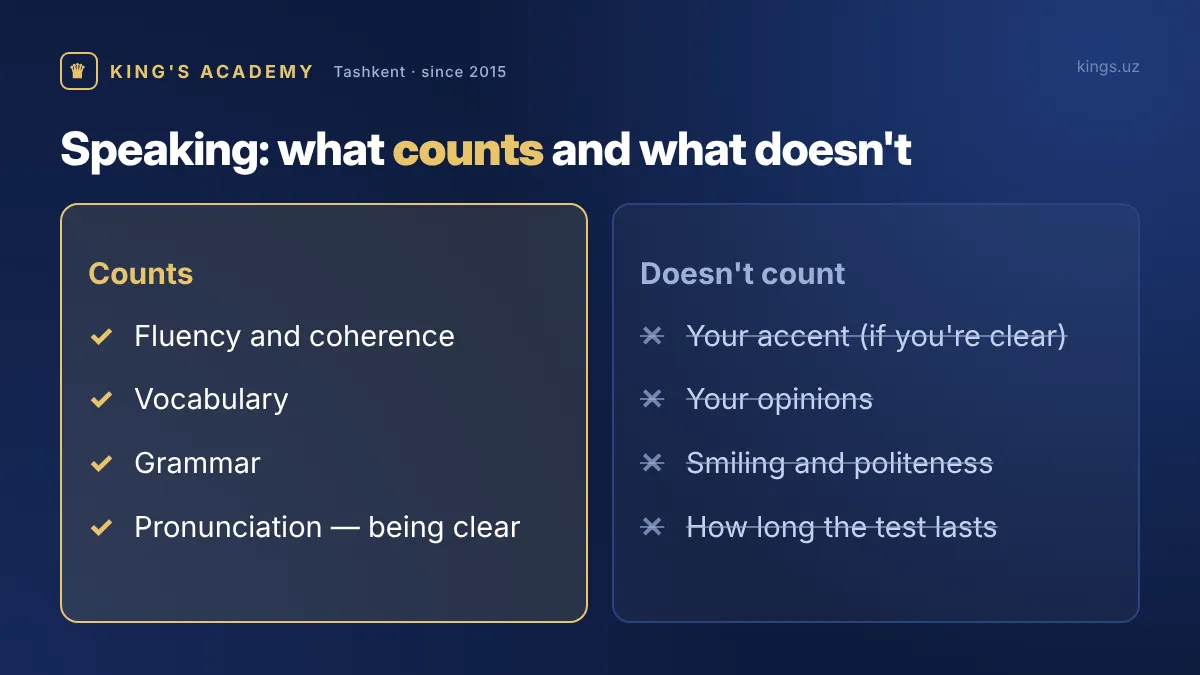
An IELTS Speaking examiner scores four things: fluency and coherence, vocabulary, grammar and pronunciation. Your accent (as long as you’re clear), your opinions, your smile and the length of the conversation don’t change your band. Memorised answers don’t help, and you can ask for a question to be repeated.
Before the Speaking test, almost every student asks me the same question: “What if I have an accent?” Then come the others. Should I learn more “clever” words? Can I ask the examiner to repeat? What happens if I disagree with them?
I used to work as an IELTS Speaking examiner, so I’ll be honest: most of these worries are aimed at the wrong target. Let’s look at where your energy should really go.
How the Speaking test works, in thirty seconds
It’s a face-to-face conversation with a certified examiner and it lasts 11 to 14 minutes. It is recorded in case it needs to be reviewed. The format is the same for Academic and General Training (IDP).
- Part 1. Questions about you: your studies, work, family, hobbies.
- Part 2. You get a card with a topic and one minute to prepare (with pen and paper). Then you speak on your own for up to two minutes.
- Part 3. A discussion linked to the Part 2 topic. The questions become broader and more abstract.
Even if you take IELTS on a computer, the Speaking test is still with a real person — sometimes on the same day, sometimes up to a week before or after the other parts.
What the examiner is actually listening for
All the criteria are in a public document — the IELTS Speaking band descriptors. It’s worth reading at least once yourself. For the 0–9 scale and how your overall band is worked out, see our article How IELTS is assessed.
Fluency isn’t speed
Many students believe that faster means better. It doesn’t. Pauses are normal. What matters is why you stop. Searching for a word or the right verb form is one thing. Stopping to think about your idea — the way you would in your own language — is something else. At high bands, pauses are mostly the second kind.
A few simple linking phrases that you genuinely use will help: The thing is…, On the other hand…, That’s why…, To be honest… Not fifteen of them — five, used in the right place.
Vocabulary: precise beats impressive
One accurate word is better than three rare ones you only half understand. A simple rule from the British Council’s Voices magazine: if you’re not 100% sure of a word’s meaning and form, don’t use it.
Compare. “Tashkent is a very big and nice city” — clear, but flat. “Tashkent has grown so fast that my old neighbourhood is hard to recognise” — still simple words, but a real thought.
Grammar: variety you can control
Short, simple sentences feel safe: fewer words, fewer mistakes. But they also hide your real level. The examiner needs to hear that you can build longer sentences — with because, although, if, and different tenses.
You don’t need to force difficult grammar in, though. Talk about your own life and the tenses will come naturally: I’ve lived in Yunusobod since I was a child, but if I could choose again, I’d probably…
Pronunciation: being understood, not sounding British
Nobody expects a British or American accent. The descriptors say it clearly: at a high level, your accent has very little effect on how easily you’re understood — and that’s enough. Here’s what I hear most often from students who speak Uzbek or Russian:
- mixing up w and v: “wery vell” instead of very well;
- th turning into s, z or t: “sink” instead of think;
- dropping the -ed and -s endings, which changes the meaning;
- flat intonation, as if you’re reading a list.
All of these can be fixed with a few weeks of regular practice.
🎧Check your real band this weekend — CD Mock IELTS: 150,000 sum, each next one 50,000 cheaper, 4th free →Five myths that cost you marks
“I have to agree with the examiner.” No. Your opinions aren’t marked — there are no right or wrong views here (IDP). If you disagree, say so politely and explain why.
“If I don’t know the topic, I’ll fail.” Your knowledge of the topic isn’t tested. Don’t know much about architecture? Talk about a building you pass every day on your way to work.
“I’ll just memorise good answers.” Probably the most expensive mistake. Examiners notice memorised answers very quickly and ask different questions to find your real level. In the official criteria, memorised phrases appear only at the lowest bands.
“You can’t ask the examiner to repeat.” You can. Sorry, could you repeat the question? or Do you mean…? is a normal part of a conversation, not a minus.
“Being polite and smiling will add a band.” Nice, but not marked. The same goes for test length: if your conversation lasted 11 minutes instead of 14, it means nothing.
If what holds you back most is the fear of opening your mouth, start with “Afraid to speak English? Why it happens and what to do about it”. It has a four-week plan and phrases that help when you need a pause.
What to do this week
- Record yourself. Take a topic like Describe a place in Tashkent you like to visit, give yourself one minute for notes and speak for two minutes into your phone. Then listen — you’ll hear right away where you pause and which words you repeat.
- Read the descriptors for your target band. Not the whole table — just two rows: where you are now and where you want to be.
- Pick one problem. Not “improve everything” — for example, only -ed endings this week.
- Take a mock exam. Feeling the real format takes away half the nerves. At the CD Mock IELTS at King’s Academy, Speaking is face to face, just like the real test.
And once your exam is behind you, you can check your scores on our Check your IELTS results page.
Need a second pair of ears?
It’s hard to hear your own mistakes. Start with a free level test or a CD Mock IELTS. Aiming for 7.0+: the intensive with Eldor Sattorov. Open groups are in the timetable.
Frequently asked questions
How long is the IELTS Speaking test?
Between 11 and 14 minutes, in three parts.
Will my accent lower my score?
No, as long as you’re easy to understand. Examiners score how clear you are, not how “British” you sound.
Can I ask the examiner to repeat a question?
Yes. It’s a normal part of the conversation and doesn’t lower your score.
Is my opinion marked?
No. What’s marked is how well you express your ideas in English, not the ideas themselves.
On computer-delivered IELTS, do I speak to a computer?
No. Speaking is always with a real examiner — on the same day or within a week of the other parts.
Sources: IDP — IELTS Speaking · IELTS Speaking band descriptors · IDP — 9 myths about IELTS Speaking · British Council — Ten don’ts for IELTS Speaking · Take IELTS — Speaking preparation
What's next?
Take the first step — it's free or takes 2 minutes:
Other articles
Daily useful articles

IELTS Myths Busted on Kun.uz: Eldor Sattorov and the British Council
On Kun.uz, Eldor Sattorov (King’s Academy) and Andrey Maksakov (British Council) explain how IELTS works and bust common myths. Watch the interview.

Tutors, Burnout and Your Child: How Many Extra Classes Are Too Many in Tashkent? A Parent’s Guide
How many tutors is too many? A Tashkent educator on burnout, sleep, realistic IELTS timelines and 8 checks to see if your child’s English course really works.

How Long Does It Take to Learn English from Zero to IELTS?
How long does it take to learn English from zero to IELTS 6.0–7.0? Realistic timelines by level, free tools, and King’s Academy courses in Tashkent.

The True Cost of IELTS 7.5 in Tashkent: How to Plan Your Child’s Education Budget for the Next 5–6 Years
How much does IELTS 7.5 really cost in Tashkent? Real 2026 prices, a planned vs last-minute budget, university fees, a 6-year savings plan and English pay data.

How to Get IELTS 7.0+ Through Self-Study: A Realistic, No-Nonsense Roadmap
Can you get IELTS 7.0 without a teacher? A realistic self-study roadmap: daily habits, a 12-week plan, free resources and how to stay disciplined to the end.

Milliy Sertifikat (CEFR) or IELTS: Which One Should You Take?
Milliy sertifikat (CEFR) or IELTS? Price, recognition, scores for university admission and validity compared — plus 5 real situations and which exam to take in each.
Submit a request
Do you want to sign up for classes or become part of our team?
Request submitted
We will contact you within the working day.