


How IELTS Is Assessed: the 0–9 Band Scale, the Criteria and Your Overall Score

In short
IELTS is scored on a band scale from 0 to 9. Each of the four sections — Listening, Reading, Writing and Speaking — gets its own band, and your overall band is their average, rounded to the nearest half band. Listening and Reading are marked by the number of correct answers out of 40; Writing and Speaking are marked by examiners against four official criteria. You can work out your overall band and check your result on our IELTS results page.
The IELTS band scale: what each score means
There is no pass or fail in IELTS: you get a band from 0 to 9 in half-band steps (for example 6.0, 6.5, 7.0). Each band has an official description of language ability:
| Band | Level (official name) |
|---|---|
| 9 | Expert user |
| 8 | Very good user |
| 7 | Good user |
| 6 | Competent user |
| 5 | Modest user |
| 4 | Limited user |
| 3 | Extremely limited user |
| 2 | Intermittent user |
| 1 | Non-user |
| 0 | Did not attempt the test |
Most universities ask for 6.0–7.0, often with a minimum in every section — which is why it helps to understand how each section is scored.
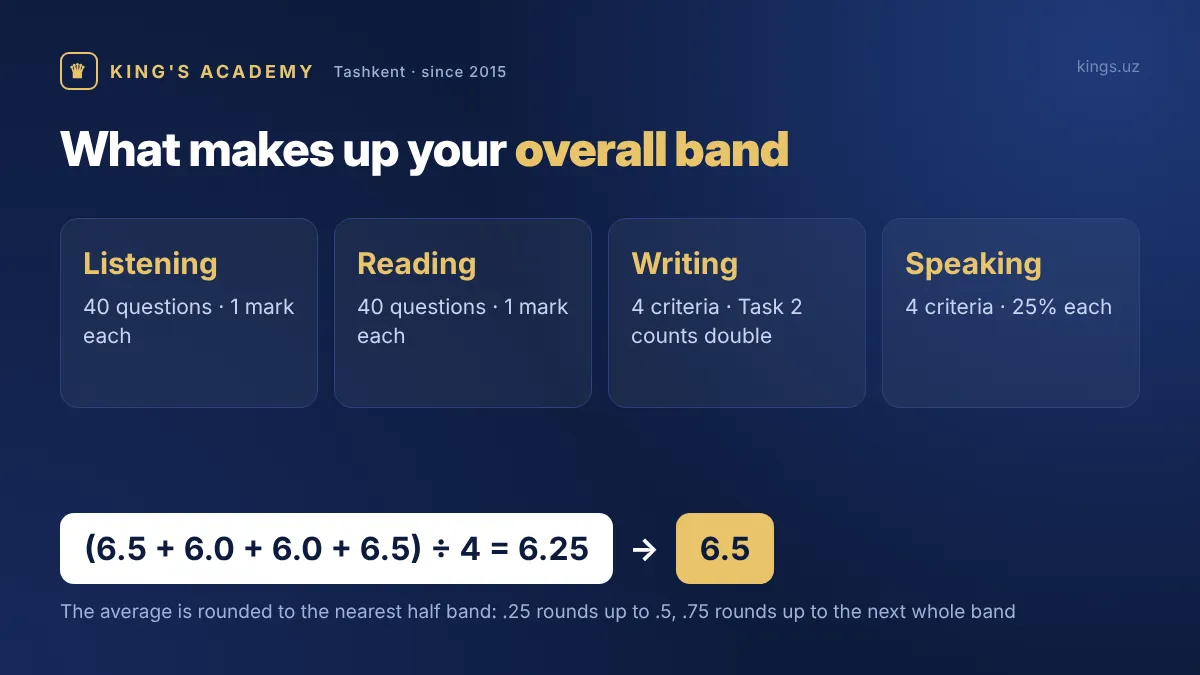
Listening and Reading: correct answers out of 40
Each section has 40 questions, with one mark for each correct answer. Wrong answers lose no marks, so never leave a blank. Your number of correct answers is converted to a band. Roughly (the tables vary slightly from test to test):
| Band | Listening | Reading (Academic) |
|---|---|---|
| 8.0 | ≈ 35 / 40 | ≈ 35 / 40 |
| 7.0 | ≈ 30 / 40 | ≈ 30 / 40 |
| 6.0 | ≈ 23 / 40 | ≈ 23 / 40 |
| 5.0 | ≈ 16 / 40 | ≈ 15 / 40 |
General Training Reading texts are easier, so you need more correct answers for the same band (around 30 for a 6.0, for example).
🎧Check your real band this weekend — CD Mock IELTS: 150,000 sum, each next one 50,000 cheaper, 4th free →Writing: two tasks, four criteria
Writing is marked by certified examiners. There are two tasks, and Task 2 (the essay) counts twice as much as Task 1. Each task is assessed on four equally weighted criteria:
- Task Achievement / Task Response — how fully and accurately you answer the task;
- Coherence and Cohesion — the logic and flow of your writing;
- Lexical Resource — your range and accuracy of vocabulary;
- Grammatical Range and Accuracy — the variety and correctness of your grammar.
Speaking: a live conversation, four criteria
Speaking takes place face to face with an examiner. Each of the four criteria is worth 25% of the band:
- Fluency and Coherence;
- Lexical Resource;
- Grammatical Range and Accuracy;
- Pronunciation.
The official descriptions of every criterion (the band descriptors) are public — they are the best guide to what you need for the next band.
How the overall band is calculated
Your overall band is the average of the four sections, rounded to the nearest half band by the official rule:
- an average ending in .25 rounds up to .5 (6.25 → 6.5);
- an average ending in .75 rounds up to the next whole band (6.75 → 7.0);
- anything else rounds down (6.125 → 6.0).
For example, Listening 6.5, Reading 6.0, Writing 6.0, Speaking 6.5: the average is 6.25, so the overall band is 6.5. Try your own scores in our IELTS overall band calculator — it uses the same rule.
Who marks it, and how to get your result
Writing and Speaking are marked by trained examiners whose work is regularly monitored; Listening and Reading are marked against answer keys. Computer-delivered results are usually ready in 1–5 days, paper-based results in about 13 days. The online result is provisional; your official document is the Test Report Form (TRF).
Exactly where to see your result with IDP or British Council, when it arrives, and how to request a re-mark (Enquiry on Results) is all on one page: how to check your IELTS results.
How to use this in your preparation
- Take a mock in the real format. It shows your band for each section and for each Writing and Speaking criterion — the CD Mock IELTS at King’s Academy is on computer, with Speaking face to face, and the report includes AI feedback and an audio recording of your Speaking.
- Work on your weakest criterion, not on “English in general”. Half a band is often lost on a single criterion such as Task Response or Pronunciation.
- Remember the weight of Task 2. The essay gives two thirds of your Writing band — practise it first.
- Never leave blanks in Listening and Reading — there is no penalty for wrong answers.
Preparing for IELTS in Tashkent?
Start with a free level test or a CD Mock IELTS. Aiming for 5.5–6.5: the CD IELTS course; aiming for 7.0+: the intensive with Eldor Sattorov (IELTS 8.5). All prices are on our prices page.
Frequently asked questions
What is the highest IELTS score?
9.0, for each section and for the test overall. Bands are given in half-band steps.
How is the IELTS overall band calculated?
It is the average of Listening, Reading, Writing and Speaking, rounded to the nearest half band: 6.25 → 6.5, 6.75 → 7.0, 6.125 → 6.0.
How many correct answers do I need for 7.0 in Listening?
About 30 out of 40. The exact table changes slightly from test to test.
Which Writing task matters more?
Task 2, the essay: it counts twice as much as Task 1.
Where can I check my IELTS result?
On the official IDP or British Council websites — links and timings are on our page “How to check your IELTS results”.
Sources: British Council — How is IELTS assessed · IELTS (IDP) — How we mark your test · IDP — Check your result · British Council Uzbekistan — Test Taker Portal
What's next?
Take the first step — it's free or takes 2 minutes:
Other articles
Daily useful articles

Milliy Sertifikat (CEFR) or IELTS: Which One Should You Take?
Milliy sertifikat (CEFR) or IELTS? Price, recognition, scores for university admission and validity compared — plus 5 real situations and which exam to take in each.

WIUT Academic Lyceum in Tashkent: How to Prepare for the Entrance Exam Without Burnout (2027 Guide)
WIUT Academic Lyceum admission in Tashkent: 2026 places, dates and tests, English certificate rules and a calm 6-month maths and English plan for Grade 9.

How Long Does It Take to Learn English from Zero to IELTS?
How long does it take to learn English from zero to IELTS 6.0–7.0? Realistic timelines by level, free tools, and King’s Academy courses in Tashkent.

Causes and Solutions Essays in IELTS: The 4-Paragraph Plan That Answers Both Questions
IELTS Task 2 causes and solutions essay: decode the question, the 4-paragraph plan, a solution for each cause, 10 collocations and a Band 7.5+ sample.
How Much Does IELTS Preparation Cost in Tashkent in 2026? Course and Exam Prices
How much IELTS costs in Tashkent in 2026: the official exam fee, course prices, your total budget and practical ways to save money.

IELTS 5.5 to 7.0: How Long Does It Take, and Can You Do It in 2 Months?
How long does it take to go from IELTS 5.5 to 7.0? Realistic timelines, an 8-week plan and an intensive course with Eldor Sattorov in Tashkent.
Submit a request
Do you want to sign up for classes or become part of our team?
Request submitted
We will contact you within the working day.