


WIUT Academic Lyceum in Tashkent: How to Prepare for the Entrance Exam Without Burnout (2027 Guide)

Short answer for parents
The Academic Lyceum of Westminster International University in Tashkent (WIUT Lyceum) is a two-year lyceum for pupils who have finished Grade 9. In 2026/27 it offered 156 places in the mathematics + foreign language profile. Applications go through my.edu.uz (in 2026: 10 June – 10 July, up to three lyceums), and entrance tests were held on 24–25 July. Nationally, 48,233 pupils applied for 14,898 lyceum places — and WIUT is one of the most popular choices in Tashkent. Success comes from 6–9 months of steady work on maths and English, not from last-minute cramming.
Why I am writing this
Since about 2015, King’s Academy has prepared pupils for the WIUT Academic Lyceum entrance exam — more than 100 of our students have been admitted. Over those years I have seen what separates the children who get in from those who narrowly miss: not talent, but a clear plan, a strong maths base, solid English and a calm head on exam day.


What is the WIUT Academic Lyceum?
- A state academic lyceum attached to Westminster International University in Tashkent (WIUT).
- Two years of study (Grades 10–11) after Grade 9, with a strong focus on mathematics and English.
- Many graduates continue at WIUT and other international universities in Tashkent and abroad.
- The lyceum also runs a fee-paying Cambridge A Level track (published fee for 2024/25: £3,600 a year).
Who can apply in 2026–2027?
- Pupils who have completed Grade 9 (or are finishing it in the year of admission).
- Applications are submitted online at my.edu.uz; in 2026 you could choose up to three lyceums.
- Places in 2026/27: 156 at the WIUT Lyceum, profile “mathematics + foreign language” (Ministry quota list).
- Check the lyceum’s own admission rules and announcements every spring — details can change from year to year.
How does the entrance exam work?
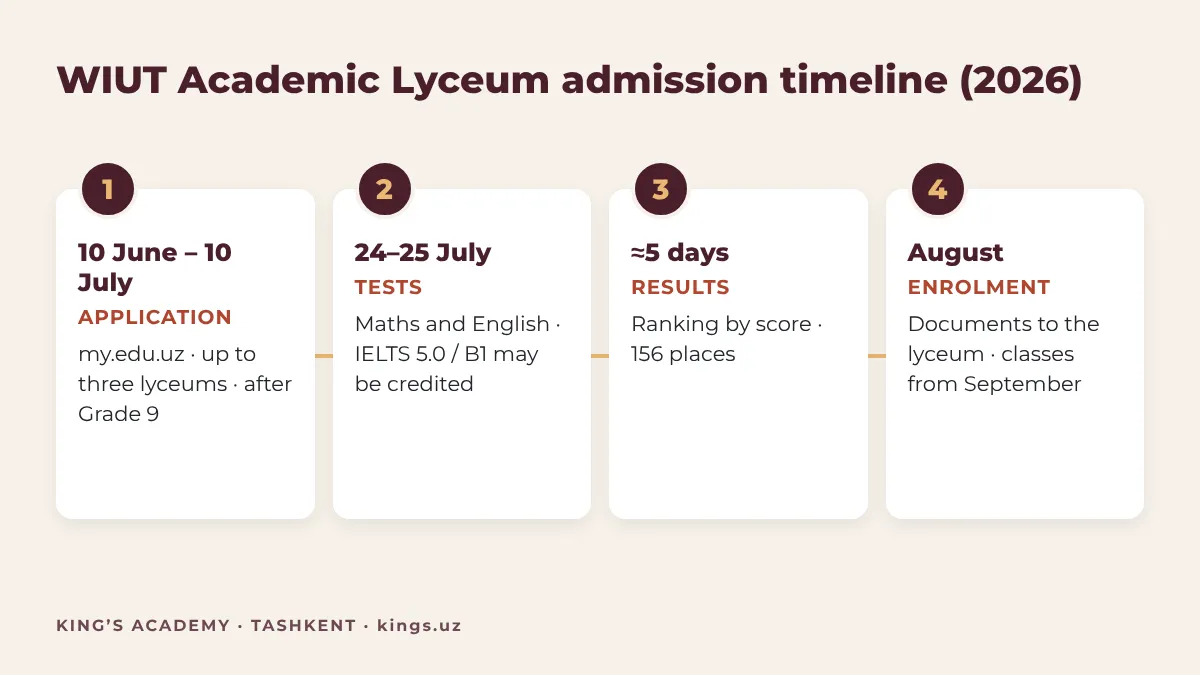
| Step | 2026 dates | What happens |
|---|---|---|
| Application | 10 June – 10 July | Online at my.edu.uz; up to three lyceums |
| Entrance tests | 24–25 July | Tests in the profile subjects (mathematics and English), organised with the Knowledge and Skills Assessment Agency |
| Results | Within about 5 days | Ranking by score within each lyceum’s quota |
| Enrolment | August | Documents submitted to the lyceum; classes start in September |
Source: official announcements for the 2026/27 intake. Dates for 2027 will be announced in spring 2027.
English certificates. The lyceum’s published rules have allowed applicants with an IELTS of at least 5.0, TOEFL iBT 42, Cambridge B1 Preliminary (PET) or a national CEFR B1 certificate to be credited for English. Always confirm the current year’s rule before you rely on it.
Weighting. In WIUT’s own earlier exams, mathematics carried about 60% of the total and English about 40%. That is a good guide to where to spend your time: maths decides most outcomes.
How competitive is it?
- In 2021, more than 3,500 pupils applied and 182 were admitted — roughly 1 in 19.
- In 2026, 48,233 pupils applied for 14,898 places in academic lyceums across Uzbekistan (source).
- WIUT, together with a few other Tashkent lyceums, attracts the strongest applicants in the city.
What does the exam really test?
- Mathematics: the full school programme up to Grade 9 — algebra (equations, inequalities, functions, percentages), geometry, word problems — plus problems that need several steps and careful reasoning.
- English: grammar, vocabulary and reading at about B1 level. A pupil with a stable B1 (IELTS 5.0–5.5 equivalent) is in a strong position.
- Speed and accuracy: many good pupils lose points on simple arithmetic mistakes under time pressure.
A 6-month plan for Grade 9
| Period | Focus | Weekly time |
|---|---|---|
| January – February | Diagnose: a full maths test and an English level test. Fill gaps in fractions, percentages, equations and basic grammar | 5–6 hours |
| March – April | Algebra and geometry topics one by one; English reading and grammar to B1; vocabulary every day | 6–7 hours |
| May – June | Mixed exam-style sets on a timer; one full mock a week; error log | 7–8 hours |
| July (before the test) | Light review of the error log, 2–3 mocks, good sleep — no new topics | 5–6 hours |
Spread over 5–6 days. School exams in Grade 9 matter too — plan around them.
Mathematics
- Keep a notebook of mistakes. Every week, redo the problems you got wrong.
- Practise mental arithmetic for 10 minutes a day — it saves time and points.
- Do timed sets of 20–30 problems, then review every wrong answer.
English
- Read 20 minutes a day: graded readers, news for teens, short articles.
- Learn 10 new words a day with examples, and review them weekly.
- If your child already has B1, consider an IELTS or a CEFR B1 certificate — it may count for the English part.
How to avoid burnout
Grade 9 is already a busy year. The children who do best are not the ones who study 12 hours a day, but the ones who keep a steady rhythm for months.
- Sleep 8–10 hours. That is the recommendation for teenagers aged 13–18 (American Academy of Sleep Medicine).
- Move every day. The WHO recommends an average of 60 minutes of physical activity a day for 5–17-year-olds (WHO).
- Phones away during study blocks. 45 minutes of focus, 10 minutes of rest.
- One free day a week.
- Talk about options. There are other strong lyceums and schools. A teenager who knows there is a plan B feels less pressure and performs better.
Warning signs: when to slow down
- Constant tiredness, even after a weekend.
- Falling school marks or loss of interest in hobbies.
- Irritability, tears or panic before tests.
- Staying up late to “catch up” several nights a week.
If you see these signs, reduce the workload for a week or two and talk calmly. Consistency over months beats intensity over weeks.
Prepare with a proven plan
Since 2015, more than 100 King’s Academy students have entered the WIUT Lyceum. See our WIUT Lyceum preparation course, check your child’s level with the free level check, or find a group on the timetable.
Frequently asked questions about WIUT Lyceum admission
Who can apply to the WIUT Academic Lyceum?
Pupils who have completed Grade 9 apply for the two-year lyceum programme (Grades 10–11).
How many places does the WIUT Lyceum have?
In 2026/27 the lyceum had 156 places in the mathematics + foreign language profile.
Where do we apply?
Online at my.edu.uz. In 2026 the window was 10 June – 10 July, and you could choose up to three lyceums.
When are the entrance tests?
In 2026 the tests took place on 24–25 July, with results within about five days.
Which subjects are tested?
The profile subjects: mathematics and English. Historically maths carried about 60% of the score and English about 40%.
Does an IELTS certificate help?
The lyceum’s published rules have credited IELTS 5.0+, TOEFL iBT 42, Cambridge PET or CEFR B1 for English. Check the current year’s rules.
How competitive is admission?
In 2021, over 3,500 pupils applied and 182 were admitted. In 2026, 48,233 pupils applied for 14,898 places in lyceums nationwide.
Is the WIUT Lyceum free?
Places filled through the state admission on my.edu.uz belong to the state lyceum system. The separate Cambridge A Level track is fee-paying (£3,600 a year in 2024/25). Confirm current terms with the lyceum.
When should my child start preparing?
Ideally 6–9 months before the exam, at the start of Grade 9 or earlier if maths gaps are large.
How many hours a week should a Grade 9 pupil study for the exam?
About 5–8 hours a week in addition to school, with 8–10 hours of sleep a night and one free day.
Related: Presidential Schools: how to prepare without burnout · How long does it take to learn English from zero? · Check your IELTS results.
About the author
Eldor Sattorov — founder and director of King’s Academy in Tashkent (since 2015), where more than 100 students have been prepared for and admitted to the WIUT Academic Lyceum. Former vice-principal at the Presidential School in Tashkent (2019). MA in TESL (Webster University), BA in International Relations with Politics (University of York, UK). CELTA-qualified, former Cambridge English Speaking examiner.
Read also: Private schools in Tashkent 2026/27: fees and admission · First-grade enrolment in Tashkent via my.gov.uz
Sources
- Ministry of Preschool and School Education — 2026/27 admission parameters (WIUT lyceum: 156 places)
- Ta’lim xabarlari — Academic lyceum applications open 10 June 2026
- Ta’lim xabarlari — 48,233 applicants for 14,898 places (10 July 2026)
- Knowledge and Skills Assessment Agency — Lyceum entrance tests 24–25 July 2026
- WIUT Academic Lyceum — Admission rules
- WIUT Academic Lyceum — Entrance exam announcement
- WIUT Academic Lyceum — Cambridge A Level programme
- Wikipedia — Academic Lyceum of WIUT
- American Academy of Sleep Medicine — Recommended sleep for children
- WHO — Physical activity fact sheet
What's next?
Take the first step — it's free or takes 2 minutes:
Other articles
Daily useful articles

How to Choose the Best IELTS Learning Centre in Tashkent: 5 Criteria to Look For
How to choose an IELTS centre in Tashkent: 5 criteria to check — teachers, mock exams, feedback, student support and real results, not just ads.
King’s Academy and American Councils YPIP: Five Years of Launching Young Professionals in Uzbekistan
What Is the American Councils Young Professional Internships Program (YPIP)? The Young Professional Internships Program (YPIP) is run by American Councils for International…

How to Get IELTS 8.0: A Complete Guide to Successful IELTS Preparation in Tashkent
How can you get IELTS 8.0? How long does IELTS preparation take? What should you do every day? Is an IELTS course really necessary? How important is typing speed for…

Study abroad on a scholarship: which English certificate 6 top programmes ask for
El-yurt umidi, Chevening, GKS, MEXT, Türkiye Bursları, Stipendium Hungaricum: what IELTS you need, who sets the bar, and a backwards plan.

Computer-Delivered IELTS: How the Exam Works
How CD IELTS works in Tashkent: the screen layout, notes, word counter, the typing speed you need and how it differs from paper-based IELTS.

IELTS Courses in Tashkent 2026: How to Choose — Formats, Prices and 10 Questions to Ask Any Centre
How to choose an IELTS course in Tashkent in 2026: preparation formats, prices, the exam fee, 10 questions to ask any learning centre, and the red flags to avoid.
Submit a request
Do you want to sign up for classes or become part of our team?
Request submitted
We will contact you within the working day.