


How to Get IELTS 8.0: A Complete Guide to Successful IELTS Preparation in Tashkent

How can you get IELTS 8.0? How long does IELTS preparation take? What should you do every day? Is an IELTS course really necessary? How important is typing speed for Computer-Delivered IELTS? And how do you choose the right IELTS learning centre in Tashkent?
Getting an IELTS Band 8.0 is not simply about knowing English well. It requires a combination of English proficiency, exam strategy, consistent practice, discipline, feedback, time management and familiarity with the test format.
For students in Tashkent and Uzbekistan, the difference between an IELTS 6.5, 7.0, 7.5 and 8.0 is often not another thousand vocabulary words. It is the accumulation of dozens of small habits: reading every day, writing regularly, analysing mistakes, learning to type quickly, practising under time limits, attending professional lessons and receiving qualified feedback.
This guide explains how to prepare for IELTS systematically — and how students aiming for IELTS 8.0 or higher can structure their preparation.
What Does IELTS 8.0 Actually Mean?
IELTS Band 8 is officially described as a “Very good” level of English. At this level, a test taker generally demonstrates fully operational command of English, with only occasional unsystematic inaccuracies, and can handle complex and detailed argumentation effectively.
For Writing, an 8.0 is particularly demanding.
IELTS Writing is assessed through four criteria:
- Task Response / Task Achievement
- Coherence and Cohesion
- Lexical Resource
- Grammatical Range and Accuracy
The criteria are equally important, while Writing Task 2 carries more weight than Task 1 in the final Writing score.
According to the official Band 8 descriptors, a strong Band 8 candidate:
- addresses the task appropriately and sufficiently;
- presents a clear and well-developed position;
- develops and supports relevant ideas;
- organises information logically;
- uses cohesion effectively;
- demonstrates a wide and flexible vocabulary;
- uses uncommon or idiomatic vocabulary appropriately when relevant;
- uses a wide range of grammatical structures flexibly and accurately;
- produces mostly error-free sentences;
- makes only occasional, non-systematic errors that have minimal impact.
This is why IELTS 8.0 cannot realistically be achieved by memorising 100 “advanced” words or learning a few essay templates.
It requires a complete preparation system.
1. Start With Your Current Level — Not Your Desired Score
One of the biggest mistakes IELTS students make is starting preparation without knowing their actual level.
A student may say:
“I need IELTS 8.0.”
But the important question is:
Where are you today?
There is a huge difference between preparing from:
- IELTS 5.0 → 8.0
- IELTS 6.0 → 8.0
- IELTS 7.0 → 8.0
- IELTS 7.5 → 8.0
Your preparation strategy should depend on your starting point.
Take a proper diagnostic test
Before starting serious preparation, complete a full IELTS-style test covering:
- Listening
- Reading
- Writing
- Speaking
Do not rely only on an online vocabulary test or grammar test.
You need to discover your weakest component.
For example:
| Skill | Current | Target |
|---|---|---|
| Listening | 7.5 | 8.5 |
| Reading | 8.0 | 8.5 |
| Writing | 6.5 | 8.0 |
| Speaking | 7.0 | 8.0 |
In this example, spending most of your study time on Reading would probably not be the most efficient use of time.
The biggest improvement opportunity is Writing.
2. Understand That IELTS Preparation Is a Daily Process
You do not need to study English for six hours every day.
You need to study consistently.
A disciplined student studying 90–120 minutes every day can make more progress than someone studying eight hours once a week.
A realistic daily IELTS routine could look like this:
Example: 2-hour daily IELTS routine
20 minutes — Vocabulary
Learn vocabulary from authentic texts rather than isolated word lists.
Focus on:
- collocations;
- synonyms;
- academic expressions;
- word families;
- natural combinations;
- precise meaning;
- common grammatical patterns.
25 minutes — Reading
Read:
- news articles;
- academic texts;
- essays;
- science and technology articles;
- economics and social issues.
Do not simply read.
Ask yourself:
- What is the author’s main argument?
- What evidence is provided?
- How is the paragraph organised?
- What vocabulary could I reuse?
- How does the writer introduce examples?
- How does the writer compare ideas?
25 minutes — Listening
Listen to English every day.
The goal is not only to understand IELTS recordings.
You want your brain to become comfortable processing English automatically.
30 minutes — Writing
Write something every day.
It does not have to be a complete IELTS essay every day.
You can practise:
- introductions;
- thesis statements;
- topic sentences;
- supporting explanations;
- examples;
- comparisons;
- conclusions;
- Task 1 overviews;
- individual paragraphs.
20 minutes — Speaking
Speak English aloud.
Talk about:
- your day;
- education;
- technology;
- health;
- transport;
- your opinions;
- current social issues;
- hypothetical situations.
Record yourself occasionally and analyse your performance.
3. If You Want Writing 8.0, Stop Writing Only Once a Week
This is one of the most important principles.
A student who writes one IELTS essay every Sunday is unlikely to develop the automaticity required for Band 8.
Writing is a skill.
Skills require repetition.
But there is an important distinction:
Writing more is not enough. You need to write, receive feedback, correct your mistakes and write again.
A productive cycle looks like this:
Write → Receive feedback → Identify mistakes → Rewrite → Compare → Repeat
For example:
First version
You write an IELTS Task 2 essay and receive:
Band 6.5
Feedback:
- unclear thesis;
- ideas insufficiently developed;
- repetitive vocabulary;
- grammatical errors with complex sentences;
- weak examples.
Do not simply move on to another topic.
Rewrite the same essay.
Then try to improve each weakness.
That second version may teach you more than writing three completely new essays without feedback.
4. Learn the Four IELTS Writing Criteria
If your target is Band 8, you should know exactly what IELTS examiners are assessing.
Task Response
Ask:
- Did I answer every part of the question?
- Is my position clear?
- Did I develop my ideas?
- Did I explain why?
- Did I provide relevant examples?
- Did I avoid irrelevant ideas?
A sophisticated vocabulary cannot compensate for failing to answer the question.
Coherence and Cohesion
Your essay should be easy to follow.
The examiner should never have to ask:
“Why is the writer suddenly talking about this?”
Learn to organise your thinking.
A typical structure might be:
Introduction
- paraphrase the topic;
- give your position.
Body Paragraph 1
- main idea;
- explanation;
- example;
- result/consequence.
Body Paragraph 2
- main idea;
- explanation;
- example;
- result/consequence.
Conclusion
- summarise the main argument;
- restate the position.
The exact structure can vary according to the question. The important principle is logical development rather than mechanical memorisation.
Lexical Resource
Band 8 vocabulary does not mean using the longest words you know.
It means using vocabulary:
- accurately;
- naturally;
- precisely;
- flexibly;
- appropriately.
For example, using “ameliorate” simply because it sounds advanced may be worse than correctly using “improve”.
Learn collocations, not just individual words.
Instead of learning:
significant
learn:
- significant increase;
- significant impact;
- significant proportion;
- significant difference;
- significant concern.
This makes vocabulary much more useful.
Grammatical Range and Accuracy
Band 8 requires both range AND control.
Do not try to put a complicated grammatical structure into every sentence.
Instead, learn to control:
- complex sentences;
- relative clauses;
- conditionals;
- concessive clauses;
- participle clauses;
- noun clauses;
- passive structures;
- comparison structures;
- complex noun phrases.
Most importantly:
Complexity without accuracy is not Band 8 grammar.
5. Learn to Type Properly
This is one of the most underestimated IELTS preparation skills.
If you are taking Computer-Delivered IELTS, typing is part of your practical exam preparation.
Imagine having excellent ideas but spending too much time searching for letters on the keyboard.
Your English ability has not changed.
Your score may still suffer because of poor time management.
King’s Academy also offers CD-IELTS preparation, including practice designed to develop the skills needed for computer-based IELTS and faster typing.
What should you practise?
Spend 10–15 minutes a day typing in English.
Practise:
- touch typing;
- punctuation;
- apostrophes;
- commas;
- full stops;
- paragraph breaks;
- spelling;
- capitalisation.
Your goal is not to become a professional typist.
Your goal is to make typing sufficiently automatic that you can concentrate on ideas, language and accuracy.
A simple progression
Week 1: accuracy
Week 2: accuracy + basic speed
Week 3: paragraphs
Week 4: timed IELTS writing
Eventually, practise writing a complete Task 2 essay under realistic time pressure.
6. Practise Writing Under Time Pressure
IELTS Writing gives you approximately 60 minutes for two tasks, and Task 2 receives greater weighting. Official IELTS guidance commonly recommends approximately 20 minutes for Task 1 and 40 minutes for Task 2.
You therefore need a system.
A useful Task 2 routine is:
5 minutes — Analyse
Identify:
- topic;
- question type;
- key words;
- exactly what you must answer.
5 minutes — Plan
Decide:
- position;
- two main ideas;
- explanations;
- examples.
25 minutes — Write
Focus on:
- development;
- organisation;
- vocabulary;
- grammar.
5 minutes — Check
Look specifically for:
- subject-verb agreement;
- articles;
- plurals;
- verb tense;
- spelling;
- punctuation;
- repeated vocabulary;
- missing words.
Do not spend the entire 40 minutes writing.
Proofreading is part of the exam skill.
7. Build an IELTS Error Log
This is a small habit that can produce a huge improvement.
Create a document or notebook called:
“MY IELTS ERROR LOG”
Every time you make an important mistake, record it.
For example:
| My mistake | Correct version | Why? |
|---|---|---|
| people is | people are | people = plural |
| discuss about | discuss | “discuss” does not require “about” |
| informations | information | uncountable noun |
| depend of | depend on | correct preposition |
| government should provides | government should provide | modal + base verb |
After several weeks, patterns will appear.
Maybe you repeatedly make mistakes with:
- articles;
- prepositions;
- verb endings;
- countable/uncountable nouns;
- sentence boundaries;
- spelling.
Now you know what to fix.
8. Read Every Day
Strong IELTS Writing is often built through strong reading habits.
Reading gives you:
- vocabulary;
- sentence structures;
- ideas;
- argument patterns;
- examples;
- grammatical models;
- awareness of academic style.
But don’t read passively.
Use the “Read → Notice → Record → Reuse” method
Read
Find a quality English article.
Notice
Underline useful expressions.
Record
Write down useful collocations.
Reuse
Use them in your own writing or speaking.
For example, you may notice:
“There is growing concern that…”
Instead of simply memorising it, create your own sentence:
“There is growing concern that excessive screen time may negatively affect children’s concentration.”
That is active learning.
9. Do Not Memorise Entire IELTS Essays
Memorising essays is tempting.
It feels efficient.
But IELTS questions are unpredictable, and memorised language can become irrelevant or unnatural.
Instead, learn flexible language structures.
For example:
Introducing an opinion
- It is often argued that…
- There is considerable debate over whether…
- From my perspective…
- I would argue that…
Explaining
- This can be attributed to…
- One possible explanation is that…
- This is largely because…
Giving examples
- A clear example of this is…
- This can be illustrated by…
- For instance…
Showing consequences
- As a result…
- Consequently…
- This may lead to…
The objective is flexibility, not memorisation.
10. Develop Your Ideas, Not Just Your English
One reason students get stuck at Band 6–7 is that they have enough English but cannot develop arguments.
Consider:
Technology is beneficial because it saves time.
This is only an idea.
A stronger development is:
Technology can save considerable amounts of time by automating routine tasks. For example, online banking allows customers to complete transactions within minutes without travelling to a physical branch. As a result, people can spend more time on work, education or family activities.
Notice the structure:
Idea → Explanation → Example → Consequence
Practise this every day.
11. Build Discipline
IELTS success is not only an academic challenge.
It is a behavioural challenge.
Many students know what they should do.
They simply don’t do it consistently.
A serious IELTS student should develop a routine.
For example:
Monday–Friday
- 20 min vocabulary
- 20 min reading
- 20 min listening
- 30 min writing
- 15 min speaking
- 10 min typing
Saturday
Full or partial IELTS mock test.
Sunday
Analysis day:
- review mistakes;
- rewrite Writing;
- analyse Reading errors;
- review vocabulary;
- identify weaknesses;
- plan the following week.
You do not need motivation every day.
You need a system that continues even when motivation disappears.
12. Take Regular Mock IELTS Tests
A mock exam is not simply a test.
It is a diagnostic tool.
A good mock IELTS can show you:
- whether you can manage time;
- whether you panic under pressure;
- which question types cause problems;
- whether your Writing score is improving;
- whether your Reading accuracy changes under time pressure;
- whether your Speaking performance is consistent.
King’s Academy has been conducting MOCK IELTS examinations since 2015, with mock exams available at its Alayskiy and Buyuk Ipak Yuli locations. The centre’s published information says results are typically provided within two days.
The important principle is:
Do not take a mock test and forget about the result.
Analyse it.
13. Choose a Professional IELTS Course
Self-study can work.
But professional guidance can significantly improve the efficiency of preparation.
A professional IELTS course should provide more than:
“Here is a book. Do exercises.”
Look for a learning centre that provides:
- experienced IELTS teachers;
- structured curriculum;
- regular writing feedback;
- speaking practice;
- mock examinations;
- progress monitoring;
- exam strategies;
- authentic or high-quality materials;
- computer-based IELTS practice;
- individual guidance when necessary.
This is particularly important if your target is IELTS 7.5, 8.0 or 8.5.
At higher bands, small weaknesses become increasingly important.
Why Choose King’s Academy for IELTS Preparation in Tashkent?
If you are searching for IELTS courses in Tashkent, King’s Academy is one of the established learning centres specialising in IELTS preparation.
King’s Academy has been operating since 2015 and its published statistics report more than 8,000 graduates since 2015, with more than 1,000 current students and more than 1,000 graduates achieving IELTS 7.0 or higher.
The centre describes itself as a British Council partner and has offered IELTS preparation since 2015.
Experience matters
King’s Academy was founded and is directed by Eldor Sattorov, who has been involved in IELTS and English-language education for many years.
According to his published professional profile, Eldor Sattorov has obtained more than 10 IELTS certificates with scores of 8.0–8.5, and has worked in senior education roles, including at King’s Academy and the Presidential School in Tashkent. His profile also records experience as a Cambridge English speaking examiner through IDP.
For students, this creates an important principle:
Learn from people who understand not only English, but the IELTS examination itself.
What IELTS Courses Does King’s Academy Offer?
King’s Academy offers several IELTS preparation formats designed for different levels and goals.
Standard IELTS Course
The centre’s published IELTS programme generally includes:
- classes three times per week;
- approximately 90 minutes per lesson;
- course duration depending on level and programme;
- experienced IELTS teachers;
- weekly Speaking Club opportunities;
- regular MOCK IELTS examinations;
- academic support;
- access to a large library of learning materials.
Published course information lists IELTS tuition at approximately 800,000–1,000,000 UZS per month, although fees can vary according to the specific group and programme.
Intensive IELTS Preparation
For students who need a more intensive schedule, King’s Academy also offers intensive formats.
The published Summer Intensive English / IELTS programme provides:
- 5 lessons per week
- 120 minutes per lesson
- approximately 3 months
- published tuition of around 1,000,000–1,200,000 UZS per month.
Intensive preparation can be particularly useful for students who have enough time to immerse themselves in English and want a concentrated preparation period.
CD-IELTS: Prepare for the Computer-Based Exam
Computer-Delivered IELTS requires students to be comfortable working on a keyboard.
King’s Academy offers a dedicated CD-IELTS course, with published information highlighting computer-based preparation and typing skills. The listed format includes approximately two-hour lessons and a 2–4 month course duration, depending on the programme.
This can be particularly relevant for students who:
- plan to take Computer-Delivered IELTS;
- type slowly;
- have difficulty writing essays on a keyboard;
- need to improve digital exam skills;
- want more practice with computer-based IELTS conditions.
Weekly MOCK IELTS at King’s Academy
One of the most useful parts of an IELTS preparation system is regular examination practice.
King’s Academy has been conducting mock IELTS examinations since 2015. The centre offers both paper and computer-based mock formats, depending on the available session.
The published mock IELTS fee is approximately 150,000–300,000 UZS, depending on the current format/session.
Mock testing allows students to practise:
- timing;
- concentration;
- exam-day routine;
- Listening;
- Reading;
- Writing;
- Speaking;
- computer-based testing.
Most importantly, it provides a measurable picture of progress.
Speaking Practice and Academic Support
IELTS is not only about Writing.
A student aiming for Band 8 needs strong performance across all four components.
King’s Academy provides opportunities such as:
- Speaking Club;
- MOCK IELTS;
- Academic Support;
- additional study materials;
- library resources.
The centre’s website reports a library containing nearly 1,000 books and resources for additional study.
These additional activities are important because IELTS preparation should not end when the lesson finishes.
King’s Academy Locations in Tashkent
King’s Academy currently lists several locations in Tashkent:
📍 Oloy / Ardus
S-4, Ardus, near Abdulla Qodiriy metro
📞 +998 90 900 79 66
📍 Buyuk Ipak Yo’li
Buyuk Ipak Yo’li Street, 77
📞 +998 94 413 09 00
📍 Sayram / Yunusobod-19
Yangi Yunusobod-19, 44
📞 +998 99 225 88 88
These locations are listed on King’s Academy’s official course pages.
You can also find King’s Academy’s Buyuk Ipak Yuli and Alayskiy locations in current local business listings. KING’S ACADEMY – Buyuk Ipak Yuli учебный центр KING’S ACADEMY Учебный Центр – Алайский филиал
How Long Does It Take to Get IELTS 8.0?
There is no universal answer.
It depends on:
- your current English level;
- your vocabulary;
- grammar;
- reading speed;
- listening ability;
- speaking fluency;
- writing ability;
- previous IELTS experience;
- amount of daily practice;
- quality of feedback;
- consistency.
A student at IELTS 7.0 may need a very different programme from a student at IELTS 5.5.
The correct approach is:
Diagnostic test → Individual weaknesses → Targeted training → Mock exams → Feedback → Adjustment → Final exam
Not:
“Study English for three months and hope for an 8.”
The 30-Day IELTS Improvement Challenge
If you are serious about improving, try this for 30 days.
Every day:
English
☐ Read for 20 minutes
☐ Listen for 20 minutes
☐ Learn/review vocabulary for 20 minutes
☐ Speak for 15 minutes
☐ Type in English for 10 minutes
IELTS
☐ Complete one IELTS Reading/Listening activity
☐ Write something for 20–30 minutes
☐ Review your mistakes
Weekly
☐ Complete at least one timed Writing Task
☐ Review your error log
☐ Take a mock test or partial mock
☐ Discuss your progress with your teacher
After 30 days, compare your work from Day 1 with Day 30.
The improvement may be surprising.
The Biggest Mistakes IELTS Students Make
❌ Studying only before the exam
IELTS is a language test, not a subject you can memorise in a few days.
❌ Memorising vocabulary lists
Vocabulary without context is quickly forgotten.
❌ Memorising essays
Templates cannot replace genuine language ability and logical development.
❌ Ignoring Writing
Writing is often one of the hardest components to improve because it requires detailed feedback.
❌ Never checking mistakes
Doing 100 exercises without analysing mistakes can reinforce the same weaknesses.
❌ Avoiding Speaking
You need regular speaking practice to develop fluency and automaticity.
❌ Ignoring typing
For Computer-Delivered IELTS, keyboard skills matter.
❌ Taking only one mock test
One test tells you very little about your long-term consistency.
❌ Changing teachers and courses constantly
Progress requires time and continuity.
❌ Expecting an IELTS certificate to happen automatically
The certificate is the result.
The preparation process comes first.
Final Advice: Think in Systems, Not Shortcuts
If you want IELTS 8.0, stop looking for the one secret technique.
There isn’t one.
Your result is built from hundreds of small actions:
30 minutes of reading.
One corrected essay.
Ten minutes of typing.
One speaking practice session.
One analysed mistake.
One mock test.
One improved paragraph.
Repeated every week.
Repeated for months.
That is how a high IELTS score is built.
And if you are preparing in Tashkent, Uzbekistan, choosing the right learning environment can make that process more structured and measurable.
King’s Academy has specialised in IELTS preparation since 2015, reports thousands of graduates and more than 1,000 students achieving IELTS 7.0+, provides regular MOCK IELTS examinations, Speaking Club opportunities, Academic Support, computer-based IELTS preparation and experienced teachers.
With the experience of its founder and director Eldor Sattorov, who has achieved multiple IELTS 8.0–8.5 results and has extensive experience in English-language education and assessment, King’s Academy’s approach is built around more than simply teaching English: it is about preparing students specifically for the demands of IELTS.
If your target is IELTS 7.0, 7.5, 8.0 or 8.5, start by measuring your current level, identify your weakest skill and build a disciplined preparation plan.
Your IELTS score is not determined by how much you want it. It is determined by what you consistently do to achieve it.
Frequently Asked Questions About IELTS Preparation in Tashkent
1. How can I get IELTS 8.0?
Start with a diagnostic IELTS test, identify your weakest skills and follow a structured preparation programme. You should combine professional instruction with daily self-study, regular Writing and Speaking practice, vocabulary development, Reading and Listening practice, mock exams and detailed error analysis.
Band 8 requires strong performance across the official IELTS assessment criteria rather than simply memorising advanced vocabulary.
2. How long does IELTS preparation take?
It depends on your starting level and target score.
King’s Academy’s published IELTS programmes range from several months depending on the student’s level and course format. Standard IELTS programmes are listed at approximately 3–9 months on the Uzbek-language course page, while other programme descriptions list 4–8 months.
The best way to estimate your preparation time is to take a diagnostic test first.
3. How much do IELTS courses at King’s Academy cost?
Published King’s Academy information currently lists standard IELTS tuition at approximately 800,000–1,000,000 UZS per month, depending on the programme. Intensive IELTS programmes are listed at approximately 1,000,000–1,200,000 UZS per month.
Prices and available groups can change, so students should contact the relevant branch for the latest schedule and fee.
4. Does King’s Academy offer Computer-Delivered IELTS preparation?
Yes. King’s Academy offers a dedicated CD-IELTS course, including preparation for computer-based testing and typing-related skills.
This is particularly useful for students who want to become comfortable writing IELTS essays on a computer.
5. Does King’s Academy organise MOCK IELTS exams?
Yes. King’s Academy has conducted MOCK IELTS examinations since 2015 and offers mock testing at its listed locations. Both paper and computer-based formats have been offered.
6. How much does a MOCK IELTS cost?
The King’s Academy website currently lists MOCK IELTS at approximately 150,000–300,000 UZS, depending on the current format and session.
7. Where is King’s Academy located in Tashkent?
King’s Academy currently lists three main locations:
Oloy / Ardus: S-4, Ardus, near Abdulla Qodiriy metro
Buyuk Ipak Yo’li: Buyuk Ipak Yo’li Street, 77
Sayram / Yunusobod-19: Yangi Yunusobod-19, 44.
8. Is King’s Academy suitable for students aiming for IELTS 8.0?
King’s Academy provides IELTS preparation for different levels, and its published student statistics include more than 1,000 graduates who have achieved IELTS 7.0 or higher.
Students targeting Band 8 should nevertheless understand that the learning centre provides the environment, instruction and feedback — while consistent individual practice remains essential.
9. Who founded King’s Academy?
King’s Academy was founded by Eldor Sattorov, who continues to serve as its director. His published professional profile reports more than 10 IELTS certificates with scores of 8.0–8.5, as well as experience in English-language education and assessment.
10. Why choose King’s Academy for IELTS preparation in Tashkent?
Students choose King’s Academy for a combination of:
- IELTS specialisation since 2015;
- experienced IELTS teachers;
- thousands of graduates;
- more than 1,000 reported 7.0+ IELTS graduates;
- regular MOCK IELTS;
- Speaking Club opportunities;
- Academic Support;
- extensive learning resources;
- CD-IELTS preparation;
- multiple Tashkent locations;
- structured IELTS courses;
- experienced leadership with direct IELTS examination and teaching experience.
For students searching for IELTS preparation in Tashkent, the most important question is not simply “Which centre is closest to me?”
Ask:
Who will teach me?
How will my progress be measured?
Who will correct my Writing?
How often will I practise?
Can I take realistic mock exams?
Will I receive individual feedback?
And does the centre have a proven history of IELTS preparation?
Those questions can help you choose an IELTS preparation programme based on the quality of the learning process — not just advertising.
Ready to Start Your IELTS Journey?
Whether your target is IELTS 6.5, 7.0, 7.5, 8.0 or 8.5, start with an honest assessment of your current level.
Then build a plan.
Study every day.
Write.
Read.
Listen.
Speak.
Type.
Analyse your mistakes.
Take mock exams.
Get professional feedback.
Repeat.
And keep going.
King’s Academy — IELTS preparation in Tashkent since 2015.
Visit King’s Academy and explore IELTS courses
Already taken IELTS? Check your IELTS results →
What's next?
Take the first step — it's free or takes 2 minutes:
Other articles
Daily useful articles

University Tuition in Tashkent 2026/27: Contract Fees and True Cost
State university contract fees in Tashkent for 2026/27: price table, super-contract, stipends, the 14% education loan and a true-cost calculator.

Building Global Bridges: Japanese students studying at King’s Academy
King’s Academy in Tashkent exemplifies modern, globally integrated education through its robust international partnerships, active institutional ties with JICA and the…

King’s Academy Signs Memorandum with the Uzbekistan Judo Federation: English for Uzbek Judokas
King’s Academy has signed an official memorandum with the Uzbekistan Judo Federation to teach English to Uzbek judokas, helping them communicate with international coaches,…

IELTS Courses in Tashkent 2026: How to Choose — Formats, Prices and 10 Questions to Ask Any Centre
How to choose an IELTS course in Tashkent in 2026: preparation formats, prices, the exam fee, 10 questions to ask any learning centre, and the red flags to avoid.
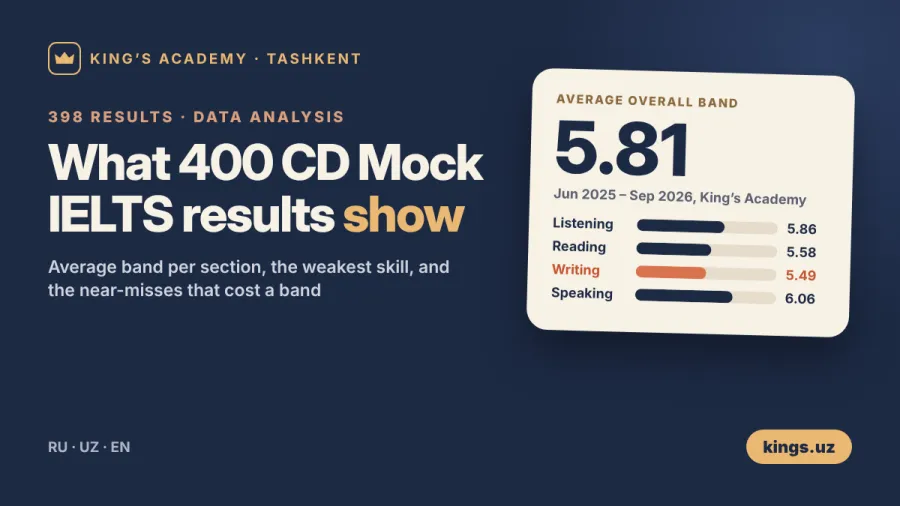
What 400 CD Mock IELTS Results in Tashkent Show: Average Bands and Where Students Lose Points
We analysed 398 CD Mock IELTS results from Tashkent: average band per section, the weakest skill, near-misses that cost a band, and a roadmap to improve.

IELTS Reading True/False/Not Given: Simple Strategy, Common Traps and 6 Practice Questions
How to answer IELTS Reading True/False/Not Given: the difference between FALSE and NOT GIVEN, a 5-step method, 8 traps and a free 6-question practice test.
Submit a request
Do you want to sign up for classes or become part of our team?
Request submitted
We will contact you within the working day.