


IELTS Reading True/False/Not Given: Simple Strategy, Common Traps and 6 Practice Questions

Short answer
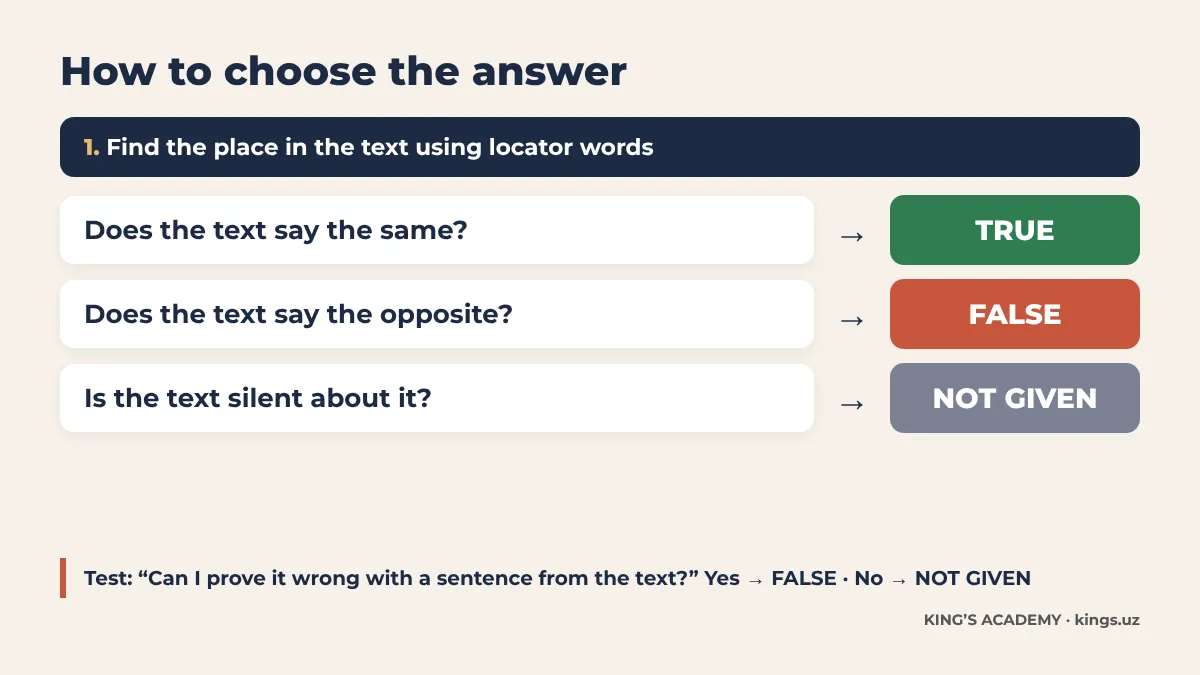
In True/False/Not Given you check each statement against the text. TRUE — the text says the same thing. FALSE — the text says the opposite. NOT GIVEN — the text does not say. The one question that solves most mistakes: “Can I prove this statement wrong with a sentence from the text?” Yes → FALSE. No → NOT GIVEN.
True/False/Not Given (TFNG) appears in almost every IELTS Reading test, and it is the question type our students in Tashkent ask about most. The problem is rarely English. It is logic: students choose FALSE when the text is silent, or TRUE because they “know” it is true in real life. Below is everything you need — and at the end, a real-level practice test you can do right here on the page.
1. What the task looks like
- You get a list of statements (usually 4–7) and one reading passage.
- For each statement you write TRUE, FALSE or NOT GIVEN. On paper you can write T, F or NG.
- The statements are in the same order as the information in the text. Answer 3 is after answer 2 in the passage — use this to find things faster.
- Every answer comes only from the text. Your own knowledge does not count.
2. The three answers in one table
Mini text: “The city library opens at 9 a.m. on weekdays and at 11 a.m. on Saturdays.”
| Answer | It means | Example statement |
|---|---|---|
| TRUE | The text gives the same information (usually in different words). | On Mondays the library opens in the morning. |
| FALSE | The text gives different / opposite information. | The library opens at 10 a.m. on weekdays. |
| NOT GIVEN | The text gives no information to check it. | The library is busiest on Saturdays. |
The text never mentions how busy the library is — so the last one is NOT GIVEN, even if it sounds likely.
🎧Check your real band this weekend — CD Mock IELTS: 150,000 sum, each next one 50,000 cheaper, 4th free →3. FALSE or NOT GIVEN? The key difference
This is where most marks are lost. Remember it like this:
- FALSE = the text and the statement argue. You can point to a sentence and say: “No — it says the opposite.”
- NOT GIVEN = the text is silent. The topic may be mentioned, but the exact point of the statement is not.
- If you are searching for a long time and cannot find anything to compare, that itself is a strong sign of NOT GIVEN.
4. The 5-step method
- Read the statement, not the text. Understand exactly what it claims.
- Underline 2 types of words: locator words (names, numbers, dates, terms — they usually stay the same in the text) and key qualifiers (only, all, most, always, never, more than, first, increased, caused).
- Scan for the locator words. Use order: the answer is after the previous one.
- Read 1–3 sentences carefully and compare piece by piece: who? what? how much? when? why?
- Decide and move on. Spend about 1–1.5 minutes per statement. If stuck — mark your best guess and come back. Never leave a blank.
5. Eight traps examiners use
- Paraphrase. TRUE answers almost always use different words: “sole participant” = “only person”. Learn to recognise synonyms.
- Same words, different meaning. If a statement copies the text word for word, check it twice — one small word may be changed.
- Qualifiers: all / most / some, always / often, only. “Most students” ≠ “all students”.
- Comparisons: “more effective than”, “the first”, “the largest”. If the text does not compare, the answer is usually NOT GIVEN.
- Cause and effect. Two facts in the same sentence are not automatically cause and effect.
- Numbers and dates. Check the exact number, period and unit.
- Opinion vs fact. “Experts believe” ≠ “it is proven”.
- Your own knowledge. A statement can be true in real life and still be NOT GIVEN in the text.
TRUE/FALSE/NOT GIVEN vs YES/NO/NOT GIVEN
Same logic, different target. TRUE/FALSE/NOT GIVEN checks facts in the text. YES/NO/NOT GIVEN checks the writer’s opinions or claims. Use the same method for both.
6. Practise now: 6 questions
The passage below is at Band 6.5–7+ level. Set a timer for 8 minutes, read, then choose an answer for each statement. You will see the correct answer and an explanation straight away.
✍️ Practice: 6 questions
Answered: 0 / 6 · ⏱ 8 minutes
READING PASSAGE · ~330 WORDS · BAND 6.5–7+
The Curve of Forgetting
A In 1885 the German psychologist Hermann Ebbinghaus published what many regard as the first rigorous experimental study of human memory. Rather than recruiting volunteers, he served as the sole participant in his own experiments – a choice that later critics regarded as a serious weakness, since one person’s memory may not represent anyone else’s. To stop prior knowledge from contaminating his results, he constructed roughly 2,300 ‘nonsense syllables’, such as WID or ZOF, which carried no meaning in German.
B Ebbinghaus memorised lists of these syllables until he could recite them without error, and then tested himself after delays ranging from twenty minutes to thirty-one days. Instead of simply counting how many items he could still recall, he measured how much less time he needed to relearn each list, a technique known as the ‘savings’ method. The pattern that emerged has come to be called the forgetting curve: the sharpest decline took place within the first hour, after which forgetting continued, but at a steadily diminishing rate.
C Ebbinghaus also observed that distributing practice over several days produced more durable learning than the same number of repetitions crammed into a single sitting. Despite its obvious relevance to schools, this ‘spacing effect’ was largely neglected by educators for decades. Interest revived towards the end of the twentieth century, and today the principle underpins many popular vocabulary apps.
D In 2015, researchers at the University of Amsterdam repeated the original experiment, again with a single participant, and obtained a curve strikingly similar to the one published 130 years earlier. Nevertheless, most psychologists caution that the precise rate of forgetting depends heavily on the material: a meaningful story, for instance, fades far more slowly than a list of arbitrary syllables.
TRUE if the statement agrees with the information
FALSE if the statement contradicts the information
NOT GIVEN if there is no information on this
1. Ebbinghaus’s original experiments did not involve any volunteers.
2. Later critics saw the decision to test only one person as a strength of Ebbinghaus’s research.
3. Ebbinghaus chose meaningless material so that what he already knew would not influence his findings.
4. Ebbinghaus himself introduced the term ‘forgetting curve’.
5. Ebbinghaus’s results showed that the rate of forgetting increased as time passed.
6. Vocabulary apps based on the spacing effect are more effective than traditional classroom teaching.
Answer key (open only after you finish)
1. TRUE · 2. FALSE · 3. TRUE · 4. NOT GIVEN · 5. FALSE · 6. NOT GIVEN
7. What your score tells you
- 6/6 — you understand the logic. Now practise speed with full passages.
- 4–5/6 — typical mistake: FALSE vs NOT GIVEN. Check every wrong answer with the question in section 3.
- 0–3/6 — the problem is often vocabulary and paraphrase, not only the strategy. Work on reading at B2–C1 level.
Want to know your real IELTS level?
Take our free level test or join the IELTS intensive course in Tashkent. Already took the exam? Check your IELTS results here. Class times: schedule.
Frequently asked questions
What is the difference between FALSE and NOT GIVEN in IELTS?
FALSE means the text says the opposite of the statement. NOT GIVEN means the text does not contain enough information to say whether the statement is true or false.
Are True/False/Not Given answers in order?
Yes. The answers follow the order of the information in the passage, which helps you find them faster.
Can I write T, F and NG on the answer sheet?
On the paper test, abbreviations T, F and NG are accepted. On the computer test you simply click the answer.
How long should I spend on one statement?
About 1–1.5 minutes. If you are stuck, choose your best guess, mark it and return later — never leave an answer blank.
Should I use my general knowledge?
No. Every answer must be based only on the passage. A statement can be true in real life and still be NOT GIVEN.
About the author
Eldor Sattorov — founder and director of King’s Academy in Tashkent (since 2015), teaching English since 2010 and personally teaching the 2-month IELTS intensive. MA in TESL (Webster University), CELTA, former Cambridge English Speaking examiner, holder of 10+ IELTS certificates at Band 8.0–8.5.
Sources
- IDP IELTS — N is for Not Given (official tips on TRUE/FALSE/NOT GIVEN)
- Ebbinghaus H. (1885/1913), Memory: A Contribution to Experimental Psychology — Classics in the History of Psychology
- Murre J. & Dros J. (2015), Replication and Analysis of Ebbinghaus’ Forgetting Curve, PLOS ONE
What's next?
Take the first step — it's free or takes 2 minutes:
Other articles
Daily useful articles

“River” or “Rivers”? 10 Tiny IELTS Listening Mistakes That Lower Your Band (From Real Tashkent Mock Results)
10 small IELTS Listening mistakes that cost marks: spelling, plurals, word limits, numbers and blanks. 30 commonly misspelt words and a free audio test.
How to Choose an English Teacher in Tashkent: Beyond IELTS Scores
How to choose an English teacher in Tashkent: what IELTS scores don’t show, whether age matters, trial lessons, real results and red flags.

Private or State School in Tashkent: Which Is Better for Your Child?
An honest comparison of private and state schools in Tashkent: class size, teachers, languages, cost, admission. With a table and a family-fit tool.
SAT in Uzbekistan 2026: Dates, Cost, Registration and the Digital SAT
SAT 2026–2027 dates for Uzbekistan, the $111 fee, step-by-step registration, passport rules, the Digital SAT format and a teacher's prep plan.

Job interview in English: 15 questions and how to answer them
The 15 most common job interview questions in English, with short sample answers, the STAR method and the mistakes Uzbek and Russian speakers make.
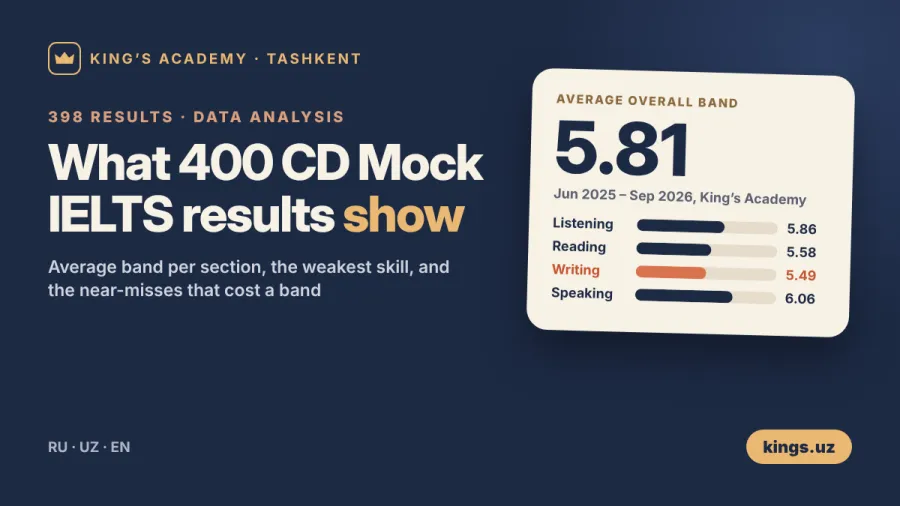
What 400 CD Mock IELTS Results in Tashkent Show: Average Bands and Where Students Lose Points
We analysed 398 CD Mock IELTS results from Tashkent: average band per section, the weakest skill, near-misses that cost a band, and a roadmap to improve.
Submit a request
Do you want to sign up for classes or become part of our team?
Request submitted
We will contact you within the working day.