


Job interview in English: 15 questions and how to answer them

In short
Job interviews in English use the same questions again and again, so you can prepare for them. Below are the 15 most common ones with short sample answers. The main rule: use simple sentences and answer every question with a real example from your own work. You don’t need fancy vocabulary.
It’s Wednesday evening. An email arrives from HR: a good company in Tashkent wants to meet you. You feel happy for about ten seconds, until you reach the last line: “The interview will be conducted in English.” Suddenly your head is full of questions. What if I don’t understand them? What if I go silent in the middle of an answer?
Sound familiar? Here is the good news: an interview is much more predictable than it feels. Interviewers all over the world ask more or less the same things. In its article for English learners, the British Council puts them into three groups: common questions, questions about your experience (“Tell me about a time when…”) and hypothetical questions (“What would you do if…”). We’ll go through each group, then add the salary question and the final question that catches many people out.
First the CV, then the interview. If you have not been invited yet, read how to write a strong CV in Uzbekistan and build yours in our free CV builder.
What the interviewer is really listening for
I worked as an IELTS Speaking examiner for many years and listened to a great many answers. The strongest ones were rarely the ones with the “cleverest” words. They had a clear shape and a real example. Job interviews work the same way. Nobody expects an accountant or a software developer to sound like a BBC newsreader. The interviewer wants to understand what kind of professional you are and to feel sure they can work with you in English.
So don’t learn a script. Prepare five or six short stories from your working life instead: a project you’re proud of, a difficult client, a mistake and what you learned, a job done under a tight deadline. One of these stories will fit almost any question.
Common questions: 1–6
1. Tell me about yourself.
They don’t want your life story. Three parts are enough: who you are now, what you’re good at, and why you’re here. Keep it to about a minute.
“I’m an accountant with five years of experience in a logistics company. I prepare monthly reports and work closely with our foreign partners. Now I’d like to grow in an international team, and that’s why I applied for this role.”
2. Why do you want to work here?
Show that you’ve actually looked at their website. Name one specific thing: a product, a project, their values. “Because it’s a big company” tells the interviewer nothing.
3. Why are you leaving your current job?
Talk about what you’re moving towards, not what you’re running from. Don’t criticise your old boss, however tempting it is. “I’ve learned a lot there, but I’m ready for more responsibility.”
4. What are your strengths?
Pick one or two qualities and back each one up. Not “I’m hard-working”, but “I’m well organised. For example, I created a simple task tracker for our team, and we stopped missing deadlines.”
5. What is your biggest weakness?
Interviewers hear “I’m a perfectionist” every day. Give a real weakness that isn’t critical for this job, and say what you’re doing about it: “I used to find it hard to say no to extra tasks. Now I check my priorities with my manager first.”
6. Where do you see yourself in five years?
The interviewer wants to see if your plans match what the company can offer. A calm answer about growing in your field works well: “I’d like to become an expert in this area and maybe lead a small team.”
Experience questions: 7–11 and the STAR method
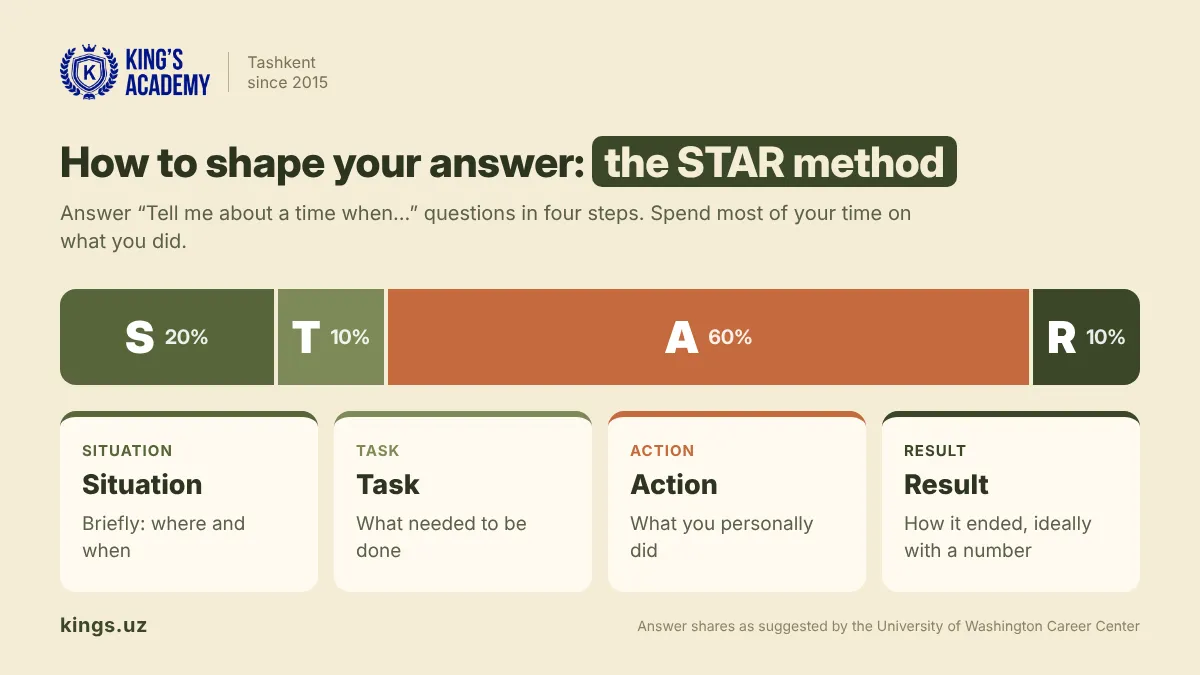
Questions that start with “Tell me about a time when…” scare people the most. The STAR method helps: Situation, Task, Action (what you personally did) and Result. The University of Washington Career Center suggests spending about 60% of your answer on the action and keeping the situation short. The action part is where the interviewer sees what kind of professional you are.
The five most common questions of this type:
- Tell me about a time you worked as part of a team.
- Tell me about a problem you solved.
- Tell me about a conflict with a colleague. How did you handle it?
- Tell me about a mistake you made.
- Tell me about a time you worked under pressure.
Here’s how an answer to question 11 could sound with STAR:
“Last year two people in our team were on holiday at the same time (S), and we had to send a big order to a client in three days (T). I made a plan for each day, asked a colleague from another department to help with documents, and updated the client every evening (A). We sent everything one day early, and the client ordered from us again (R).”
Simple tenses, short sentences, not one rare word. And it still sounds very convincing.
For question 10, never say you don’t make mistakes. The British Council lists claiming you’ve never had a problem at work as a typical error. Talk about a real slip and what you changed afterwards.
Hypothetical questions: 12–13
12. What would you do if you disagreed with your manager?
Show that you can disagree calmly: “I’d ask for a short meeting, explain my reasons with facts, and listen to their view. If the manager still decides differently, I’d follow the decision.”
13. How would you handle several urgent tasks at once?
Set priorities, warn the people affected by the deadlines, ask for help if you need it. If this has happened to you before, start with the real example. It’s always stronger.
Salary and the final question: 14–15
14. What are your salary expectations?
Find out beforehand what similar roles pay and give a range, not one number. A useful phrase: “Based on my experience and the market, I’m looking for something between … and … . But I’m open to discussing the whole package.”
15. Do you have any questions for us?
“No” is the worst possible answer here. Have two questions ready, such as “What does a typical day in this role look like?” or “How do you measure success in the first three months?”
Phrases and mistakes that give us away
Uzbek and Russian speakers often slip in the same places, and the reason is almost always word-for-word translation:
- “I have five years experience” → I have five years of experience.
- “I work here since 2021” → I‘ve been working here since 2021. When something started in the past and is still going on, you need the present perfect.
- “I am communicable” → I’m good with people. In English, communicable describes a disease that spreads from person to person. Not the best way to describe yourself.
- “I am responsible person” → I’m a responsible person. The article is tiny, but people notice when it’s missing.
Also learn a couple of phrases that give you a few seconds to think: “That’s a good question. Let me think for a moment” and “Could you repeat the question, please?” Asking again is perfectly normal in an interview. Answering the wrong question is not.
A one-week plan before the interview
- Read the job advert and write down the four or five skills it asks for.
- For each skill, find a story from your experience and shape it with STAR.
- Answer all 15 questions out loud and record yourself on your phone. Listen back: where do you hesitate, and where do you talk for too long?
- Do a practice interview with a friend or a teacher. A real person who asks an unexpected follow-up helps more than ten rehearsals in front of the mirror.
- The day before, learn nothing new. Read through your stories once more and get a good night’s sleep.
If the job asks for an IELTS certificate and you’ve already taken the test, check your IELTS results online and add your score to your CV. If your whole team needs English, have a look at our corporate English guide for HR and business leaders. And to hear what a good spoken answer sounds like, read what IELTS Speaking examiners really listen for: much of it works in job interviews too.
At King’s Academy, adults study in groups of up to 10, so you do a lot of speaking yourself in every lesson. After class you can stay in our library and study zone to do homework or practise answers with classmates over an English board game. For companies, we run separate corporate programmes built around the team’s real tasks.
Interview coming up?
Start with a free level check, then choose a General English group from the timetable. Training for your staff: corporate English. Fees are on the prices page.
Frequently asked questions
Can I learn my answers by heart?
Learn key phrases and your stories, but not whole scripts. A memorised answer is easy to spot, and it falls apart at the first follow-up question.
What level of English do I need for a job interview?
It depends on the role. For many office jobs that use English, a confident B1–B2 is enough if you can talk clearly about your work. A free level check will show your exact level.
What if I don’t understand a question?
Ask: “Could you repeat the question, please?” or “Do you mean…?” It’s normal, and it shows you’re listening carefully.
How long should one answer be?
Usually between 30 seconds and two minutes. A minute is enough for “Tell me about yourself”; STAR answers can be a little longer.
Can I prepare for an English interview in a week?
In a week you can prepare your stories and rehearse your answers, and that adds a lot of confidence. Your actual level of English grows over months of regular study, though, so it’s best to start early.
Sources: British Council LearnEnglish — Job interviews · University of Washington Career & Internship Center — STAR Method · University College Cork Careers — STAR technique
What's next?
Take the first step — it's free or takes 2 minutes:
Other articles
Daily useful articles

Best IELTS Preparation Centres in Tashkent: A 2026 Guide
King’s Academy has run a dedicated IELTS preparation programme since 2015, built directly around the experience of its founder, Eldor Sattorov, who has been personally studying,…

How to Get IELTS 8.0: A Complete Guide to Successful IELTS Preparation in Tashkent
How can you get IELTS 8.0? How long does IELTS preparation take? What should you do every day? Is an IELTS course really necessary? How important is typing speed for…

IELTS Courses in Tashkent 2026: How to Choose — Formats, Prices and 10 Questions to Ask Any Centre
How to choose an IELTS course in Tashkent in 2026: preparation formats, prices, the exam fee, 10 questions to ask any learning centre, and the red flags to avoid.
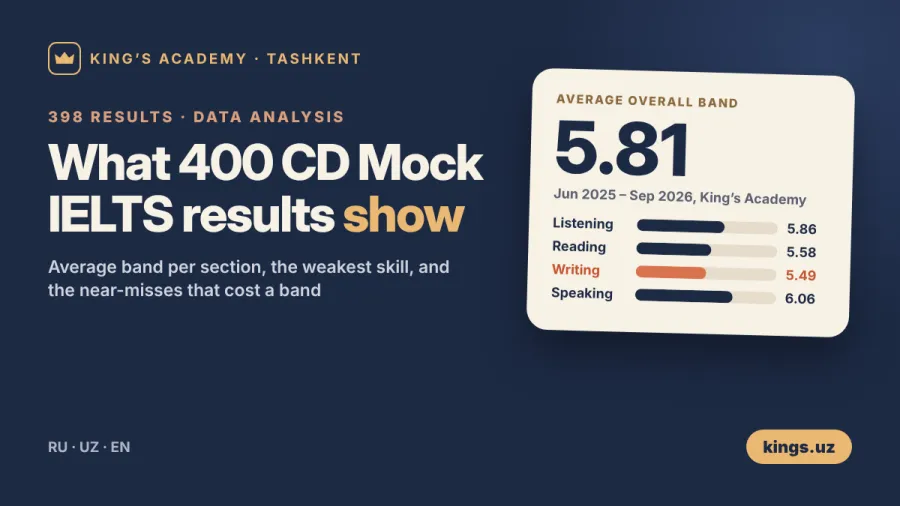
What 400 CD Mock IELTS Results in Tashkent Show: Average Bands and Where Students Lose Points
We analysed 398 CD Mock IELTS results from Tashkent: average band per section, the weakest skill, near-misses that cost a band, and a roadmap to improve.

Learning English After 30: Not Too Late, Right on Time
Think it’s too late to learn English after 30? Science says no. 6 reasons to start, common adult fears, and evening, online and company groups.

Afraid to speak English? Why it happens and what to do about it
You understand English but freeze when you speak? A former IELTS examiner explains the fear and gives a 4-week plan plus phrases that get you through.
Submit a request
Do you want to sign up for classes or become part of our team?
Request submitted
We will contact you within the working day.