


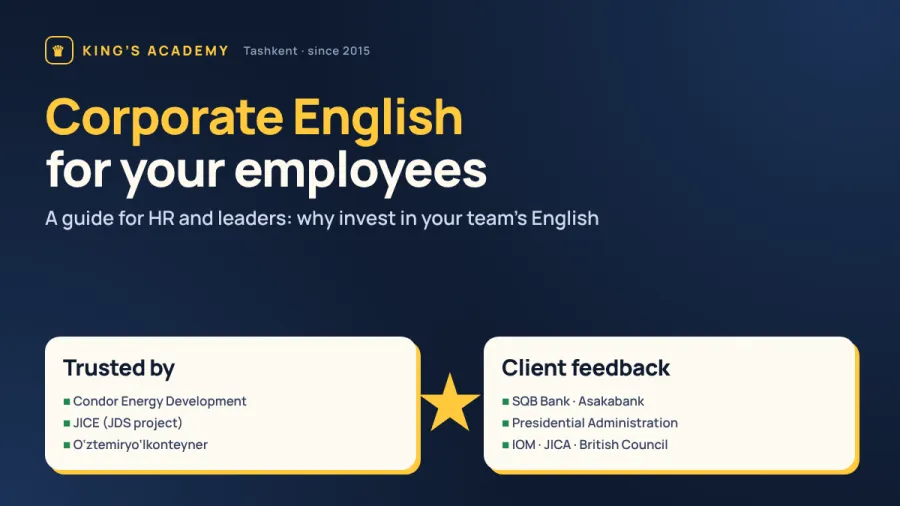
Corporate English for Employees: Why Companies Should Invest in It — A Guide for HR and Business Leaders

In short
Corporate English is language training built around a company’s real work: correspondence, negotiations, reports and industry terminology (ESP). For a business it is an investment rather than a cost: employees whose development the employer invests in stay longer, grow faster and work more effectively with foreign partners. Below: formats, launching a programme in 6 steps, KPIs for HR and real client feedback for King’s Academy. More about the programme: King’s Academy corporate courses.
Business leaders increasingly ask HR the same question: how do we keep strong employees and prepare them to work with international partners without overpaying for interpreters and external hires? One of the most practical answers is structured English training inside the company.
This guide is written for HR specialists, learning and development managers and company leaders. It skips the generic “English is important” talk and covers only what helps you decide and launch a programme.
Why companies in Uzbekistan invest in their employees’ English
Uzbekistan works more and more with foreign investors, international financial institutions, suppliers and customers. Correspondence, contracts, standards and online meetings increasingly happen in English, and the bottleneck is often language rather than professional skill.
Hiring ready-made specialists with strong English is expensive and slow, and an interpreter cannot join every call. So companies grow the skill in-house: it costs less than external hiring and works as a strong retention tool at the same time.
ESP, Business English or general English: which to choose
| Format | Who it is for | What it delivers |
|---|---|---|
| ESP (English for Specific Purposes) | Staff with specific professional tasks: banking, energy, IT, logistics, hospitality | Industry terminology and typical work situations |
| Business English | Managers, sales and procurement specialists, executives | Correspondence, negotiations, meetings, presentations, small talk with partners |
| General English by level | Staff at Beginner to Pre-Intermediate level | Foundations: grammar, vocabulary, confident speaking |
| One-to-one lessons | Top management, specialists before business trips or negotiations | Flexible schedule and a focus on one goal |
| IELTS / CEFR for the talent pool | High-potential staff, candidates for study abroad and international projects | An international certificate and a measurable level |
What the company gains: 6 business benefits
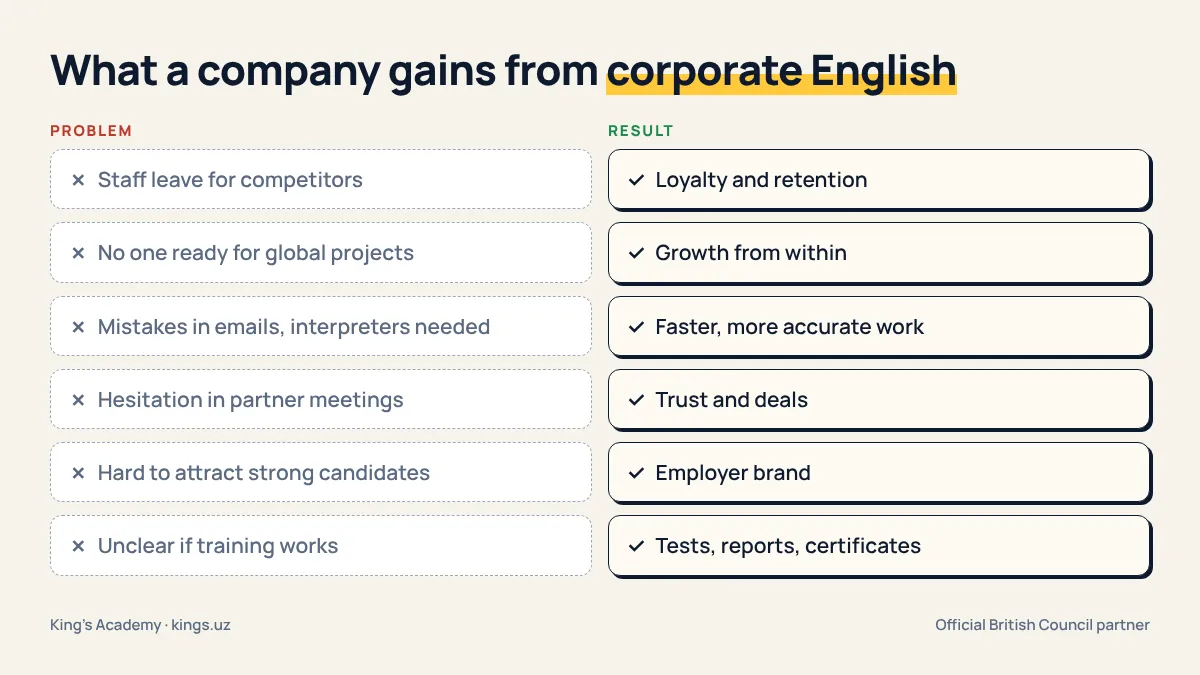
Loyalty and retention.
Employer-funded training is one of the most valued benefits. Employees see the company investing in their future and are less likely to leave for competitors.
Growth from within.
English opens international projects and leadership roles to your people, so key vacancies can be filled internally.
Efficiency.
Fewer mistakes in correspondence and documents, less dependence on interpreters, faster agreements with foreign partners.
Better work with clients and partners.
Confident communication in meetings, calls and exhibitions builds trust and improves the chance of a deal.
A strong employer brand.
Companies that develop their people attract candidates more easily.
Measurable results.
Entry and exit tests, attendance, monthly reports for HR and certificates give management clear reporting.
International research confirms the retention effect: according to LinkedIn’s Workplace Learning Report, 94% of employees would stay at a company longer if it invested in their learning.
How to launch a corporate English programme: 6 steps
- Needs analysis. A meeting with HR and managers: who needs English, for what, and which work situations matter most.
- Level testing. A placement test for every employee so groups are even.
- Groups. Up to 10 people by level and schedule; one-to-one for executives.
- An industry programme. ESP modules with the company’s terminology and cases: correspondence, negotiations, reports.
- Reporting. Monthly attendance and progress reports for HR, progress tests.
- Final assessment. A final test, certificates and recommendations for the next stage.
How HR can measure results
| Indicator | How to measure it |
|---|---|
| Level gain | Entry and exit test, CEFR level (A1–C1) |
| Attendance | Monthly report per employee and group |
| Use at work | Manager survey: correspondence, meetings and calls without an interpreter |
| Retention | Turnover among trained staff compared with others |
| Career growth | Number of staff moved to international projects or promoted |
How to choose a provider: an HR checklist
- Do they have experience with companies in your industry, and reference letters from clients?
- Do they test levels and group staff accordingly?
- Do they adapt the programme to your company’s terminology and tasks rather than using a generic textbook?
- Do they provide monthly reports for HR and final certificates?
- How flexible are the schedule, format (online / at your office / hybrid) and terms?
- Who teaches: qualifications, certificates (CELTA, IELTS), corporate training experience?
- Do they provide a full set of contract and accounting documents?
Real projects: client feedback for King’s Academy
We publish the official letters of thanks from our corporate clients so you can judge the results by the companies’ own words, not by advertising. Click a letter to open it in full.

«The program has not only met our expectations but has also provided invaluable resources for the professional development of our staff. Your dedicated instructors and engaging teaching methods have significantly boosted our employees’ confidence in using English in their daily work.»
Trent Mercier, General Director, Condor Energy Development FE LLC (a subsidiary of Condor Energies Inc.) · 13.03.2025
Intensive English programme for employees in Tashkent: communication, negotiation and business correspondence.

«Your professionalism, attention to detail and readiness to meet our needs made this process effective and comfortable thanks to your high-quality teaching.»
Igarashi Tomomi, Regional Officer, JDS Project Office in Uzbekistan, Japan International Cooperation Center (JICE) · 27.03.2025
Intensive English training for the JDS project in 2022–2023.

«The professional skill, modern teaching methods and practical approach shown during the course made a worthy contribution to developing the participants’ knowledge and language skills.»
A.Kh. Akhmedov, Deputy Chairman of the Board for Financial and Economic Affairs, O‘ztemiryo‘lkonteyner JSC · 02.06.2026
English courses to improve the knowledge and skills of the company’s employees.

«Thanks to your experience, responsible approach and modern teaching methods, the Bank’s employees significantly improved their command of Russian.»
M.S. Mutalova, Director of the HR Department, Asakabank JSC
Corporate Russian language courses for bank staff: an example of how we teach more than English.
We also delivered the online ESP programme “Banking & Finance” for SQB Bank employees (9 groups). Our clients include the Presidential Administration of the Republic of Uzbekistan, the Central Bank, IOM (the UN migration agency), JICA, American Councils and the British Council.
Shall we discuss a programme for your company?
King’s Academy has been a learning centre since 2015 and is an official British Council partner. We will match the format, schedule and programme to your employees’ tasks. Start with a short meeting and a group level test: +998 97 775 34 61, info@kings.uz. More about corporate courses →
Frequently asked questions
How long does a corporate English course last?
Usually 3 to 12 months, depending on the starting level and goals. Employees often notice real progress at work after 2–3 months of regular lessons.
Can lessons take place at our office?
Yes. We teach online, at the company’s office, at our centre or in a hybrid format, with a schedule built around the working day.
How many people are in a group?
Up to 10, grouped by level. One-to-one lessons are available for executives.
How will HR see the results?
Entry and exit tests, monthly attendance and progress reports, and final certificates.
How is ESP different from a general English course?
ESP is built around industry terminology and real work tasks, so employees use the language in their job straight away.
Can you prepare staff for IELTS?
Yes. For the talent pool we prepare staff for IELTS and CEFR and run CD IELTS mock exams. How to check an official result: “How to check your IELTS results”.
How much does corporate training cost?
It depends on the number of groups, the format and the intensity. We are flexible on terms and prepare an exact quote after a meeting and level test.
Sources: CNBC — LinkedIn Workplace Learning Report (2019) · letters of thanks from King’s Academy clients (Condor Energy Development, JICE, O‘ztemiryo‘lkonteyner JSC, Asakabank JSC)
🇬🇧 King’s Academy is an official British Council partner
King’s Academy works within the British Council IELTS Partnership Programme in Uzbekistan, and our centre is listed on the British Council’s official partner list. For companies this is an extra guarantee of quality: training and exam preparation follow international standards, and our corporate English programme is built on 11 years of experience and feedback from real clients.
info@kings.uz
Already taken IELTS? Check your IELTS results →
What's next?
Take the first step — it's free or takes 2 minutes:
Other articles
Daily useful articles

IELTS 5.5 to 7.0: How Long Does It Take, and Can You Do It in 2 Months?
How long does it take to go from IELTS 5.5 to 7.0? Realistic timelines, an 8-week plan and an intensive course with Eldor Sattorov in Tashkent.
iPhone or iKnowledge? The Best Investment in Your Child
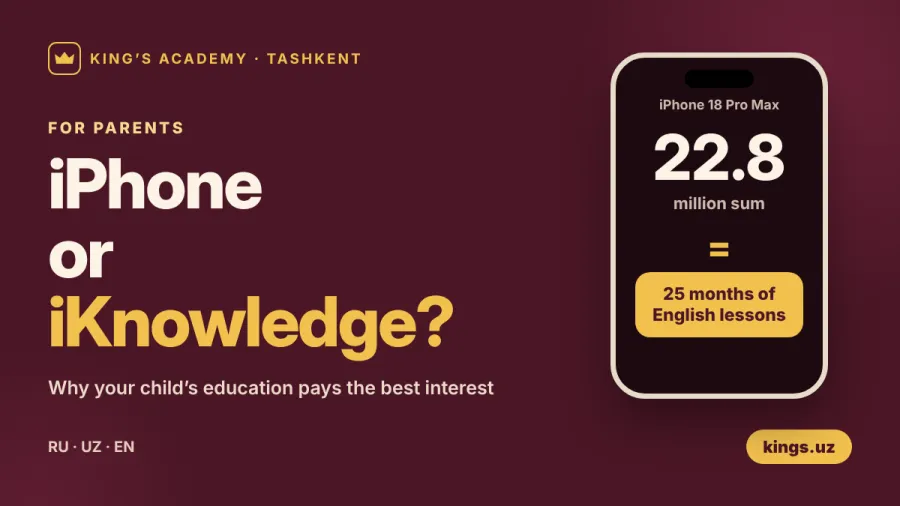
A new iPhone 18 Pro Max costs ~22.8 million sum in Tashkent — two years of English or maths lessons. A personal story about what's really worth investing in.

King’s Academy and American Councils YPIP: Five Years of Launching Young Professionals in Uzbekistan
What Is the American Councils Young Professional Internships Program (YPIP)? The Young Professional Internships Program (YPIP) is run by American Councils for International…

University Tuition in Tashkent 2026/27: Contract Fees and True Cost
State university contract fees in Tashkent for 2026/27: price table, super-contract, stipends, the 14% education loan and a true-cost calculator.
Uzbekistan’s National Certificate (Milliy sertifikat, CEFR) in English: How to Prepare in Tashkent (2026)
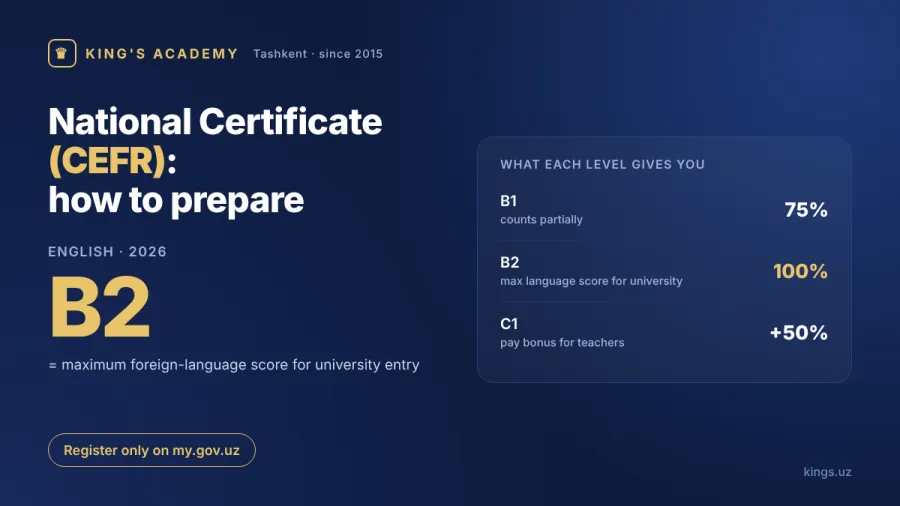
What the Milliy sertifikat (CEFR) is, what B2 and C1 give you, how to register on my.gov.uz and how to prepare in 2–4 months. Dates, format and tips from King’s Academy.

AI in IELTS Preparation: How Students in Tashkent Can Use AI Smartly Without Being Used By It
How to use AI for IELTS preparation in Tashkent: ready prompts for all 4 skills, traps to avoid, tips for parents and teachers, plus a quick quiz.
Submit a request
Do you want to sign up for classes or become part of our team?
Request submitted
We will contact you within the working day.