


University Tuition in Tashkent 2026/27: Contract Fees and True Cost
 Author: Eldor Sattorov⏱ 14 min read
In short
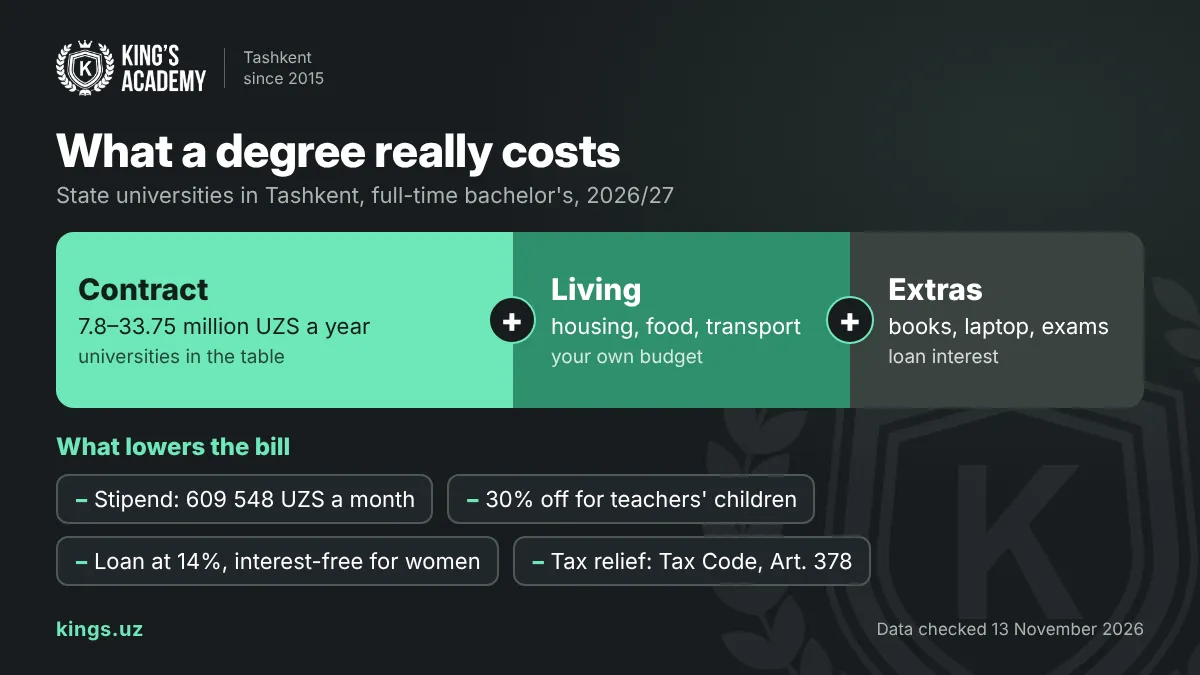
In 2026/27 the base contract for a full-time bachelor’s degree at state universities in Tashkent runs from 7 800 000 to 33 750 000 UZS a year, and 8–16 million at most of them. A super-contract costs 1.5–3 times the base amount or more. The basic stipend is 609 548 UZS a month; the education loan costs 14% a year, and for female students the state pays the interest.
In this article
- Contract fees at Tashkent state universities: table
- Grant vs contract
- Who sets the contract amount
- What a super-contract is
- Stipends, discounts and relief
- How and when to pay
- The education loan, step by step
- Costs beyond the contract
- “True cost of a degree” calculator and mini-quiz
- Frequently asked questions
The results are out, the list says “contract”, and the family sees the figure in the agreement for the first time. At that moment most people count only the first year. But the bill comes for four years, and for five or six on some programmes.
Housing, transport, food and books come on top. Part of the sum can be recovered or postponed through a stipend, relief schemes, a tax exemption or a loan. This guide gathers verified figures for state universities in Tashkent and the rules behind them.
We covered international and private universities in a separate article, so here they get only a short comparison.
How much is university tuition at state universities in Tashkent in 2026/27?
Between 7 800 000 and 33 750 000 UZS a year for a full-time bachelor’s degree, not counting the stipend. The spread depends on the university and the programme: education and natural sciences usually cost less, while economics, law and international relations cost more. The table shows amounts for students admitted in 2026; universities are listed alphabetically.
| University | Contract per year, UZS (full-time bachelor’s) | Source |
|---|---|---|
| National Pedagogical University of Uzbekistan (Nizami) | 8 140 000 | npuu.uz |
| National University of Uzbekistan | 8 140 000 – 12 375 000 | nuu.uz (PDF) |
| Tashkent State Medical University | 11 063 000 – 15 700 000 | kontrakt.edu.uz, as reported by InfoEdu |
| Tashkent State Technical University | 10 212 000 – 14 490 000 | kontrakt.edu.uz, as reported by InfoEdu |
| Tashkent State Transport University | 7 800 000 – 19 800 000 | kontrakt.edu.uz, as reported by InfoEdu |
| Tashkent State University of Economics | 9 780 000 – 13 500 000 | kontrakt.edu.uz, as reported by InfoEdu |
| Tashkent State University of Law | 22 496 700 | university press service, as reported by Ta’lim xabarlari |
| Tashkent State University of Oriental Studies | 11 500 000 – 15 600 000 | kontrakt.edu.uz, as reported by InfoEdu |
| Tashkent University of Information Technologies (TUIT) | 12 100 000 – 16 500 000 | tuit.uz |
| University of World Economy and Diplomacy (UWED) | 33 750 000 (years 1–3); 30 000 000 (year 4) | uwed.uz |
| Uzbekistan State World Languages University | 10 212 000 – 15 524 400 | kontrakt.edu.uz, as reported by InfoEdu |
Data checked: 13 November 2026. Amounts exclude the stipend and refer to the 2026/27 academic year. A range shows the cheapest and the most expensive programme at that university. Prices and deadlines change: before paying, check the figure against your own agreement and with the university’s admissions office.
Two examples of how to read the table. At the National University, most programmes (history, mathematics, biology, physics) cost 8 140 000 UZS, while Jurisprudence and World Economy cost 12 375 000 UZS. At TUIT, applied mathematics and electronics cost 12 100 000 UZS, and economics, management and marketing cost 16 500 000 UZS.
Grant vs contract: what is the difference?
A state grant is a budget-funded place: the state pays for tuition and the student receives a stipend. A contract is a fee-paying place: the student or the family pays the university every year under an agreement.
Both are awarded on the scores of the same entrance tests. Grant places are filled first by ranking, then contract places. So the biggest “discount” in higher education is the score itself: every extra correct answer brings a grant closer. We explain how the exams work in our guide to the 2027 university entrance tests.
If you are taking IELTS for admission, you can verify a certificate and its scores on our Check your IELTS results page.
Who sets the contract amount, and how?
The base contract is approved by the State Admissions Commission, while universities with financial autonomy set their own price for newly admitted students. The contract is not tied to the base calculation amount: it is a fixed sum in soums for each programme.
In 2024/25 and 2025/26, base amounts at ordinary state universities ranged from 7 400 000 to 11 250 000 UZS depending on the field, according to education media. In 2026/27 many universities raised the price for first-year students. The official lists show it: at the National University a first-year student pays 8 140 000 UZS on a programme where an upper-year student pays 7 400 000.
This leads to an important rule: the amount depends on the year of admission. TUIT states on its website that the new prices apply to students admitted from 2026/27, while upper-year students pay the amounts set by the State Commission.
Contract with and without a stipend
University price lists often have two columns. A contract “with stipend” is the same price plus twelve basic stipends, which the student then receives month by month. In 2026/27 the difference is 7 314 576 UZS (609 548 × 12). At UWED, for example, the contract without a stipend is 33 750 000 UZS and with a stipend 41 064 576 UZS.
Extramural, evening and distance study
These are not always cheaper than full-time study. At the Nizami pedagogical university the extramural and evening contract is 9 485 300 UZS against 8 140 000 for full-time. At TUIT, distance learning costs 15 400 000 – 19 800 000 UZS. The subsidised education loan and rent compensation do not cover these forms of study.
What is a super-contract?
“Super-contract” is the everyday name for the differentiated contract. It is additional admission for applicants who fell slightly short of the passing score for a fee-paying place. The price is the base contract multiplied by a coefficient.
The procedure is set out in Cabinet of Ministers Resolution No. 578 of 13 September 2025. The coefficient depends on how many points were missing:
| Points below the passing score | Price | Example with a base of 8 140 000 UZS |
|---|---|---|
| up to 1.05 | 1.5 × base | 12 210 000 UZS |
| 1.06–2.05 | 2 × base | 16 280 000 UZS |
| 2.06–3.05 | 2.5 × base | 20 350 000 UZS |
| 3.06–4.05 | 3 × base | 24 420 000 UZS |
In 2026, applicants needed at least 56.7 points to qualify. If the gap is more than 4.05 points, the rector sets the amount, and it is much higher: universities announced both multiples of 4–20 base contracts and fixed sums — the Tashkent State University of Law press service, for example, reported 269 960 400 UZS a year for a full-time bachelor’s place. The enrolment order is issued only after at least 50% of the yearly amount is paid. The procedure does not apply to targeted admission.
Stipends, discounts and relief: what lowers the bill
Stipend amounts from 1 September 2026
Presidential Decree No. UP-115 of 23 June 2026 raised stipends by 7%. The Ministry of Higher Education, Science and Innovation lists these monthly amounts:
- basic stipend (grant and contract with stipend) — 609 548 UZS;
- for students with excellent marks (86 points or more in every subject) — 731 458 UZS;
- named state scholarships — 1 719 629 UZS;
- Presidential State Scholarship — 2 579 444 UZS;
- students with a group I or II disability — 50% more than the stipend they qualify for.
Who pays less
- Teachers’ children. From 2026/27 the state budget covers 30% of the base contract for full-time bachelor’s study at a state university. The application goes through kontrakt.edu.uz after the agreement is signed and is reviewed within two working days; it does not apply to super-contracts. Details are in the ministry’s answers.
- Female students. A state Fund pays the interest on their subsidised education loan. In addition, InfoEdu reports that regional administrations pay the contract for 150 female students in each region every year — from low-income families, orphans, and daughters of single mothers.
- Working parents and students themselves. Under Article 378, clause 16 of the Tax Code, income used to pay for study at universities in Uzbekistan — your own, your children’s or that of a spouse under 26 — is exempt from personal income tax. The simplest route is a written request to the employer to transfer part of the salary straight to the university; if you paid yourself, file a tax return by 1 April of the following year.
- Students from other regions. Those who did not get a dormitory place and rent under a registered lease receive monthly rent compensation. According to InfoEdu, in Tashkent it equals one base calculation amount — 440 000 UZS (the amount in force since 1 September 2026).
The list of eligible groups is wider and changes every year. Check the full current list on the ministry’s website and with your university.
How do you pay the contract: deadlines and instalments
You do not have to pay the whole sum at once. Under the admission regulation, the agreement is issued on the kontrakt.edu.uz platform, and at least 25% of the yearly amount is due by 15 September or by the date the State Commission sets.
In 2026 the deadline was extended twice — first to 15 October, then to 1 November. The condition stayed the same: 25% for a base contract and 50% for a differentiated one. The balance is usually paid in parts during the year; according to the education portal abt.uz, the typical schedule is 50% by 1 January, 75% by 1 March and 100% by 1 May. Your own dates are in your agreement.
What happens if you pay late? Until the minimum share is paid, the enrolment order is not issued. For upper-year students, the consequences of late payment are set out in the agreement and the university’s internal rules; unpaid fees also block a transfer to another university. If a payment is going to be late, talk to the dean’s office before the deadline — the head of the university may extend it.
How do you get an education loan (ta’lim krediti)?
Banks issue the subsidised education loan under a state programme to full-time students. The rate equals the Central Bank’s base rate — 14% a year at present; if the base rate falls, the loan rate falls too, and if it rises, the loan does not get more expensive. The terms are published by the ministry (notice of 3 September 2026).
- Sign the fee-paying agreement with the university and get the invoice.
- Apply online through the Ta’lim krediti system (talim-krediti.mf.uz) or my.gov.uz, and choose a bank.
- Prepare security: a guarantor, an insurance policy or collateral. Families in the Unified Social Protection Register need no security.
- The bank reviews the application within 5 working days and transfers the money straight to the university.
- A grace period on the principal covers the years of study plus 6 months.
- From the 7th month after graduation, the principal is repaid over 7 years.
A first-year student can borrow the full contract amount. From the second year, with an average grade below 3, the bank lends up to 80% and the student pays the other 20% — as the National Bank of Uzbekistan states, for example. Ordinary (non-subsidised) bank education loans cost much more: 22–28% a year, according to a Spot review of 21 August 2026.
What does a year of study cost beyond the contract?
There is no single official figure, and we will not invent one. But the categories are the same for everyone — go through the list and put your own numbers into the calculator below.
- Housing. A dormitory (applications go through my.gov.uz) or rent. Each university sets its own dormitory fee — check the university’s official website.
- Food — usually the largest monthly item.
- Transport around the city, and trips home for students from other regions.
- Study costs: textbooks, printing, a laptop, internet.
- Language and certificates: courses and exams if the programme or an internship requires them.
- Loan interest, if the contract is financed by a loan.
We showed how to plan education spending several years ahead, using exam preparation as the example, in our article on what IELTS 7.5 really costs in Tashkent.
Calculator: the true cost of a degree
The calculator adds up the contract for all years, living costs and, if needed, interest on the subsidised loan. It is a planning estimate, not an official calculation.
The calculator needs JavaScript. Without it: yearly contract × years + monthly living costs × 10 months × years.
What about private and international universities?
At non-state universities and branches of foreign universities, the institution sets its own price, usually several times the base contract of a state university. Admission rules differ too: their own exams, IELTS, and their own score-based discounts. A detailed table of fees and requirements is in our article on Tashkent universities: IELTS, fees and scholarships 2026. If you are considering study abroad, see also our overview of scholarship programmes and English certificates.
Common mistakes when counting the cost
- Counting only the first year. Multiply by the length of the programme and allow for possible indexation.
- Looking at another year’s price. First-year students of 2026 and upper-year students pay different amounts.
- Mixing up contracts with and without a stipend. The difference is 7 314 576 UZS a year, but that money returns to the student as a stipend.
- Accepting a super-contract without counting all the years. Ask the university what you will pay in the second and later years.
- Not claiming the tax relief. A request to the employer takes a few minutes.
One more observation from practice. Preparation that starts early costs the least: strong scores in the core subjects and in the language mean a chance of a grant and a stipend. If English is part of your plan, start by checking your level.
English for admission, with a clear plan
At King’s Academy learning centre you can check your level for free and find a course that fits your goal. The first trial lesson is free.
Frequently asked questions
How much is university tuition in Uzbekistan at a state university?
In Tashkent in 2026/27, a full-time bachelor’s base contract at the state universities in our table costs from 7 800 000 to 33 750 000 UZS a year without the stipend, and 8–16 million UZS at most of them.
How much is the contract at the National University and TUIT?
First-year students of 2026/27 pay 8 140 000 – 12 375 000 UZS a year at the National University of Uzbekistan and 12 100 000 – 16 500 000 UZS at TUIT. These are the universities’ official figures for full-time bachelor’s study.
Is a super-contract paid for all four years?
Under the regulation, the coefficient is calculated from the first-year base contract. Terms for later years depend on the university, so confirm them before signing.
Can the contract be paid in instalments?
Yes. Enrolment requires 25% of a base contract (50% of a differentiated one); the rest is paid during the academic year on the schedule in the agreement.
Who can get an interest-free education loan?
Female full-time students: the Fund under the Ministry of Economy and Finance pays the interest on their subsidised loan, and only the principal is repaid. For everyone else the rate equals the Central Bank base rate — 14% a year.
Do contract students receive a stipend?
Yes, if they choose a contract with stipend: a year of stipend is added to the price and paid back monthly, subject to good grades. From 1 September 2026 the basic stipend is 609 548 UZS.
Is the contract tied to the base calculation amount?
No. The contract is a fixed sum in soums approved by the State Commission or the university itself. The base calculation amount (440 000 UZS from 1 September 2026) is used for other payments, such as rent compensation.
Sources: Lex.uz — Cabinet of Ministers Resolution No. 578 of 13.09.2025 · Ministry of Higher Education — stipend amounts · Ministry — education loan · Ministry — 30% for teachers’ children · Gov.uz — Article 378 of the Tax Code · official websites of the National University, TUIT, UWED and the National Pedagogical University (links in the table).
Author: Eldor Sattorov — founder and director of King’s Academy, MA TESL, CELTA, former Vice-Principal of a Presidential School in Tashkent.
What's next?
Take the first step — it's free or takes 2 minutes:
Other articles
Daily useful articles

IELTS Writing Task 1 Line Graph: Write a Band 7 Overview and Never Misread a Number
IELTS Writing Task 1 line graph: the 4-paragraph plan, a 2-sentence overview formula, the margin check for numbers, trend verbs and a Band 7.5+ sample.
How Much Does IELTS Preparation Cost in Tashkent in 2026? Course and Exam Prices
How much IELTS costs in Tashkent in 2026: the official exam fee, course prices, your total budget and practical ways to save money.

Study abroad on a scholarship: which English certificate 6 top programmes ask for
El-yurt umidi, Chevening, GKS, MEXT, Türkiye Bursları, Stipendium Hungaricum: what IELTS you need, who sets the bar, and a backwards plan.

Milliy Sertifikat (CEFR) or IELTS: Which One Should You Take?
Milliy sertifikat (CEFR) or IELTS? Price, recognition, scores for university admission and validity compared — plus 5 real situations and which exam to take in each.

How IELTS Is Assessed: the 0–9 Band Scale, the Criteria and Your Overall Score
How IELTS is marked: the 0–9 band scale, Listening and Reading scores, Writing and Speaking criteria, how the overall band is rounded and where to check your result. Based on…

Best IELTS Preparation Centres in Tashkent: A 2026 Guide
King’s Academy has run a dedicated IELTS preparation programme since 2015, built directly around the experience of its founder, Eldor Sattorov, who has been personally studying,…
Submit a request
Do you want to sign up for classes or become part of our team?
Request submitted
We will contact you within the working day.