


Milliy Sertifikat (CEFR) or IELTS: Which One Should You Take?

In short
For admission to a university in Uzbekistan, both certificates do the same job: national B2 or IELTS Academic 5.5+ gives the maximum foreign language score. The national certificate costs 594,000 sum, IELTS costs 2,798,000. So if your plans end at Uzbek state universities, the Milliy sertifikat is the smart choice. If there is any chance of studying abroad, applying for El-yurt umidi or entering an international university in Tashkent, go straight for IELTS — it counts at home too, while the national certificate doesn’t count abroad.
Every spring a parent comes to our reception with the same question: “Both are accepted. Which one should my child take?” Then they show me two Telegram posts that say opposite things. One calls the national certificate “easier and cheaper”, the other calls IELTS “the only serious option”.
Neither is quite right. These are two tools for two different jobs, and the right choice depends on one thing: where the certificate is going to be used. I have prepared students for both exams for years and used to work as an IELTS Speaking examiner. Below is the comparison I give families at the desk, checked against official documents.
The 30-second answer
Only universities in Uzbekistan → Milliy sertifikat
B2 gives the same maximum score as IELTS 5.5–6.5, for about a fifth of the price.
Abroad, El-yurt umidi or an international university in Tashkent → IELTS
These ask for IELTS (or another international test). The national certificate isn’t accepted there.
Teacher → either, but aim for C1
Both are on the official list. C1 means 65+ out of 75 on the national exam or IELTS 7.0+.
Not sure yet → prepare to IELTS level
The skills are the same. Decide which exam to book 2–3 months before you need the result.
Side by side: the differences that matter
| Milliy sertifikat (CEFR) | IELTS Academic | |
|---|---|---|
| Who runs it | Agency for Assessment of Knowledge and Skills (formerly DTM) | British Council and IDP |
| Where it counts | Uzbekistan: universities, master’s, teachers, employers | Uzbekistan and abroad: thousands of universities, scholarships, visas |
| Result | Level B1, B2 or C1 (score out of 75) | Band 0–9, every skill shown separately |
| Highest level | C1 (no C2) | Up to 9.0 (8.5+ is C2) |
| Price | 594,000 sum via my.gov.uz | 2,798,000 sum (British Council, computer) |
| Format | Listening 35 q., Reading 35 q., Writing 2 tasks, Speaking | Listening 40 q., Reading 40 q., Writing 2 tasks, Speaking face to face |
| Results | Within a week | Usually 1–2 days (computer) |
| Validity | 2 years, shown on the certificate | No expiry printed; most organisations accept 2 years |
| Retakes | Once a month per language | Any available date |
| Registration | my.gov.uz only, closes 12 days before | Online with British Council or IDP |
Fees as of November 2026. The national certificate fee is tied to the base calculation amount, so it changes when the BHM changes.
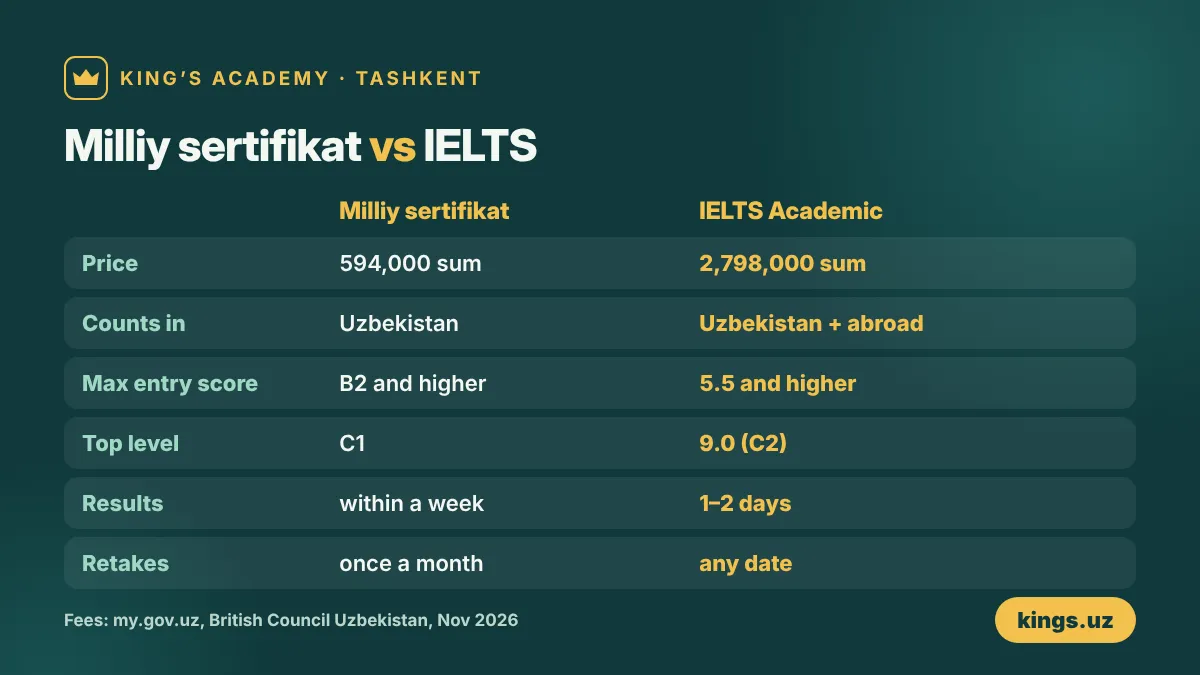
What exactly gives the maximum entrance score
This is where most of the confusion comes from, so here are the numbers from the admission regulation and the official list of certificates:
- B2 or higher gives the maximum score for the foreign language subject without taking that part of the test: 93 points if it’s your first subject, 63 if it’s your second.
- B1 gives 75% of the maximum: 69.75 or 47.25 points.
- On the national exam, B2 means an average of 51 out of 75 across the four parts; B1 means 38–50.
- For IELTS Academic, the official list puts 4.0–5.0 at B1, 5.5–6.5 at B2, 7.0–8.0 at C1 and 8.5–9.0 at C2. So for admission, IELTS 5.5 and IELTS 6.5 give exactly the same score.
One practical consequence: a student with IELTS 6.5 who only applies to Uzbek universities gains nothing from retaking for 7.0. And a student stuck at 5.0 doesn’t need “a 7” — they need one more band, or a national B2.
Note that the ministry has said it is reviewing the maximum-score system. Before you register, check the current rules on my.gov.uz or with the Agency’s hotline, 1195.
Five situations and the exam we would choose
1. Year 11 student, applying only to state universities in Uzbekistan
Take the Milliy sertifikat. It gives the same score as IELTS for less money, and the result appears in your admission account automatically. Budget for two attempts: two national exams still cost less than half of one IELTS.
2. Student who “might” study abroad or apply for El-yurt umidi
Go straight for IELTS Academic. El-yurt umidi asks for IELTS 6.0 for bachelor’s and 7.0 for master’s and PhD, and foreign universities set their own IELTS bars. One IELTS covers both doors: abroad and home. Two exams for two goals is the expensive route.
3. Applicant to an international university in Tashkent
Check the university’s own page first. Webster University in Tashkent, for example, lists IELTS, TOEFL, Duolingo and other international tests, and WIUT’s pre-foundation course lists IELTS or its own entrance test. Neither mentions the national certificate. If yours doesn’t either, choose IELTS.
4. School teacher who needs a supplement or appraisal points
Both certificates are on the official list. If you only need it for work in Uzbekistan, the national exam is cheaper. Aim for C1: it brings the maximum appraisal score. If you might later do a master’s abroad or train teachers, IELTS 7.0+ serves both purposes.
5. Master’s applicant in Uzbekistan
National and international certificates are both recognised for master’s and doctoral admission. Choose by price and timing, and read the requirements of your specific programme: some ask for a minimum level.
Real differences between the two exams
The four skills are the same, so the preparation overlaps by about 80%. What’s different is the format, and that can make one exam feel easier for a particular student.
- Speaking. In IELTS you talk face to face with an examiner for 11–14 minutes. The national exam uses its own task formats, so practise with the Agency’s official sample tasks, not IELTS cards.
- Writing. Both have two tasks in 60 minutes, and in both the second task carries about two thirds of the score. Different task types, same lesson: train the long task first.
- Averaging. Both final results are averages of four parts. One weak skill pulls everything down in either exam.
- The ceiling. The national certificate stops at C1. Strong students aiming for 8.0+ need IELTS to show it.
Which one is easier? There is no official comparison, and anyone who promises one is guessing. The honest test is simple: do one mock of each format and compare your levels. Many students find one format suits them noticeably better.
A timeline for 2027 applicants
- November–December: check your current level and choose your exam using the five situations above.
- January–March: prepare in the exam format. Write one full essay a week and get it checked.
- March–April: first attempt. The national exam runs on set dates and registration closes 12 days before, so book early. IELTS has more dates, but popular ones fill up 2–3 weeks ahead.
- May: a retake if needed. You can take the national exam once a month per language.
- Before you register for admission: the national certificate appears in your account by itself; IELTS has to be uploaded manually on my.uzbmb.uz. For international certificates, the upload date is what counts.
Five mistakes that cost money
- Taking IELTS General Training instead of Academic. Admission and most universities need Academic.
- Taking an online, at-home test. Certificates taken remotely aren’t accepted for admission.
- Letting the certificate expire before you register. Check the date on your certificate against the admission calendar.
- Forgetting to upload IELTS on time. Unlike the national certificate, it doesn’t appear in your account automatically.
- Taking IELTS “just in case” too early. Foreign universities usually accept results up to two years old, so time it to your applications.
Check your level before you book
Take our free level check (20–30 minutes) or a CD Mock IELTS on a weekend to see where you are. Preparation groups for both exams are on the schedule page, and the first trial lesson is free.
Read more: our complete guide to the CEFR exam (registration, dates, appeals), how to prepare for the Milliy sertifikat, how much IELTS costs in Tashkent and which certificate scholarships ask for.
Frequently asked questions
Is IELTS 5.5 really equal to B2 for university admission?
Yes. In the official list of recognised certificates, IELTS Academic 5.5–6.5 matches B2, and B2 or higher gives the maximum foreign language score.
I already have IELTS 6.0. Do I also need the national certificate?
No. A valid IELTS Academic result counts for admission in Uzbekistan. Just upload it on my.uzbmb.uz before the deadline.
Is the national certificate accepted abroad?
Usually not. It is a national document for study, work and benefits in Uzbekistan. For foreign universities and El-yurt umidi, take IELTS or another international test.
Which exam is easier?
Neither officially. They test the same skills in different formats. Try one mock of each and choose the format where you score higher.
How can I check an IELTS result online?
We explain it step by step on our Check your IELTS results page. To understand how each band is calculated, read How IELTS is assessed.
Read also: Uzbekistan university entrance test 2027 (DTM): a guide
Sources: uzbmb.uz — Multilevel (national certificate) scoring system · Lex.uz — Administrative regulation on foreign language proficiency (Resolution No. 73) · Lex.uz — Bachelor’s admission regulation (Resolution No. 578) · Lex.uz — List of recognised national and international certificates (reg. No. 3515) · British Council Uzbekistan — IELTS test fees · British Council — IELTS test format · IELTS — Verifying IELTS results (2-year recommendation) · Webster University in Tashkent — Bachelor’s admission · WIUT — Pre-Foundation entry requirements · El-yurt umidi Foundation · my.gov.uz — state services portal
What's next?
Take the first step — it's free or takes 2 minutes:
Other articles
Daily useful articles

Afraid to speak English? Why it happens and what to do about it
You understand English but freeze when you speak? A former IELTS examiner explains the fear and gives a 4-week plan plus phrases that get you through.

Learn English on Your Own: 5 Daily Habits and Websites
Learn English on your own: 5 daily habits, free podcast and audiobook websites, and a 30-minute daily plan. Tips from King’s Academy, Tashkent.
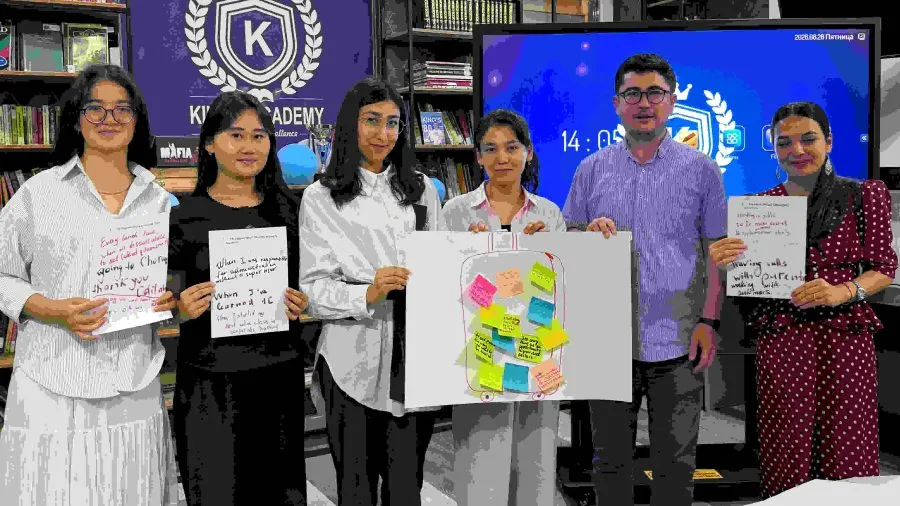
King’s Academy and American Councils YPIP: Five Years of Launching Young Professionals in Uzbekistan
What Is the American Councils Young Professional Internships Program (YPIP)? The Young Professional Internships Program (YPIP) is run by American Councils for International…

IELTS 9.0: how to get it, and do you even need it? An honest guide
The "niner" craze in Uzbekistan: do you need IELTS 9.0 for university, how parents can help without pressure, and a realistic roadmap to 9.0.

IELTS 5.5 to 7.0: How Long Does It Take, and Can You Do It in 2 Months?
How long does it take to go from IELTS 5.5 to 7.0? Realistic timelines, an 8-week plan and an intensive course with Eldor Sattorov in Tashkent.
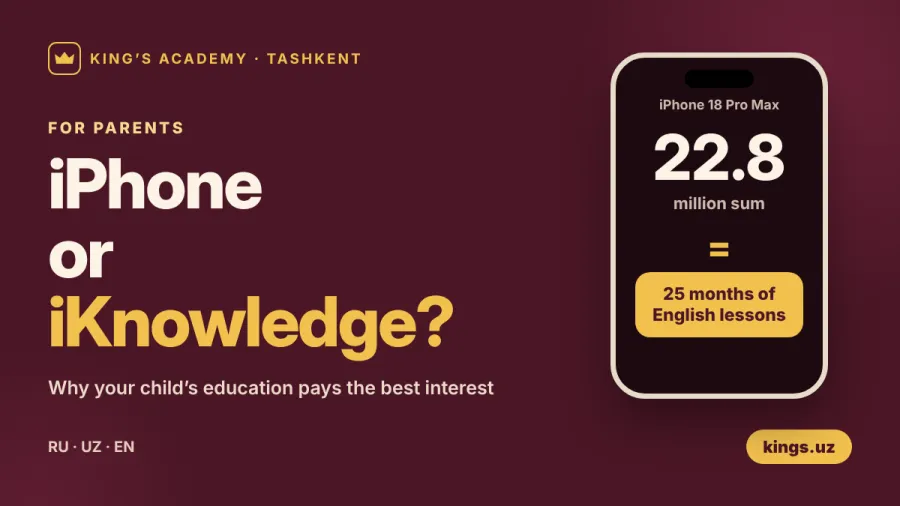
iPhone or iKnowledge? The Best Investment in Your Child
A new iPhone 18 Pro Max costs ~22.8 million sum in Tashkent — two years of English or maths lessons. A personal story about what's really worth investing in.
Submit a request
Do you want to sign up for classes or become part of our team?
Request submitted
We will contact you within the working day.