


The CEFR Exam in Uzbekistan (Milliy Sertifikat): A Complete Guide to Format, Scores, Fees, Registration and IELTS

In short
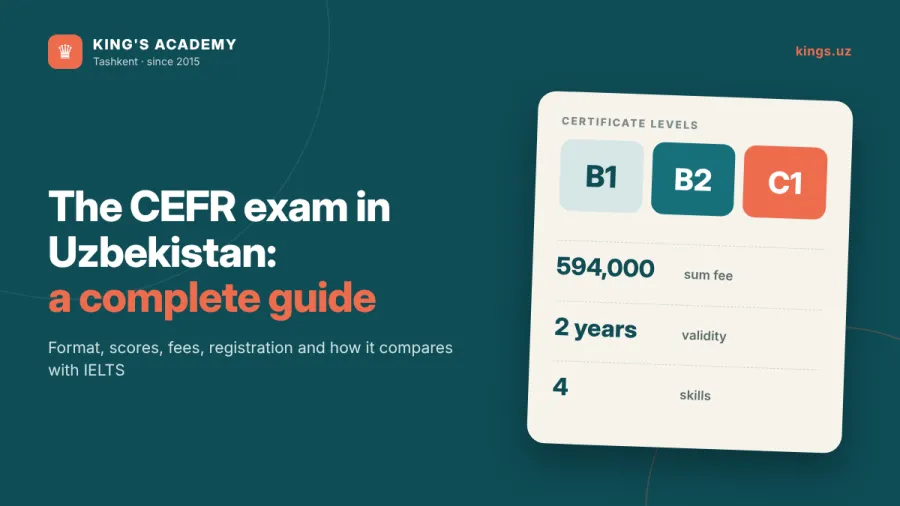
The CEFR exam (Milliy sertifikat) is Uzbekistan’s state foreign language exam, run by the Agency for Assessment of Knowledge and Skills. It tests Listening, Reading, Writing and Speaking and confirms level B1, B2 or C1. You can only register on my.gov.uz, the fee is currently 594,000 sum when paid through the portal, and the certificate is valid for 2 years. For Uzbek universities, B2 or higher gives the maximum foreign language score; for study abroad, you need IELTS.
In Uzbekistan, you can prove the same B2 level for 594,000 sum or for almost 2.8 million. For entry to a university inside the country, both certificates give the same maximum foreign language score. No wonder I get more and more questions about “CEFR”: what kind of exam it is, how it differs from IELTS, and who needs which.
I’ve prepared students for exams for many years, and I used to work as an IELTS Speaking examiner. In this guide I’ve put together everything you need to know before you register: only facts checked against official documents, plus practical tips without the fluff.
What the CEFR exam is
People call it different names: “CEFR”, “Milliy sertifikat”, “multilevel”. Officially, it’s the foreign language proficiency exam run by the Agency for Assessment of Knowledge and Skills (Bilim va malakalarni baholash agentligi, formerly DTM). If you pass, you get a national certificate.
CEFR is the Common European Framework of Reference, a scale of language levels from A1 (beginner) to C2 (near-native). The exam confirms three of its six levels:
- B1: you communicate confidently on familiar topics and understand the main points of simple texts;
- B2: you discuss most topics freely, read articles and write a clear, connected text;
- C1: you use the language flexibly and accurately for study and work.
The exam is available in English and several other languages, including German, French, Turkish and Arabic. The rules set no age limit.
Who needs it and why
University applicants
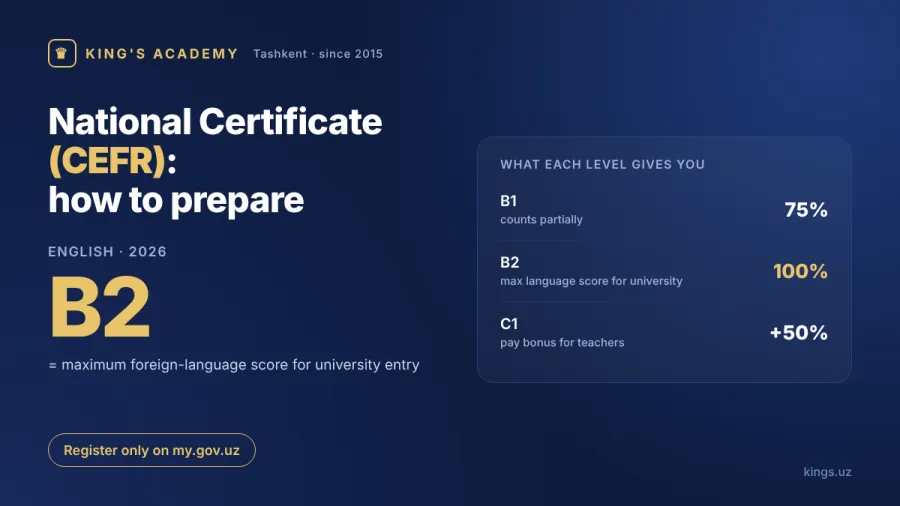
Under the bachelor’s admission rules, a B2 or higher certificate gives the maximum score for the foreign language subject on the entrance test, and B1 gives 75% of the maximum. If a foreign language is your first subject, you need at least a B1 certificate to apply (Cabinet of Ministers Resolution No. 578, clause 12). Put simply, a good certificate frees you from the language block and gives you time for your other subjects.
Teachers
B2 and C1 certificates entitle teachers to salary supplements. New English teachers in state schools must have at least B2, and teachers with C1 receive the maximum score in their compulsory appraisal (List of recognised certificates, reg. No. 3515). The exact supplement depends on the position, so check with your employer.
Master’s applicants, college students and job seekers
For master’s programmes and colleges, levels B1, B2 and C1 are recognised. Many employers in Uzbekistan also ask for the certificate as a clear proof of level.
🎧Check your real band this weekend — CD Mock IELTS: 150,000 sum, each next one 50,000 cheaper, 4th free →How the exam works
The exam has four parts: Listening, Reading, Writing and Speaking. It can be held on paper or on computer (Administrative regulation, Resolution No. 73).
- Listening and Reading: multiple-choice and short-answer tasks. According to the Agency, C1 usually needs about 28–35 correct answers per section, B2 about 18–27, and B1 about 10–17.
- Writing: two tasks. The first, shorter one gives about a third of the section score; the second, longer one gives two thirds.
- Speaking: a conversation with an examiner, with three types of tasks.
The Agency publishes the exact timings and sample tasks, so look at them before the exam.
How scores are calculated
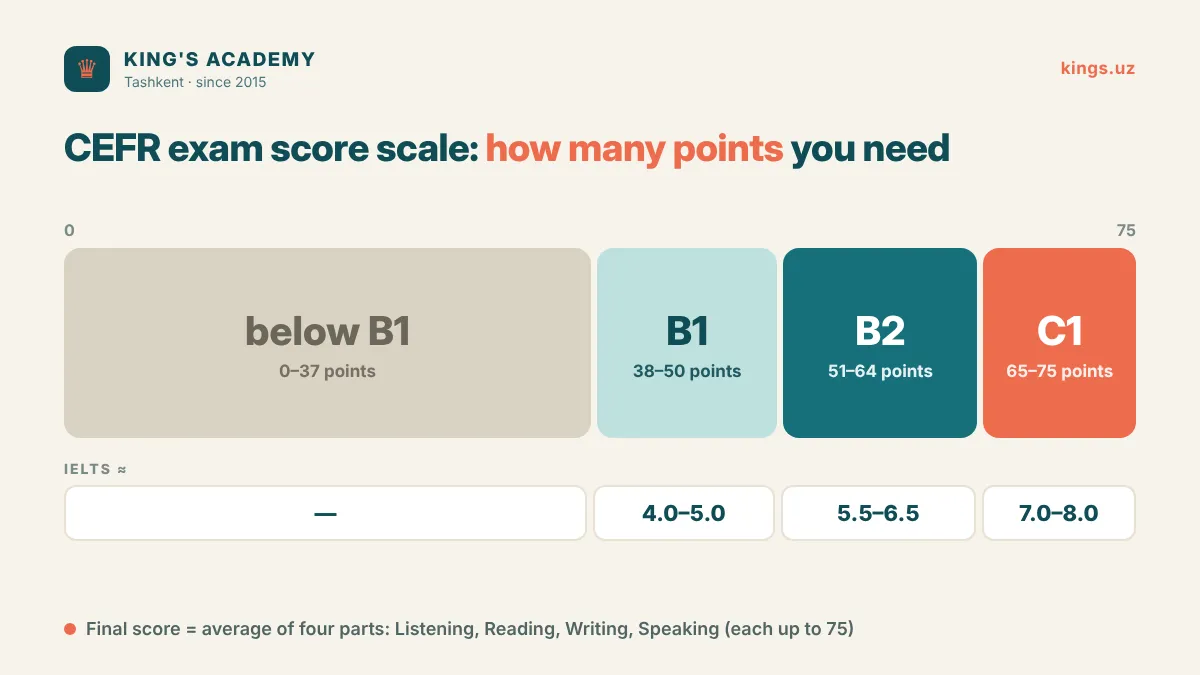
Each of the four parts is scored on a scale up to 75. Your final score is the average of the four parts. The level is set like this (uzbmb.uz, scoring system):
- 65–75: C1;
- 51–64: B2;
- 38–50: B1;
- 0–37: below B1.
Keep in mind that it’s an average. A strong Reading score can pull up a weak Writing score, but it works the other way too: one bad part drags down the whole result.
How much it costs
Under the regulation, the certificate fee is 1.5 times the base calculation amount (BHM). If you pay through my.gov.uz, you pay 90% of that. Right now, that’s 594,000 sum. People listed in the Unified Social Protection Register and people with Group I or II disabilities get a 50% discount. When the BHM changes, the fee changes too; the exact amount always shows when you register.
How to register
- Go to my.gov.uz and log in with OneID.
- Find the service for determining foreign language proficiency and fill in the form: language, region, date.
- Pay the fee by the deadline. Your seat isn’t reserved until you pay.
- Three days before the exam, you’ll get a notice with the address and exact time.
- On exam day, bring your passport or ID card.
Important details: registration closes at least 12 days before the exam, and seats in each region are limited, so places can run out earlier. You can take an exam in only one foreign language per month.
Exam dates
The exam runs several times a year, and the Agency announces the schedule for each half-year. The next round in 2026 is 12–14 December: registration from 13 to 27 November, payment by 28 November. Dates can change, so check them on my.gov.uz or call the Agency’s hotline, 1195, before you register.
Results, certificate and appeals
- Results are published within a week of the exam.
- The certificate is electronic, with a QR code. It arrives in your my.gov.uz account and is valid for 2 years.
- Appeals can be filed through the portal within three working days of the exam; the commission takes up to two weeks to decide.
- Refunds are possible only if you missed the exam for a valid reason and applied no later than three days after it. Being late or not turning up without a reason means no refund.
CEFR or IELTS: which one to choose
Both exams test the same four skills, but they do different jobs.
- Where it’s recognised. The CEFR certificate is for Uzbekistan: universities, schools, employers. IELTS is recognised by thousands of universities and organisations around the world.
- Price. CEFR costs 594,000 sum. Computer-delivered IELTS at the British Council in Uzbekistan costs 2,798,000 sum (British Council).
- Scale. CEFR shows B1, B2 or C1. IELTS gives a band score from 0 to 9. In the official list, B1 matches IELTS 4.0–5.0, B2 matches 5.5–6.5, and C1 matches 7.0–8.0.
- Validity. The CEFR certificate is valid for 2 years. Organisations also usually accept IELTS results for up to two years.
- Speed. CEFR takes up to a week. Computer-delivered IELTS usually takes 1–2 days.
My advice is simple. If you’re applying to a university in Uzbekistan or need a teacher’s supplement, CEFR is cheaper and does the job fully. If you plan to study or work abroad, prepare for IELTS from the start: it counts in Uzbekistan too, but CEFR isn’t accepted abroad. If you’ve already taken IELTS, you can see your scores on our Check your IELTS results page, and we explain how each part is marked in How IELTS is assessed.
How to prepare: three tips from an examiner
You’ll find a detailed 8–12 week plan in our article on preparing for the Milliy sertifikat. Here are the three things where people lose the most points.
- Don’t neglect Writing. The second task is worth two thirds of the section score. Write one full essay a week and always get feedback on your mistakes.
- Speak out loud every day. Two minutes on any topic, recorded on your phone. In Speaking, people lose points not because of vocabulary but because of long pauses and short answers.
- Practise in the exam format. Do tasks against the clock: knowing the language and knowing how to take the exam are two different skills.
Check your level before you register
Take our free level check to see what you can realistically expect right now. Preparation groups are on the schedule page, and fees are on the prices page. If you need IELTS 7.0+, have a look at our IELTS intensive course.
Frequently asked questions
Are the CEFR exam and the Milliy sertifikat the same thing?
Yes. Both names refer to the national foreign language certificate issued by the Agency for Assessment of Knowledge and Skills. “Multilevel” is another informal name for the same exam.
Can I get C2?
No. The exam only confirms B1, B2 and C1. If you need a higher level, an international exam such as IELTS is the right choice.
What happens if I score below 38?
Your B1 level won’t be confirmed. You can register and pay for another exam, but no more than once a month for the same language.
Is the CEFR certificate accepted abroad?
Usually not. It’s a national certificate for study, work and benefits inside Uzbekistan. For universities abroad, prepare for IELTS or another international exam.
Can I use IELTS instead of CEFR for university admission?
Yes. IELTS is on the official list of recognised certificates; for example, IELTS 5.5–6.5 matches B2. The certificate must be valid and taken at an official test centre, not as an online test at home.
How can someone check that a certificate is genuine?
The certificate is electronic, with a QR code. It can be verified through the relevant service on my.gov.uz.
Sources: Lex.uz — Administrative regulation on foreign language proficiency (Resolution No. 73) · uzbmb.uz — Multilevel test scoring system · Lex.uz — List of national and international certificates (reg. No. 3515) · Lex.uz — Bachelor’s admission regulation (Resolution No. 578) · British Council Uzbekistan — IELTS fees · IELTS.org — Verifying IELTS results
What's next?
Take the first step — it's free or takes 2 minutes:
Other articles
Daily useful articles
How to Choose an English Teacher in Tashkent: Beyond IELTS Scores
How to choose an English teacher in Tashkent: what IELTS scores don’t show, whether age matters, trial lessons, real results and red flags.

Presidential Schools in Uzbekistan: How to Prepare Your Child for the Entrance Exam Without Burnout (2027 Guide)
Presidential Schools admission explained by a former vice-principal: who can apply, both exam stages, 2026 dates and scores, and a calm 12-month study plan.

How IELTS Is Assessed: the 0–9 Band Scale, the Criteria and Your Overall Score
How IELTS is marked: the 0–9 band scale, Listening and Reading scores, Writing and Speaking criteria, how the overall band is rounded and where to check your result. Based on…

IELTS Myths Busted on Kun.uz: Eldor Sattorov and the British Council
On Kun.uz, Eldor Sattorov (King’s Academy) and Andrey Maksakov (British Council) explain how IELTS works and bust common myths. Watch the interview.

Private Schools in Tashkent 2026/27: Fees, Curricula, Admission
What private schools in Tashkent cost in 2026/27: a verified table of 11 schools with fees, curricula, languages, districts, admission and a school finder.
Uzbekistan’s National Certificate (Milliy sertifikat, CEFR) in English: How to Prepare in Tashkent (2026)
What the Milliy sertifikat (CEFR) is, what B2 and C1 give you, how to register on my.gov.uz and how to prepare in 2–4 months. Dates, format and tips from King’s Academy.
Submit a request
Do you want to sign up for classes or become part of our team?
Request submitted
We will contact you within the working day.