


Study abroad on a scholarship: which English certificate 6 top programmes ask for

In short
Every scholarship has its own English rules. El-yurt umidi names an IELTS score directly (6.0 for bachelor’s, 7.0 for master’s and PhD), while Chevening, GKS, MEXT, Türkiye Bursları and Stipendium Hungaricum mostly follow the requirements of the university you choose. So the first step is not “get the highest IELTS you can”. It is to write down the requirements of three real programmes and count the months left before the deadline.
Every autumn, the same scene happens at our reception desk. A mother or father walks in with a printout and asks: “My son needs a scholarship. Which IELTS should he get, 6 or 7?” And the honest answer is almost always: “It depends on the scholarship, and on the university.”
That is not dodging the question. Scholarships work in very different ways. Some set their own English bar. Others dropped it completely and left the decision to the university. Below are the six programmes people in Uzbekistan ask about most, and what each one really wants to see. All facts come from the programmes’ official pages. If the rules change, trust what those pages say.
The key idea: the university asks for the certificate, not the scholarship
Almost all big scholarships follow the same pattern. You get into a university, and the scholarship pays for your studies and living costs. So the university writes the English requirement itself, for example “IELTS Academic 6.5, with no band below 6.0”. Look closely at the second half of that sentence. Students often celebrate an overall 6.5 and miss that their Writing is 5.5, which is no longer enough.
Two more rules will save you stress. For university study you need IELTS Academic, not General Training. And many universities accept only a recent result, usually no older than two years, so taking the test “just in case” three years before you apply is not a good plan.
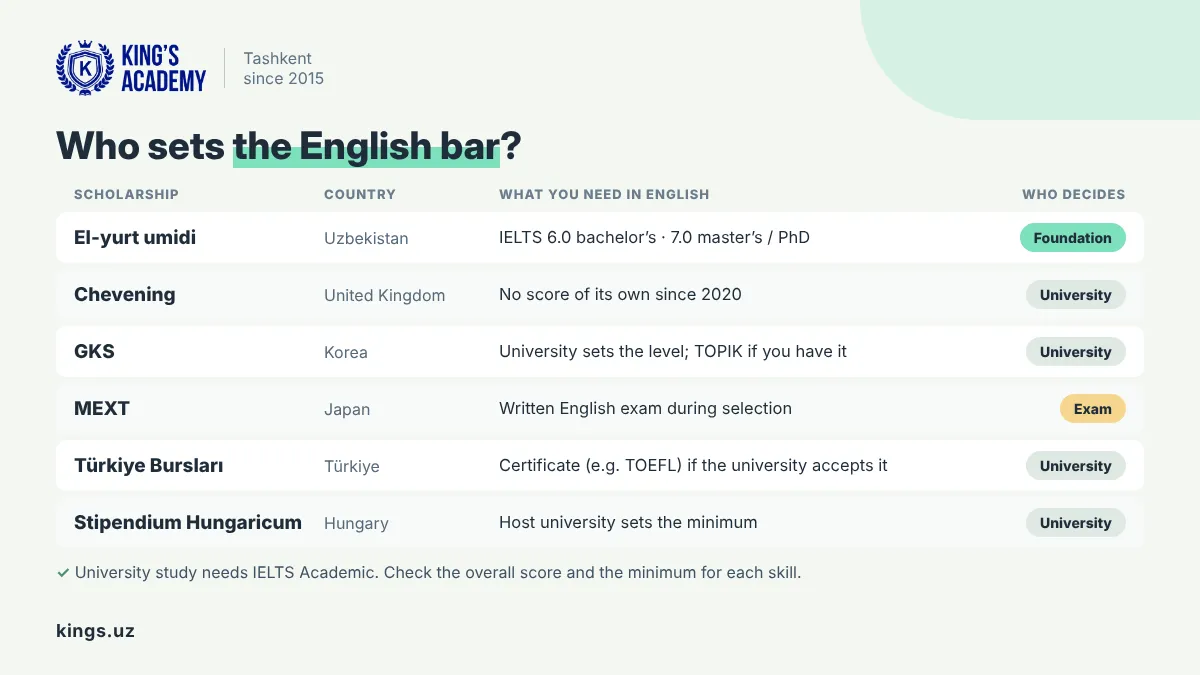
Six scholarships and what they ask for
El-yurt umidi: the only one that names a score
This is Uzbekistan’s state scholarship programme. Its second 2026 competition is open right now: documents are accepted from 1 to 15 November 2026, until 23:59, through the foundation’s platform at el-yurt.uz. There are 290 places: 101 for bachelor’s, 158 for master’s and 31 for doctoral study.
For English, the announcement asks for IELTS Academic of at least 6.0 for bachelor’s and at least 7.0 for master’s and PhD (or an equivalent international certificate). If you already hold an unconditional offer from a foreign university, a separate language certificate is not needed. There are age limits too: up to 30 for bachelor’s, 22–40 for master’s and 25–45 for doctoral study. Master’s applicants also need more than one year of work experience.
Chevening (UK): no score of its own any more
Many people still think Chevening requires IELTS 6.5. That is out of date: its own English requirement was removed in 2020. But you still need an unconditional offer from at least one of three UK universities, and UK universities nearly always ask for IELTS. For the 2027/28 cycle, that offer is due by 8 July 2027. Applications for this cycle closed in October 2026; the next round usually opens in August. Other conditions: at least two years of work experience (2,800 hours) and a promise to return home for at least two years.
Global Korea Scholarship (Korea)
The university sets the language level: Korean-taught programmes need Korean (usually TOPIK), English-taught ones need English. In the document list, TOPIK appears as an extra document “if applicable”. The scholarship covers airfare, tuition, a monthly allowance, insurance and a year of Korean language training. For master’s study, applicants must be under 40.
MEXT (Japan)
Here, your English is tested on the spot. In the embassy selection, research students sit written exams in Japanese and English, and undergraduate applicants in Japanese, English, maths and science. Recruitment runs in April–May, a year before you travel. According to the official Study in Japan website, tuition is free, airfare is paid, and research students receive ¥143,000–145,000 a month. An IELTS certificate is a plus, but you will still write the exam.
Türkiye Bursları (Türkiye)
Many programmes are taught in Turkish. For English-taught programmes you need an international certificate (TOEFL, for example) if your chosen university accepts it. An interesting detail: even if you study in English, without a C1 Turkish certificate you will spend a year learning Turkish. You apply online, free of charge, usually from January to February. Age limits: under 21 for bachelor’s, under 30 for master’s and under 35 for PhD.
Stipendium Hungaricum (Hungary)
The host university decides the minimum language level. If your previous studies were in the programme’s language, you can upload proof of that instead. The scholarship gives free tuition, a monthly stipend, an accommodation contribution and medical insurance. In the last cycle, the deadline was 15 January 2026, so if you are aiming for 2027/28, start getting ready now.
A backwards calendar: count from the deadline
After more than ten years of teaching, the mistake I see most often is starting IELTS preparation one month before the deadline. You cannot go from 5.5 to 7.0 in a month. So count backwards:
- Today. Choose three programmes and write down for each: the overall score, the minimum for each skill, how long the certificate stays valid, and the deadline.
- 6–8 months before. Find out your real level. A mock exam is more honest than “I think I’m about 6.5”.
- 3–4 months before. Take the real IELTS. Leave time for a retake in case you are half a band short.
- 1–2 months before. Essays, references, document translations. Your motivation letter tests your English too, just without a score.
A small exercise for today. Write one sentence about what you want to study abroad and why your country needs it: “I want to study urban planning because Tashkent is growing fast, and I want to help build better public transport.” If the sentence comes easily, you already have the start of an essay. If it doesn’t, start right there.
Where the missing half band usually hides
When I worked as an IELTS Speaking examiner, I noticed a pattern. Our students’ Reading and Listening are often strong, while Writing and Speaking lag half a band or a full band behind. The reason is simple: writing and speaking need feedback from a real person, not just tests on a phone. If your university asks for “no band below 6.0”, start with writing.
You can quickly find your past results on our Check your IELTS results page. We also wrote in detail about how long the road from 5.5 to 7.0 really takes in IELTS 5.5 to 7.0: how long does it take? And if you are aiming for a US bachelor’s degree, our guide SAT in Uzbekistan 2026 will help.
At King’s Academy we prepare students for IELTS in groups of up to 10, with printed books, and we use technology only as a helper. After class, many students stay in our library and study zone to do homework, read and play board games in English. For people aiming at a scholarship, this matters more than it seems: you are surrounded by others with the same goal.
Find out how far you are from your scholarship score
Start with a free level check or take a weekend CD Mock IELTS. If you need to raise your score fast, see the IELTS 5.5 → 7.0 intensive, our schedule and prices.
Frequently asked questions
What IELTS score do I need for the El-yurt umidi scholarship?
In the second 2026 competition: IELTS Academic of at least 6.0 for bachelor’s and at least 7.0 for master’s and PhD, or an equivalent international certificate. With an unconditional offer from a foreign university, no certificate is required.
Do I need IELTS for Chevening?
The programme itself has had no English requirement since 2020. But you need an unconditional offer from a UK university, and that usually requires IELTS or another recognised test.
Is IELTS General Training accepted?
For university admission you usually need IELTS Academic. General Training is mostly used for work and migration, so always check the requirements of your specific programme.
Can I get a scholarship without English?
Yes, if the programme is taught in another language: in Türkiye, Korea and Japan many programmes use the local language. English still helps, though. In MEXT selection, for example, you take an English exam.
How long should I prepare for IELTS for a scholarship?
It depends on your starting level. Moving up one band usually takes several months of regular work, so start at least six months before the deadline.
Read also: Tashkent university tuition and contract fees 2026/27
Sources: El-yurt umidi Foundation · Chevening · Study in Japan (MEXT) · Türkiye Bursları · Stipendium Hungaricum
What's next?
Take the first step — it's free or takes 2 minutes:
Other articles
Daily useful articles
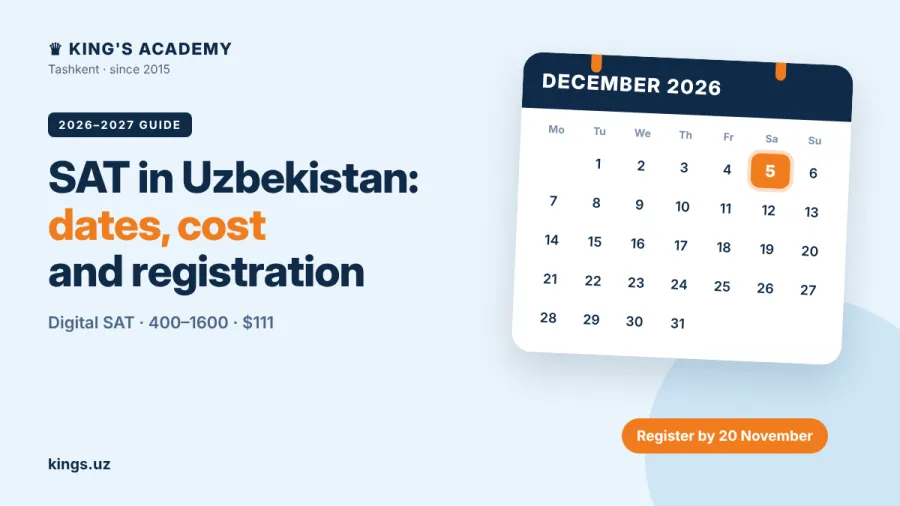
SAT in Uzbekistan 2026: Dates, Cost, Registration and the Digital SAT
SAT 2026–2027 dates for Uzbekistan, the $111 fee, step-by-step registration, passport rules, the Digital SAT format and a teacher's prep plan.

IELTS Speaking Part 2: How to Talk for 2 Full Minutes Without Running Out of Ideas
IELTS Speaking Part 2: a 1-minute plan, 5 time-buying phrases, stronger words than “very good”, Band 6 vs Band 8 answers and timed practice.

Causes and Solutions Essays in IELTS: The 4-Paragraph Plan That Answers Both Questions
IELTS Task 2 causes and solutions essay: decode the question, the 4-paragraph plan, a solution for each cause, 10 collocations and a Band 7.5+ sample.

IELTS Matching Headings in 4 Steps: How to Stop Losing 5 Marks in Passage 3
IELTS Matching Headings strategy in 4 steps: read the headings first, find the main idea, cross out used headings, manage time. Free 8-minute test.
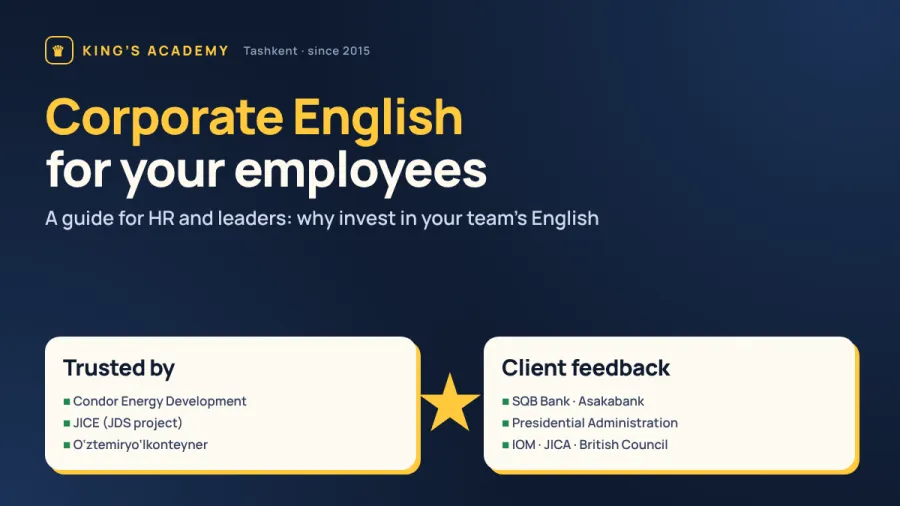
Corporate English for Employees: Why Companies Should Invest in It — A Guide for HR and Business Leaders
How corporate English (ESP, Business English) improves employee loyalty, growth and efficiency: formats, launching a programme in 6 steps, KPIs for HR and real client feedback for…

IELTS Writing Task 1 Line Graph: Write a Band 7 Overview and Never Misread a Number
IELTS Writing Task 1 line graph: the 4-paragraph plan, a 2-sentence overview formula, the margin check for numbers, trend verbs and a Band 7.5+ sample.
Submit a request
Do you want to sign up for classes or become part of our team?
Request submitted
We will contact you within the working day.