


IELTS Speaking Part 2: How to Talk for 2 Full Minutes Without Running Out of Ideas

Short answer
In Part 2 you get 1 minute to prepare and should speak for up to 2 minutes. In your notes, write keywords for 4 things: what, when, why, and how you felt, plus one short story. Use natural linking phrases to move from point to point, and replace “very good” with stronger words. The examiner stops you at 2 minutes, which is a good sign.
📊 FROM OUR MOCK RESULTS
In our September 2026 CD Mock IELTS, Vocabulary (Lexical Resource) was the lowest Speaking score for several candidates, and short, simple answers held Fluency back. Many stopped after 60–70 seconds because they had answered the bullet points with one sentence each and had nothing left to say.
1. How Part 2 works
- The examiner gives you a task card with a topic and 3–4 points, plus a pencil and paper.
- You have 1 minute to prepare and make notes. Then you talk for up to 2 minutes.
- The examiner stops you when the time is up, then may ask one or two short questions on the same topic.
- You are marked on 4 equal criteria: Fluency and Coherence, Lexical Resource (vocabulary), Grammatical Range and Accuracy, Pronunciation.
2. The 1-minute plan: What · When · Why · Feel
Don’t write sentences, there is no time. Draw 4 boxes and fill each with 3–5 keywords: What (the place / person / thing + 2 details), When (when, how often, who with), Why (2 reasons), Feel (your feelings + one short story). The story is your secret weapon: one real moment (“the first time I bargained there…”) easily fills 30 seconds. If you can, pick a real example, because invented ones run out fast.
💡 Ask about words at the start
If you don’t understand a word on the card, ask the examiner at the start of the preparation minute, not at the end.
3. 5 phrases that buy thinking time naturally
These phrases give you 2–3 seconds to think while still sounding fluent. Each one also tells the examiner you are moving to the next point, which helps Coherence:
- I’d like to talk about…
- What I remember most is…
- Another thing I should mention is…
- As for why…, I suppose…
- Looking back, …
Learn them as tools, not as a memorised speech. Examiners notice rehearsed answers.
4. Replace “very good” with stronger words
“Very” + a basic adjective is the fastest way to stay at Band 5–6 in Lexical Resource. The stronger word is in bold, and the weak version is struck through:
5. Band 6 vs Band 8: the same cue card
SPEAKING PART 2 · CUE CARD
Describe a place in your city that you like to visit.
You should say:
- where it is
- when you go there
- what you do there
and explain why you like it.
Band 6 (about 45 seconds)
I want to talk about Chorsu Bazaar. It is in Tashkent, in the old city. I go there sometimes with my mother, maybe on weekends. There are many things there, like fruits, vegetables, bread and spices. It is very big and very busy. The prices are good and the food is very good. I like it because it is interesting and I can buy many things. Also the building is very beautiful, it has a blue dome. I feel very happy when I go there. So that’s why I like Chorsu Bazaar.
Clear, but short. “very” ×6, simple sentences, the bullet points are answered and then the speaker stops.
Band 8 (about 2 minutes)
I’d like to talk about Chorsu Bazaar, which is one of the oldest markets in Tashkent. It’s in the old part of the city, right next to Chorsu metro station, and you can’t miss it because of its huge turquoise dome.
I usually go there on Sunday mornings with my mother, mostly to stock up on fresh fruit and vegetables and, of course, hot non straight from the tandir.
What I enjoy most is the atmosphere. The moment you walk in, you’re hit by the smell of spices and freshly baked samsa, and the stallholders keep calling out to customers, offering you a taste of dried apricots or raisins. It’s absolutely packed at weekends, so you have to squeeze between the stalls, but that’s part of the fun.
Another thing I should mention is the bargaining. At first I found it quite awkward, but my mother taught me a few tricks, and now I actually look forward to it. Getting a good price feels like a small victory.
As for why I like it so much, I suppose it’s because it feels genuinely authentic. Supermarkets are convenient, but they all look the same, whereas Chorsu has real character and a sense of history. Whenever friends visit from abroad, it’s the first place I take them, and they’re always fascinated.
So, all in all, it makes me feel connected to my city, and I always leave in a great mood, usually with far more bags than I planned!
Natural signposts (What I enjoy most… Another thing… As for why…), precise words (packed, stock up on, authentic), a short story about bargaining, a range of grammar.
6. Practice: speak for 2 minutes now
Do this exactly like the exam: start the 1-minute timer and make notes, then start the 2-minute timer and speak out loud. Record yourself if you can and listen back: did you use “very”? Did you stop early? Then answer the 8 questions below.
SPEAKING PART 2 · CUE CARD
Describe a place in your city that you like to visit.
You should say:
- where it is
- when you go there
- what you do there
and explain why you like it.
Your notes (keywords only):
0 words
✍️ Part 2 check: 8 questions
Answered: 0
1. What should you write in your 1-minute notes?
2. Upgrade it: “The plov was ______.”
3. Upgrade it: “On Sundays the bazaar is ______.”
4. Upgrade it: “When I passed, I was ______.”
5. You forget what to say next. What is the best option?
6. Why do many Band 6 answers stop after about 1 minute?
7. Which is the best way to continue “It’s a really busy place.”?
8. The examiner stops you at 2 minutes while you are mid-sentence. Is that a problem?
Your score
Reread sections 2–4, then do the timed practice again. Most marks in Part 2 come from planning and extending each point.
Good! Now record a full 2-minute answer and count how many times you say “very”.
Excellent. Practise one new cue card every day with the timer and recorder, and you’ll feel the difference in a week.
Get your Speaking scored by an examiner
We run CD Mock IELTS in the real computer-delivered format every weekend at our Alayskiy branch: all 4 sections in one day, feedback on every skill and a recording of your Speaking. The first mock is 150,000 sum, each next one is 50,000 cheaper, and the fourth is free. 10 seats per date. You get scores for all four Speaking criteria and the audio of your test, so you can hear exactly what to fix. For daily speaking practice, join our CD IELTS course or the IELTS 7.0+ intensive. Already took the exam? Check your IELTS results online.
Read next
Frequently asked questions
How long do I have to prepare in Speaking Part 2?
One minute. The examiner gives you a pencil and paper to make notes.
How long should I speak in Part 2?
Up to 2 minutes. The examiner will stop you when the time is up, so keep talking until then.
What happens if I stop before 2 minutes?
The examiner may wait or ask you to say more. Stopping early usually means less evidence for Fluency and Vocabulary.
Can I talk about a slightly different topic?
You can adapt the topic a little if you can describe your example better, but make the link clear at the start and still cover the card.
Can I make up a story?
Yes, you are not marked on truth. But real examples are easier to talk about for 2 minutes.
Should I memorise answers?
No. Examiners notice memorised speeches. Learn useful phrases and practise many different topics instead.
Are all 4 Speaking criteria equally important?
Yes. Fluency and Coherence, Lexical Resource, Grammatical Range and Accuracy, and Pronunciation are weighted equally.
Sources
- IELTS.org — IELTS Speaking: test format
- IELTS.org — How to use the preparation time in Speaking Part 2
- IELTS.org — Speaking band descriptors (official PDF)
📅 Free 30-day IELTS plan
Daily tasks for every section, a mock exam every week, and a free CD Mock IELTS at the finish.
Already taken IELTS? Check your IELTS results →
What's next?
Take the first step — it's free or takes 2 minutes:
Other articles
Daily useful articles

What an IELTS Speaking Examiner Really Listens For (and What They Ignore)
A former IELTS examiner explains what really affects your Speaking score: accent, opinions, memorised answers, plus a simple plan for this week.

How Long Does It Take to Learn English from Zero to IELTS?
How long does it take to learn English from zero to IELTS 6.0–7.0? Realistic timelines by level, free tools, and King’s Academy courses in Tashkent.

“I am agree” and 9 more mistakes that give us away in English
"I am agree", "explain me", "depend from": 10 common mistakes of Uzbek and Russian speakers, why they happen and how to fix them in 3 weeks.
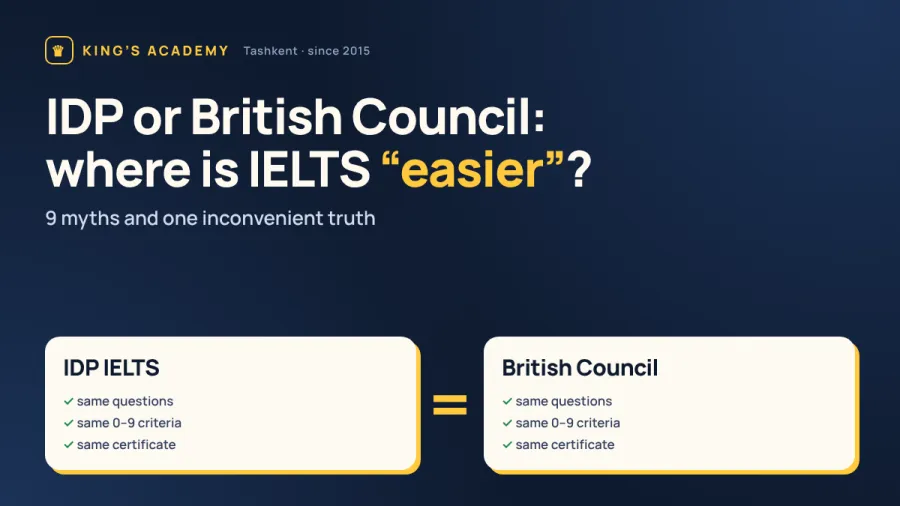
IDP or British Council: Where Is IELTS “Easier”? 9 Myths and One Inconvenient Truth
IDP or British Council — where is IELTS easier and the score higher? We check 9 popular myths (Speaking, “nines”, winter vs summer) against official IELTS sources and explain how…

Tashkent Universities: IELTS, Fees and Scholarships 2026
15 universities in Tashkent compared: minimum IELTS, 2026/27 tuition in UZS and USD, scholarships and deadlines — plus what each IELTS band opens.
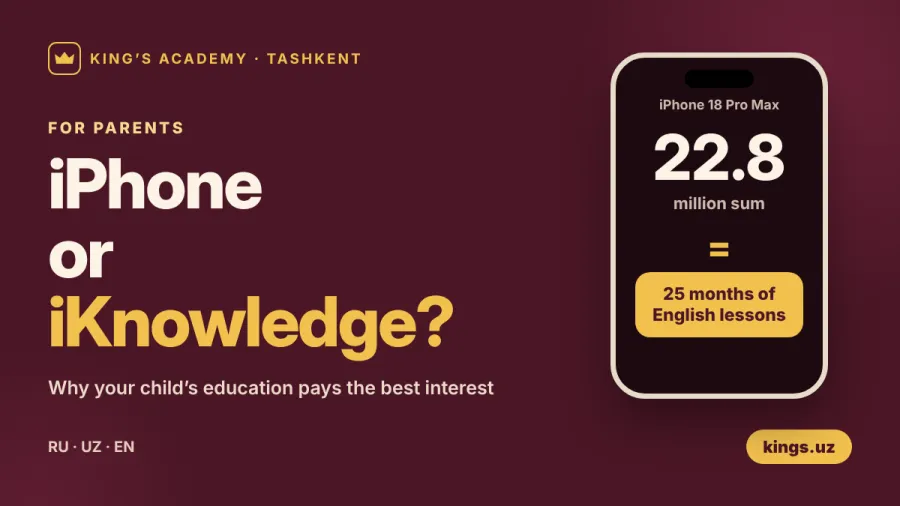
iPhone or iKnowledge? The Best Investment in Your Child
A new iPhone 18 Pro Max costs ~22.8 million sum in Tashkent — two years of English or maths lessons. A personal story about what's really worth investing in.
Submit a request
Do you want to sign up for classes or become part of our team?
Request submitted
We will contact you within the working day.