


Tutors, Burnout and Your Child: How Many Extra Classes Are Too Many in Tashkent? A Parent’s Guide

Short answer for parents
For most Tashkent schoolchildren, two subjects outside school at a time is the ceiling, each two or three times a week. That means about 4–6 extra hours a week in primary school, 6–8 in Grades 5–9 and no more than 10–12 in Grades 10–11, and never at the cost of sleep (9–12 hours for ages 6–12, 8–10 hours for teenagers). A good course shows measurable progress every 8–12 weeks. And plan early: Cambridge English estimates 500–600 guided hours to reach B2 (around IELTS 5.5–6.5) from zero — that is three school years, not six months.
Twenty minutes to nine
It is 20:40 on a Tuesday. A Grade 10 girl walks out of her third learning centre of the day. School finished at 13:30; maths with a repetitor until 16:00; chemistry until 18:00; English until 20:30. Her homework for tomorrow is still in her bag. She will open it at 22:00, scroll Instagram until midnight, and wake up at 6:45.
I have been teaching since 2010 and running King’s Academy since 2015. I have seen thousands of children like her — and their parents, who love them, pay for all of it, and honestly believe that more classes mean a better future. Here is the uncomfortable truth after fifteen years: more hours do not equal more learning. Past a certain point, every extra class makes the others less effective.
Your childhood was not their childhood
Think back. When you were fifteen, what did a school day look like? School, home, the yard, maybe one kruzhok, maybe one book a week. Was anyone asking you for an IELTS certificate at sixteen? Did you compare yourself with 500 classmates’ highlight reels every evening?
Your child’s world is different, and the numbers show it:
- In 2026, 677,907 young people registered for university entrance in Uzbekistan (Oliygoh.uz), for about 205,600 bachelor’s places in the 2026/27 quotas (Infoedu.uz).
- 125,354 applicants already had a national or international foreign-language certificate at registration.
- In 2024, nearly 53,000 young people scored IELTS 5.5 or higher — about five times more than in 2020 — and 13,424 scored 7.0–8.0 (British Council and IDP data via Kun.uz).
So yes, the pressure is real. A certificate that made someone special ten years ago is now a normal requirement. But ask yourself honestly: is the answer to more competition simply more hours? Or is it earlier, smarter, calmer hours?
The repetitor economy in numbers
In the first half of 2026 alone, people in Uzbekistan spent 23.8 trillion sum on education services, 22.7% more than a year earlier. Tashkent city accounted for 12.7 trillion — more than half of the country’s total (National Statistics Committee).
Why do Tashkent families pay so much? Partly because school alone is not enough. In Uzbekistan’s first PISA in 2022, 15-year-olds scored 364 in maths, 336 in reading and 355 in science, against OECD averages of 472, 476 and 485 (Kun.uz). Parents see the gap and try to close it with tutors. That instinct is right. The method — stacking class on class — is often wrong.
How many extra classes are too many?
Here is the rule of thumb I give parents in our consultations. It is not an official standard — it comes from what I have seen work over fifteen years.
| Age / grade | Subjects outside school at a time | Extra hours per week | Sleep per night |
|---|---|---|---|
| Grades 1–4 (6–10 years) | 1, maximum 2 (one can be sport or music) | 4–6 | 9–12 hours |
| Grades 5–8 (11–14 years) | 2 | 6–8 | 9–12 hours until 12, then 8–10 |
| Grade 9 (lyceum or school exams) | 2 | 6–8 | 8–10 hours |
| Grades 10–11 (IELTS + university exam) | 2, maximum 3 for short periods | 10–12 | 8–10 hours |
Sleep: American Academy of Sleep Medicine. The WHO also recommends an average of 60 minutes of physical activity a day for ages 5–17 — that hour is part of the plan, not a luxury.
Sleep is not a reward for finishing homework; it is when the brain stores what it learned. A teenager who sleeps six hours to attend a fourth class is paying for lessons he will not remember (AASM, WHO).
Signs your child is overloaded
- Falling marks at school despite more tutoring.
- Constant tiredness, headaches or stomach aches before lessons.
- Homework done late at night or copied in the morning.
- Losing interest in friends, sport and hobbies.
- Tears, anger or silence when you ask about classes.
If you see two or more of these, remove one activity for a month and watch what happens. Most parents are surprised: marks often go up, not down.
The “six-month miracle” that does not exist
Every January our phones ring with the same request: “My son is in Grade 11. He knows almost no English. He needs IELTS 6 and a good maths score by June. Can you do it?”
Let us do the arithmetic together. Cambridge English estimates these guided learning hours from zero (Cambridge English):
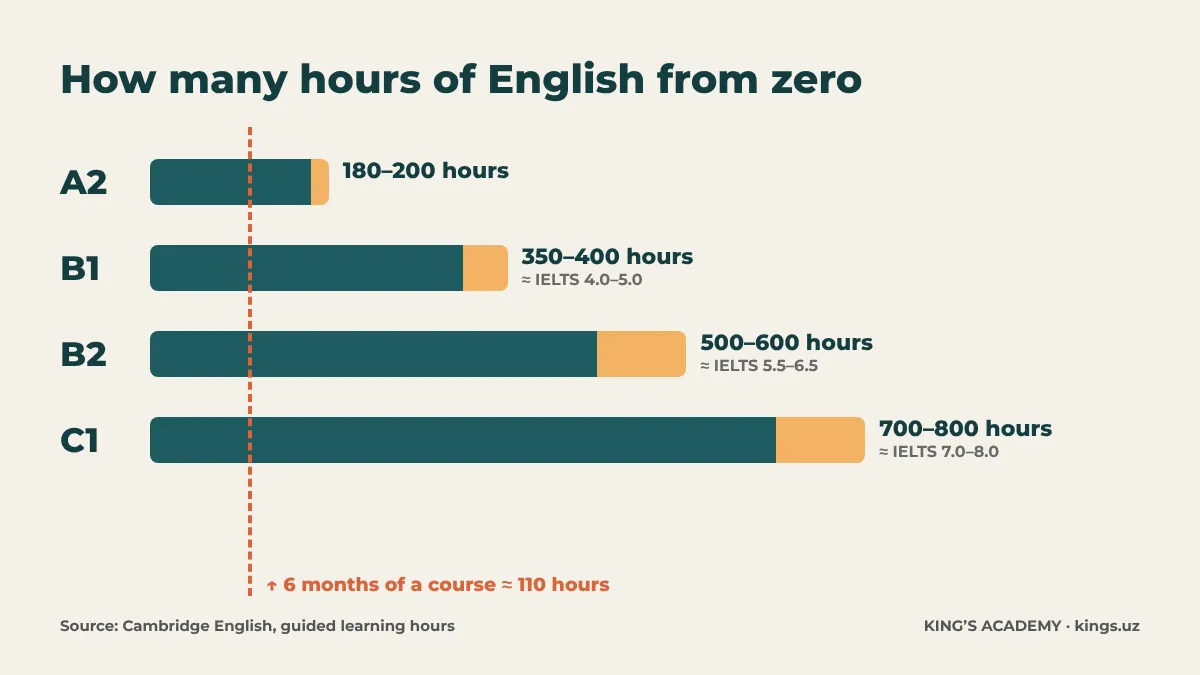
- A2: 180–200 hours
- B1: 350–400 hours (around IELTS 4.0–5.0)
- B2: 500–600 hours (around IELTS 5.5–6.5)
- C1: 700–800 hours (around IELTS 7.0–8.0)
A normal group course meets three times a week for 90 minutes — about 18 hours a month. Six months gives roughly 110 hours. From near zero, that is A2. Not IELTS 6. And the same student must also prepare maths and a second subject for the university test. Can a teenager really absorb 500 hours of English, plus maths, in 24 weeks while finishing school? Can yours?
This is not the child’s fault. It is a planning failure — usually ours, the adults’. The same student starting in Grade 8 would have needed the same 500 hours, spread calmly over three years.
Quality over quantity: is your child’s English course actually working?
Many children spend years “doing English” and stay at the same level. They memorise textbook units, fill in gaps, pass a unit test — and still cannot hold a two-minute conversation. Use these eight checks:
- There was a placement test and a clear goal — for example, “B1 by May”, not just “English”.
- Progress is measured every 8–12 weeks with a level test or a mock exam, and you see the results.
- Your child speaks in class — most of the lesson time is the students’ voices, not the teacher’s.
- Writing comes back with real feedback, not just a mark.
- Your child reads in English outside the textbook: graded books, articles, stories.
- The teacher is qualified: a teaching certificate such as CELTA, a high personal IELTS score, experience with your child’s age.
- The group is small — up to 10 students, so each child is heard.
- Homework makes them think, not copy.
Red flags: the same textbook for years, no test for months, “memorise these model answers for Speaking”, and a child who cannot tell you what he learned this week.
Measuring matters. In our analysis of CD Mock IELTS results at King’s Academy, the average overall score across 398 complete results was 5.81 — and the students who reached 7.0+ were almost always the ones who tested themselves more than once and worked on what the report showed.
Time management for teens: a realistic week
Here is a schedule that works for a Grade 10 student preparing for IELTS alongside school. It has fewer classes than most families expect — and better results.
| Time | Monday–Friday | Saturday | Sunday |
|---|---|---|---|
| Morning | School | School or free morning | Free |
| 14:00–15:00 | Lunch, rest, no screens | Rest | Family time |
| 15:00–16:30 | School homework (hardest subject first) | Mock test or IELTS practice (every 2–3 weeks) | Free |
| 17:00–18:30 | One course (English 3×, maths 2× a week) | Sport or outdoors | Light reading in English (30 min) |
| 19:00–20:00 | Sport, walk, family dinner | Friends | Plan the week (15 min) |
| 20:00–21:00 | Independent study: vocabulary, reading, writing | Free | Free |
| 23:00 | Phone off, sleep | Sleep | Sleep |
Three rules make it work: homework before courses, one phone-free study block every day, and lights out by 23:00.
“I don’t have time” is not an excuse
I hear it every week: “We both work, we don’t have time to check his studies.” I understand — I am a working father too. But let me say it plainly: a child’s education cannot be outsourced completely. Paying three centres is not the same as being involved. Not finding time for your child’s future is not a busy schedule; it is a choice with consequences, and the child pays for it later.
You do not need hours. You need 20 minutes a day: ask what they learned, look at one piece of homework, read the teacher’s report, put the phone away at dinner. You find time for work calls and for choosing a new phone — find it for this. I wrote more about these choices in iPhone or iKnowledge?.
A calm plan from Grade 5 to Grade 11
| Grade | English goal | What else matters |
|---|---|---|
| 5–6 | A1 → A2; reading habit | Strong arithmetic, curiosity, sport |
| 7–8 | B1 | Algebra basics; choose 1–2 subjects the child enjoys |
| 9 | B1+; a first certificate if ready | Lyceum or school decision; maths base |
| 10 | B2; first IELTS mock | Pick the university direction and test subjects |
| 11 | IELTS 6.5–7.5 | University test subjects; applications; sleep |
Started in Grade 5, each step is about one school year. Started in Grade 10, the same steps have to be squeezed into months.
Peer pressure — and believing in your child
“The neighbour’s son got 8.0.” “My colleague’s daughter is in Westminster.” Do these sentences help your child, or do they make him feel he is already losing? Every child has a different starting point and pace. Compare your child with who he was three months ago, not with someone else’s child.
Children who know their parents believe in them work harder and recover faster from a bad test. Praise effort and strategy — “you planned your week well” — not just the score. Confidence is not a soft extra; it is what gets a teenager through 500 hours of learning.
Start with an honest diagnosis
Check your child’s level with our free level check, see General English and the IELTS course, or find a group on the timetable. We will tell you honestly how long your child’s goal will take.
Frequently asked questions about tutoring and burnout
How many tutors or learning centres should a schoolchild in Tashkent attend?
As a rule, no more than two subjects outside school at a time, each two or three times a week. In Grades 10–11 a third subject is acceptable for short periods.
How many extra hours a week are too many?
Roughly more than 6 hours for primary school, 8 for Grades 5–9 and 12 for Grades 10–11, or any amount that cuts sleep below the recommended level.
How much sleep does a teenager need?
The American Academy of Sleep Medicine recommends 9–12 hours for ages 6–12 and 8–10 hours for ages 13–18.
Can a Grade 11 student get IELTS 6.0 in six months from almost zero?
Very rarely. Cambridge English estimates 500–600 guided hours from zero to B2; a normal course gives about 110 hours in six months.
How many hours does it take to reach IELTS 7.0?
IELTS 7.0 is around CEFR C1, which Cambridge estimates at 700–800 guided hours from zero, plus independent study.
How can I tell if my child’s English course is working?
Look for a clear goal, a level test or mock every 8–12 weeks, lots of speaking in class, written feedback, outside reading and a small group.
What are the signs of academic burnout in children?
Falling marks despite more tutoring, constant tiredness, headaches before lessons, late-night or copied homework, loss of interest in friends and hobbies.
When should my child start preparing for IELTS?
Ideally general English from Grade 5–6 and IELTS-specific preparation in Grades 9–10, so the exam is taken calmly in Grade 10 or 11.
Is individual tutoring better than a group?
It is useful for specific gaps or exam strategy, but a good small group gives more speaking practice and motivation at a lower cost. Many students combine both briefly before the exam.
I work full-time. How can I support my child’s studies?
Twenty minutes a day is enough: ask what they learned, check one piece of homework, read teacher reports and keep dinner phone-free.
Related: iPhone or iKnowledge? · How long does it take to learn English from zero to IELTS? · The true cost of IELTS 7.5 in Tashkent · Check your IELTS results.
About the author
Eldor Sattorov — founder and director of King’s Academy in Tashkent (since 2015), teaching English since 2010. Former vice-principal at the Presidential School in Tashkent (2019). MA in TESL (Webster University), BA in International Relations with Politics (University of York, UK). CELTA-qualified, former Cambridge English Speaking examiner.
Sources
- Kun.uz — Uzbekistan’s PISA 2022 results (maths 364, reading 336, science 355)
- National Statistics Committee via Anhor.uz — 23.8 trillion sum spent on education services, Jan–Jun 2026
- Cambridge English — Guided learning hours per CEFR level
- Oliygoh.uz — 2026 university admission statistics (677,907 applicants)
- Infoedu.uz — 2026/27 university admission quotas
- Kun.uz — IELTS results of young people in Uzbekistan, 2020–2024
- Kun.uz — EF English Proficiency Index 2025: Uzbekistan 104th of 123
- American Academy of Sleep Medicine — Recommended sleep for children and teenagers
- WHO — Physical activity fact sheet
What's next?
Take the first step — it's free or takes 2 minutes:
Other articles
Daily useful articles

Presidential Schools in Uzbekistan: How to Prepare Your Child for the Entrance Exam Without Burnout (2027 Guide)
Presidential Schools admission explained by a former vice-principal: who can apply, both exam stages, 2026 dates and scores, and a calm 12-month study plan.
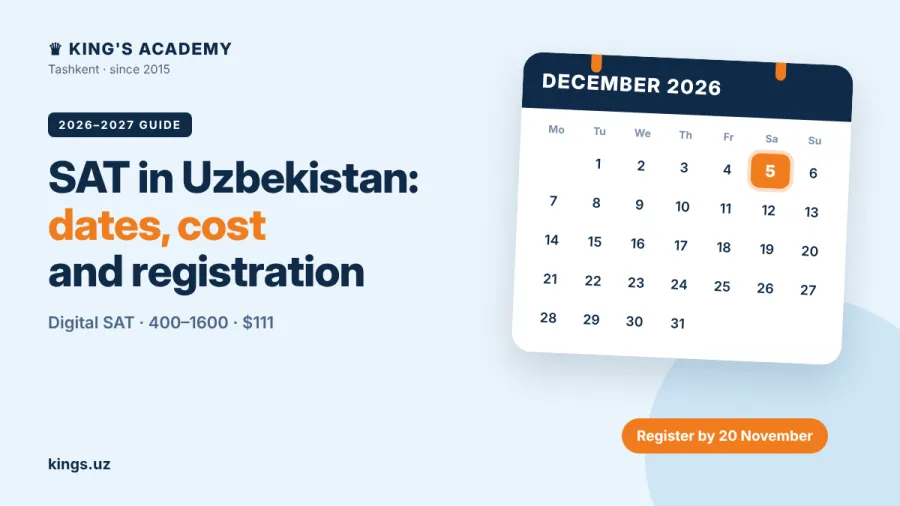
SAT in Uzbekistan 2026: Dates, Cost, Registration and the Digital SAT
SAT 2026–2027 dates for Uzbekistan, the $111 fee, step-by-step registration, passport rules, the Digital SAT format and a teacher's prep plan.

IELTS Myths Busted on Kun.uz: Eldor Sattorov and the British Council
On Kun.uz, Eldor Sattorov (King’s Academy) and Andrey Maksakov (British Council) explain how IELTS works and bust common myths. Watch the interview.

How to Get IELTS 7.0+ Through Self-Study: A Realistic, No-Nonsense Roadmap
Can you get IELTS 7.0 without a teacher? A realistic self-study roadmap: daily habits, a 12-week plan, free resources and how to stay disciplined to the end.
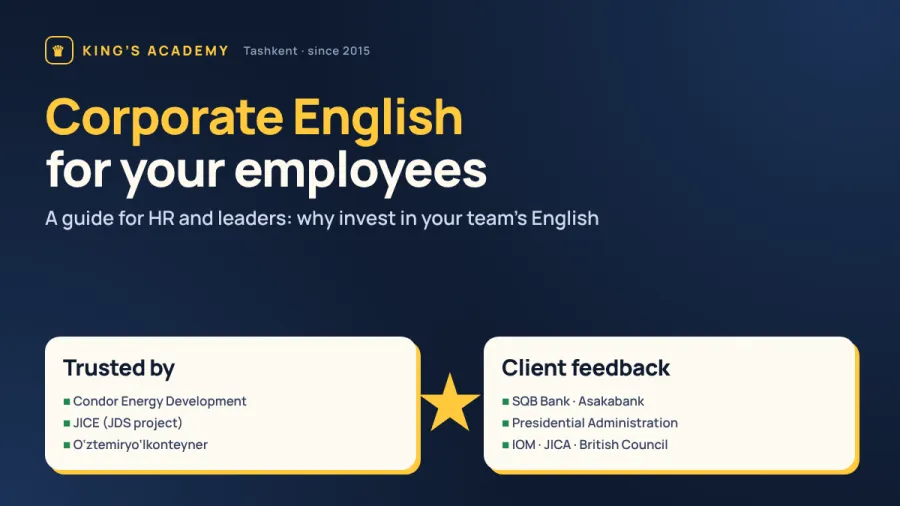
Corporate English for Employees: Why Companies Should Invest in It — A Guide for HR and Business Leaders
How corporate English (ESP, Business English) improves employee loyalty, growth and efficiency: formats, launching a programme in 6 steps, KPIs for HR and real client feedback for…
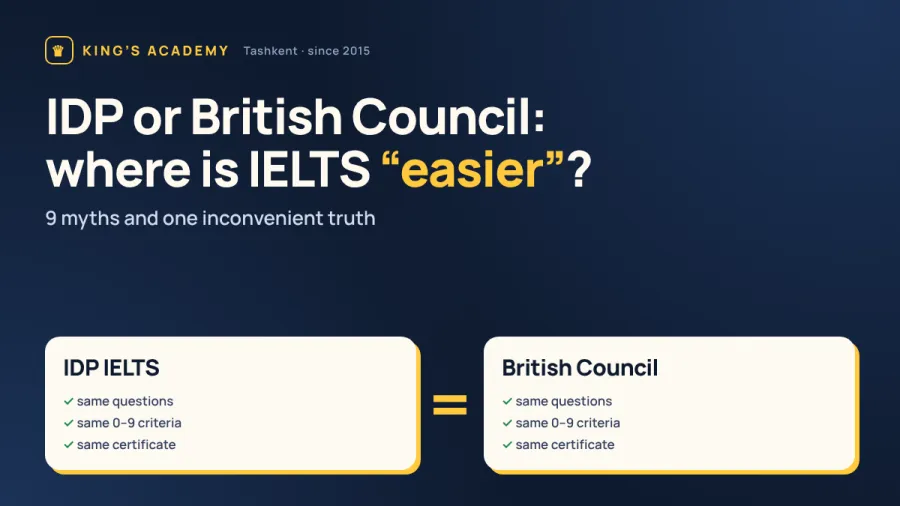
IDP or British Council: Where Is IELTS “Easier”? 9 Myths and One Inconvenient Truth
IDP or British Council — where is IELTS easier and the score higher? We check 9 popular myths (Speaking, “nines”, winter vs summer) against official IELTS sources and explain how…
Submit a request
Do you want to sign up for classes or become part of our team?
Request submitted
We will contact you within the working day.