


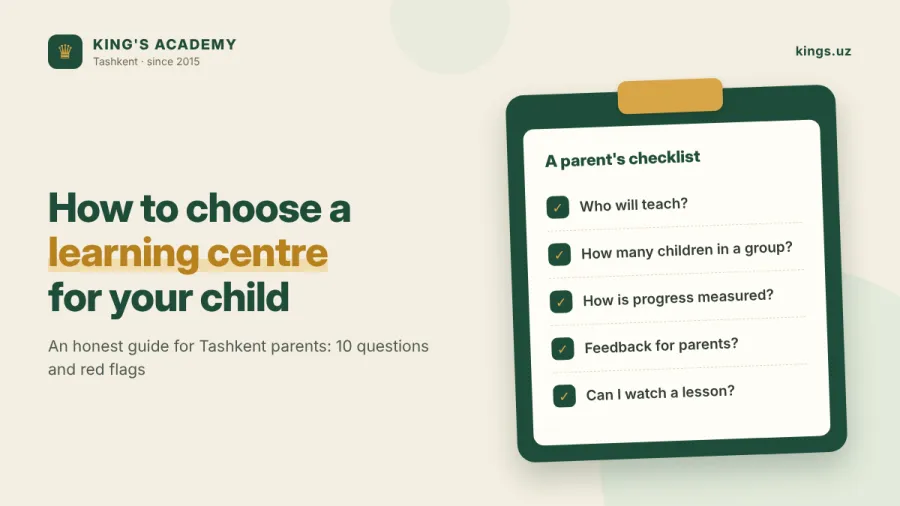
How to Choose a Learning Centre for Your Child in Tashkent: An Honest Guide for Parents

In short
Tashkent has a huge number of learning centres, and they all have nice adverts. Don’t judge by the sign or the app. Look at three things: who exactly will teach your child, how much attention they will get in class, and how you will hear about their progress. Before you pay, go to a trial lesson, ask the 10 questions in this guide and watch out for the red flags.
Almost every week, parents ask me the same question: “Teacher, how do we know which centre is good? There are three on one street!” It’s true. In Yunusobod, Chilanzar or Sergeli, there are signs for English, maths and “school preparation” on nearly every building. On Instagram and Telegram there are even more: bright videos, discounts “only until Friday”, apps with points and leaderboards.
Having so much choice is good news, because parents can be picky. But it also makes the most important thing harder to see: will your child actually learn? Here is the honest guide I would give my own friends. No names, no hard feelings, just the essentials.
Why choosing a centre matters so much
You can always earn money again. You can’t get back your child’s time. A year in a weak group doesn’t just waste the fees. It can also kill interest: your child decides that “English is boring” or “I’m just not good at it”. Fixing that later takes much longer than teaching from scratch.
So choosing a centre isn’t like buying a service. You’re deciding who your child will spend several hours a week with, at the age when they absorb the most. It deserves the same care as choosing a doctor.
Two approaches you’ll meet in Tashkent
The “conveyor belt”
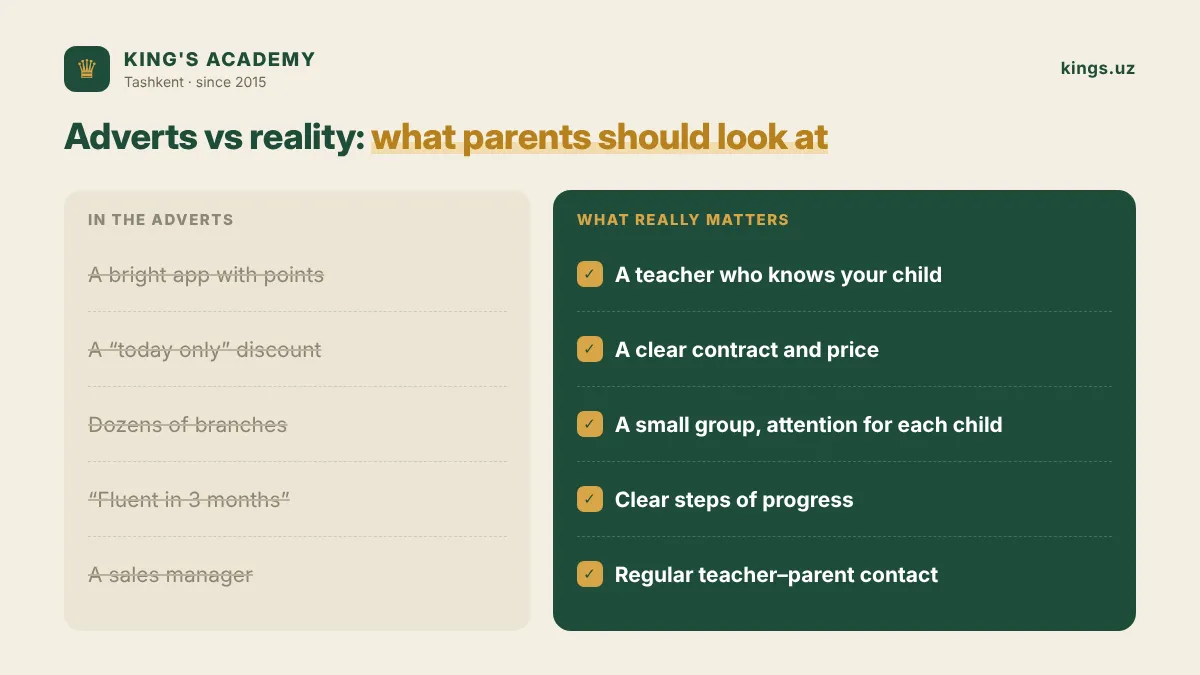
Let me be fair first: big doesn’t mean bad. Large chains can have convenient branches, well-organised systems and good teachers. But in some of them, teaching works like a factory. Your child stops being a student and becomes a “client” in a CRM system. The managers have sales targets, the branch has numbers to hit, and the first question at the meeting isn’t “What can your child do?” but “Which package shall we sign you up for?”
This approach is easy to spot. You get advice from a salesperson, not a teacher. Nobody knows yet who will teach. Teachers change often. There’s a lot of talk about the app, points and games, and very little about what your child will actually be able to do in three months.
An app is not a teacher
Modern technology isn’t bad in itself. But it helps to know that there is less proof of its value than there is advertising. UNESCO’s big report on technology in education says it directly: there is little robust evidence that digital technology adds value in education, and a lot of the evidence comes from those trying to sell it (UNESCO, Global Education Monitoring Report 2023). The same report notes that just having a phone nearby distracts students.
An app is a useful helper for reviewing words or listening to audio. But a child learns to speak, write and think in a language from a real person who sees their mistakes, their mood and their progress. We wrote more about this in Screens don’t teach. Teachers and books do.
The “school next door”
The other approach is a centre where the director knows students by name, the teacher calls parents personally, and children are in no hurry to leave after class. There aren’t a hundred branches, but there is attention. This kind of centre is hard to fit into an advert. You can’t put a warm atmosphere, or a teacher who noticed your child was sad today, into a short video. You can only see it with your own eyes.
10 questions to ask any centre
- Who exactly will teach my child? Can I meet them? What are their qualifications, and how much experience do they have with children?
- How many children are in a group? Research by the Education Endowment Foundation shows that smaller classes help only when the teacher really changes how they teach and gives each child more attention (EEF, Reducing class size). So ask not only “how many?” but also “how does the teacher work with each child?”
- How do you check my child’s level? A good centre tests first, instead of putting your child into “the next group that starts”.
- Which books do you use? Does your child get a printed book and a notebook, or is everything on a phone?
- How do you measure progress? Are there clear steps? For example, Cambridge has children’s levels (Pre A1 Starters, A1 Movers and A2 Flyers) linked to the international CEFR scale (Cambridge English).
- How often will I get feedback? And from whom: the teacher or a manager?
- What happens if my child falls behind or misses lessons?
- How long have your teachers worked here? Frequent teacher changes are a warning sign.
- Can I watch a trial lesson? Notice who talks more: the teacher or the children.
- What does the contract say? Are the price, rescheduling and refund rules clear?
Red flags
- Promises like “fluent in three months”.
- Pressure: “discount today only”, “almost no places left”, “pay now, think later”.
- Nobody can tell you who the teacher will be.
- The whole conversation is about the app and gifts, not about teaching.
- You’re not allowed to watch a lesson.
The atmosphere teaches too
Children learn where they feel calm and curious. Notice the small things: where your child waits before class, whether there’s a place to do homework, how the receptionists talk to them. EEF research also highlights the role of parents: when families and teachers work together, children gain on average about three extra months of progress a year (EEF, Working with parents).
How we do it at King’s Academy
I’ll keep this short and skip the sales talk. We’ve been teaching since 2015, and we chose on purpose not to grow into a chain with dozens of branches. We have three branches in Tashkent. Groups are small, up to 10 students, so the teacher knows every child rather than a “stream” of clients. We teach from printed books and use technology only as a helper.
We have a large library and study area. Students don’t come only to do homework there. They read, play board games in English and chat with each other in a warm, almost homely atmosphere. For many children it becomes a second home, where English is part of life rather than a chore. And we stay in touch with parents: the teacher and the office tell you how things are going, and if something isn’t working, we decide together what to do.
Older students who have already taken IELTS can check their scores on our Check your IELTS results page. If your child is older and preparing for IELTS specifically, our guide on how to choose IELTS courses in Tashkent will help.
Come and see for yourself
Start with our free level check, then pick a convenient group on the schedule. Course fees are on the prices page.
Frequently asked questions
At what age should my child start at a learning centre?
Readiness matters more than age: can your child sit calmly through a class, and are they interested? For little ones, short sessions with games and songs work better than “school-style” lessons.
Is a big centre or a small one better?
Size alone guarantees nothing. What matters is who the teacher is, how many children are in the group and how the centre talks to parents. Ask the 10 questions in this guide. The answers will tell you more than the number of branches.
How can I tell if my child is really learning?
After two or three months, they should be able to do something new: talk about themselves, understand a simple story, write a few sentences. Ask the teacher to show you what has changed, not just the scores in an app.
Does my child need learning apps on top of lessons?
As a helper, yes: 10–15 minutes of word practice. As a replacement for a teacher, no. A screen can’t replace real conversation and a teacher’s feedback.
How often should a centre give me feedback?
Good practice is a short update after each topic or once a month, plus the chance to talk to the teacher whenever you need. If you only hear about problems when it’s time to pay, that’s a reason to think again.
Should we switch centres in the middle of the year?
Yes, if your child has lost interest, the teacher keeps changing, or you’ve seen no progress for two or three months in a row. Before switching, ask the new centre to check your child’s level so they join the right group.
Read also: Private schools in Tashkent 2026/27: fees and admission · Private or state school in Tashkent: which is better
Sources: UNESCO — Global Education Monitoring Report 2023: Technology in education · Education Endowment Foundation — Reducing class size · Education Endowment Foundation — Working with parents · Cambridge English — Qualifications for young learners
What's next?
Take the first step — it's free or takes 2 minutes:
Other articles
Daily useful articles

Tutors, Burnout and Your Child: How Many Extra Classes Are Too Many in Tashkent? A Parent’s Guide
How many tutors is too many? A Tashkent educator on burnout, sleep, realistic IELTS timelines and 8 checks to see if your child’s English course really works.
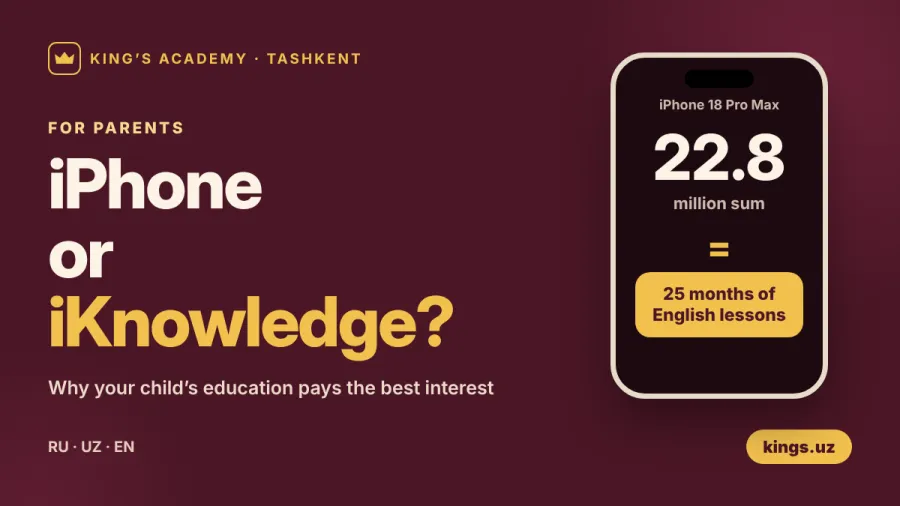
iPhone or iKnowledge? The Best Investment in Your Child
A new iPhone 18 Pro Max costs ~22.8 million sum in Tashkent — two years of English or maths lessons. A personal story about what's really worth investing in.

Typing Speed in CD IELTS: The Overlooked Skill That Costs Band Scores
Why typing speed and accuracy matter in computer-delivered IELTS: Listening, spelling, Writing time. Test your speed in 60 seconds and learn touch typing.

The True Cost of IELTS 7.5 in Tashkent: How to Plan Your Child’s Education Budget for the Next 5–6 Years
How much does IELTS 7.5 really cost in Tashkent? Real 2026 prices, a planned vs last-minute budget, university fees, a 6-year savings plan and English pay data.

How to Write a Strong CV in Uzbekistan: What Employers Look For, 7 CVs That Get Rejected and a Free CV Builder
How to write a strong CV in Uzbekistan: what employers check first, 7 CV mistakes with examples, ready AI prompts and a free online CV builder with PDF.

How IELTS Is Assessed: the 0–9 Band Scale, the Criteria and Your Overall Score
How IELTS is marked: the 0–9 band scale, Listening and Reading scores, Writing and Speaking criteria, how the overall band is rounded and where to check your result. Based on…
Submit a request
Do you want to sign up for classes or become part of our team?
Request submitted
We will contact you within the working day.