


Chess and English: lessons from Sindarov vs Gukesh

In short
On 24 November 2026 at 19:00 Tashkent time, Javokhir Sindarov starts his World Championship match against Gukesh Dommaraju — the first time a player from Uzbekistan has played for the crown. Chess will not make your English better “automatically”, but the two share habits of mind: spotting patterns, planning, learning from mistakes and thinking against the clock. Below: a game against my bot, 20 chess words in English, a puzzle, a quiz and the story of chess in Uzbekistan.
World Championship match · Geneva
Gukesh 0 : 0 Sindarov
Game 1 — 24 November, 19:00 Tashkent time. The score on this page is updated after every game.
Contents
- Sindarov vs Gukesh: the key facts in one table
- What chess and English really have in common
- Play a game against Eldor’s bot
- Chess English: 20 words and phrases
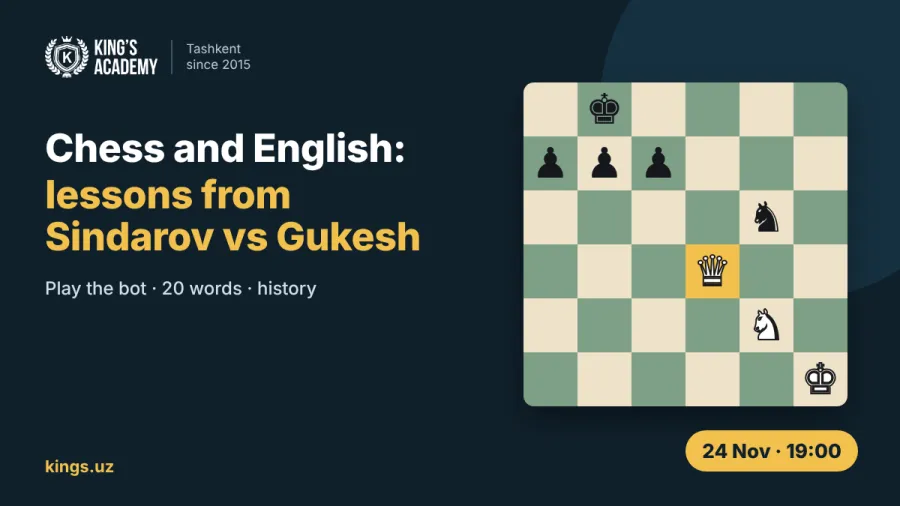
- Puzzle: mate in one
- Chess in Uzbekistan: from Afrasiab to Geneva
- Quiz: chess words in everyday English
- How to support Sindarov and learn English at the same time
I have taught English since 2010, and I play chess as an amateur — my rapid rating is around 1500 at the moment. That is nowhere near grandmaster level, but it is enough to notice something every day: a good move and a good sentence are born in a similar way. First you recognise a familiar picture, then you calculate, then you check yourself. So for me the match in Geneva is not only a national sporting celebration, but also a perfect excuse to talk about how we learn.
Sindarov vs Gukesh: the key facts in one table
The match takes place in Geneva from 24 November to 11 December 2026: up to 14 classical games, and the first player to reach 7.5 points wins. Both players are 20, which makes it the youngest World Championship match in history.
| Item | Details |
|---|---|
| Players | Gukesh Dommaraju (India, reigning champion) vs Javokhir Sindarov (Uzbekistan, winner of the 2026 Candidates Tournament) |
| Venue | Fondation Martin Bodmer, Cologny, Geneva (Switzerland) |
| Start time | 15:00 Central European Time = 19:00 Tashkent time |
| Game days | 24, 25, 26, 28, 29, 30 November; 2, 3, 4, 6, 7, 8, 10, 11 December. Tiebreaks (if 7–7) on 12 December |
| Time control | 120 minutes for 40 moves, then 30 minutes for the rest of the game, plus 30 seconds per move from move 41 |
| Prize fund | USD 2.5 million |
| Head-to-head (classical) | Sindarov: 2 wins, 1 draw, 0 losses |
Data checked: 15 November 2026, from the FIDE regulations and the match schedule.
What chess and English really have in common
The short answer: chess does not train your English directly, but it practises the same habits a language learner needs. Let’s be honest: a large review of 24 studies (Sala and Gobet, 2016) found that chess lessons had a moderate effect on children — stronger in maths than in reading — and in studies with a stricter design the effect becomes much smaller. So I won’t promise that a chess club can replace an English lesson. But I see five parallels every day, both in the classroom and at the board.
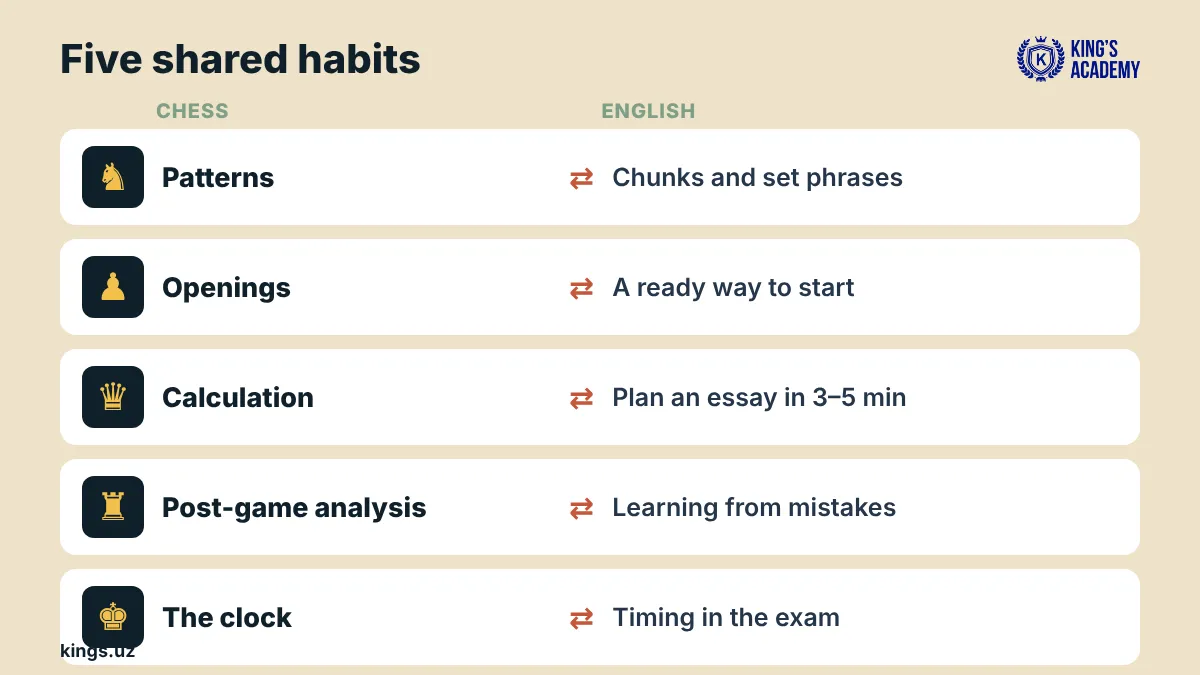
1. Patterns, not single pieces
In the classic study by Chase and Simon (1973), masters rebuilt a position from a real game almost perfectly after seeing it for a few seconds, but with randomly placed pieces their advantage almost disappeared. They remembered familiar groups — “chunks” — not individual pieces. Language works the same way: fluent speakers think in ready-made blocks — take into account, on the other hand, as far as I know. Learn word combinations, not single words.
2. Openings are set phrases
Players often know the first moves by heart and understand them more deeply later. Phrases for starting a conversation, a letter or an essay work the same way: learn a reliable opening first, and the meaning will come with practice.
3. Calculation is planning your answer
A strong player thinks first and moves second. A strong IELTS candidate spends 3–5 minutes planning an essay before writing. An impulsive move and an unplanned paragraph are punished in the same way.
4. Analysing defeats is working on mistakes
Grandmasters learn most from the games they lose. The best students learn from their mistakes — if they write them down and review them. Our guide to 10 common mistakes in English is exactly that kind of “post-game analysis”.
5. The clock
In chess and in exams, time is part of the game. IELTS Reading gives you 60 minutes, and a candidate who cannot manage time loses marks just like a player in time trouble. Practise with a timer — in chess and in English.
Play a game against Eldor’s bot
This is a small bot I made for our readers. The “Warm-up” level plays at roughly 1000 (it sometimes slips, like a real beginner), and “Real Eldor” plays at roughly 1500, like me right now. Choose rapid (10 minutes) or blitz (3+2) and play as many times as you like. After every game you get one English word with an example.
The levels are approximate: this is a simple program, not an official rating. Moves are written in chess notation — a tiny language with its own grammar: Nf3 means “the knight goes to f3”.
Chess English: 20 words and phrases
If you watch the broadcast in English, you will hear these words hundreds of times. The second half of the table shows expressions that have moved into everyday English, the news and business.
| Word or phrase | Meaning | Example |
|---|---|---|
| king / queen / rook | the three most valuable pieces | He traded his rook for a bishop. |
| bishop / knight / pawn | the minor pieces and the foot soldiers | The knight jumps over other pieces. |
| check / checkmate | the king is attacked / attacked with no escape | It’s checkmate in two moves. |
| stalemate | no legal move, no check — a draw | The game ended in stalemate. |
| castle (castling) | the king and rook move together for safety | White castled on the kingside. |
| to resign | to stop and accept defeat | Black resigned after move 41. |
| a draw | nobody wins | The first game was a draw. |
| time trouble | almost no time left on the clock | He blundered in time trouble. |
| a blunder | a very bad mistake | One blunder cost him the game. |
| tiebreak | extra, faster games to decide a winner | The final went to tiebreaks. |
| a pawn in someone’s game | a person used by more powerful people | She felt like a pawn in their game. |
| an opening gambit | a clever first step to gain an advantage | A discount was their opening gambit. |
| endgame | the final stage of something | We are in the endgame of the project. |
| Your move. | now it is your turn to act | I’ve made my offer. Your move. |
| to think several moves ahead | to plan for the future | Good managers think several moves ahead. |
| to keep something in check | to keep it under control | Try to keep your spending in check. |
The table has 16 rows but more than twenty words, because the first rows name two or three pieces each. Save it: when a commentator says “Sindarov castles”, you will know exactly what happened.
Puzzle: mate in one
The most common checkmate in amateur games happens on the back rank. Can you find it in ten seconds?
Chess in Uzbekistan: from Afrasiab to Geneva
In short: some of the oldest known chess pieces were found in Uzbekistan, the first grandmaster from Central Asia came from Tashkent, and in the last five years the country has become one of the strongest chess nations in the world.
Ancient roots
In 1977 archaeologist Yuri Buryakov found seven ivory pieces at the ancient site of Afrasiab in Samarkand. They are dated to roughly the 7th–8th centuries and are considered one of the earliest known chess sets in the world; today they are kept in the Samarkand State Museum. Historians still debate even older figurines from Dalverzintepa, which may belong to a forerunner of chess.
Names to know
Georgy Agzamov from Almalyk became the first grandmaster from Central Asia in 1984. Rustam Kasimdzhanov from Tashkent won the FIDE World Championship in Tripoli in 2004 and later worked as a second for Viswanathan Anand. The new generation includes Nodirbek Abdusattorov (World Rapid Champion 2021), Javokhir Sindarov, Nodirbek Yakubboev, Shamsiddin Vokhidov and Mukhiddin Madaminov.
| Year | Achievement |
|---|---|
| 2022 | Gold at the Chess Olympiad in Chennai (India) |
| 2024 | Bronze at the Olympiad in Budapest |
| November 2025 | Sindarov, 19, becomes the youngest-ever FIDE World Cup winner (Goa) |
| January 2026 | Tata Steel Masters: 1st Abdusattorov, 2nd Sindarov |
| April 2026 | Sindarov wins the Candidates Tournament in Cyprus with a round to spare, unbeaten |
| September 2026 | A second Olympiad gold — at home, at the 46th Olympiad in Samarkand |
| November 2026 | The first World Championship match for a player from Uzbekistan |
Why now: support that works as a system
Results like these do not happen by accident. In 2018 chess began to be introduced into the curriculum of 150 schools as a pilot. On 14 January 2021 President Shavkat Mirziyoyev signed a decree on developing and popularising chess: the “Chess at School” project, new chess schools and clubs, and the goal of entering the top ten countries in the FIDE rankings. A reward system for medal winners and preparations for the 2026 Olympiad in Samarkand followed. In April 2026 the President personally presented Sindarov with a state award, and in September FIDE named the Uzbekistan Chess Federation its best federation; a dedicated support system for women’s chess and para-chess was also announced.
The Youth Affairs Agency and its director Alisher Sadullayev deserve a special mention: after the 2022 Olympiad gold, the free UzChess platform appeared with lessons in Uzbek, and more than half a million users registered in its first year. Chess is now open to a child in any district of the country, not only to those near a club in the capital.
As a teacher, one idea matters most to me here: talent was always there, but a system — schools, coaches, tournaments and access to knowledge — turns talent into results. The same is true of English.
Quiz: chess words in everyday English
Five quick questions on the expressions from the table above.
How to support Sindarov and learn English at the same time
Games start at 19:00 Tashkent time and last several hours — that is 14 evenings of ready-made listening practice. A simple plan:
- Watch the English broadcast, at least the first 20 minutes: commentators explain ideas in simple words and repeat the same expressions.
- Write down 5 phrases each evening — for example, “he’s under pressure”, “a bold decision”.
- Write a 50-word report in English: who had White, who was better and how it ended. That is a mini-essay with real content.
- Speak for one minute: “Who do you think will win and why?” — perfect practice for IELTS Speaking Part 3.
- Don’t chase perfection. If speaking scares you, read our article on being afraid to speak English, and for a daily routine see 5 habits for learning on your own.
If you are preparing for an exam, keep our tool to check your IELTS results online close at hand for results day.
Your next move
At King’s Academy we teach English in small groups, with printed books and a clear plan — the way a good coach prepares a chess player. Find a course in a minute with the course finder or see the group timetable. The first lesson is free.
Frequently asked questions
When does the Sindarov vs Gukesh match start?
Game 1 is on 24 November 2026 at 15:00 Central European Time, which is 19:00 in Tashkent. The last classical game is scheduled for 11 December, with tiebreaks on 12 December if the score is 7–7.
How many games are there and how is the winner decided?
Up to 14 classical games. The first player to reach 7.5 points wins. At 7–7 there are tiebreaks: rapid games first, then faster ones.
Does chess really help you learn English?
Research does not show direct “transfer”: the effect of chess on school skills is moderate and shrinks in stricter experiments. But chess trains useful study habits — recognising patterns, planning, analysing mistakes and working against the clock.
Where were the oldest chess pieces found?
Some of the earliest known pieces were found in 1977 at Afrasiab in Samarkand: seven ivory pieces dated to roughly the 7th–8th centuries. They are kept in the Samarkand State Museum.
Who was Uzbekistan’s first grandmaster?
Georgy Agzamov, who earned the title in 1984, was the first grandmaster from Central Asia. Rustam Kasimdzhanov became FIDE World Champion in 2004.
How strong is the bot in this article?
It has two levels: roughly 1000 and roughly 1500. These are guides, not official ratings; the bot makes the occasional mistake on purpose to keep games lively.
Sources: FIDE — 2026 match regulations; FIDE — Presidential decree of Uzbekistan (2021); Sala & Gobet (2016), Educational Research Review; Chase & Simon (1973), Cognitive Psychology; ChessBase — the Afrasiab pieces; FIDE — 2025 World Cup; Kun.uz — state award; gov.uz — 2026 Olympiad; Daryo — the President meets the national team.
Author: Eldor Sattorov — founder and director of King’s Academy, MA TESL (Webster University), CELTA, former IELTS Speaking examiner, amateur chess player (rapid ≈1500).
What's next?
Take the first step — it's free or takes 2 minutes:
Other articles
Daily useful articles
How to Choose a Learning Centre for Your Child in Tashkent: An Honest Guide for Parents
How to choose a learning centre for your child in Tashkent: 10 questions to ask any centre, red flags, and why an app can't replace a teacher.

Private Schools in Tashkent 2026/27: Fees, Curricula, Admission
What private schools in Tashkent cost in 2026/27: a verified table of 11 schools with fees, curricula, languages, districts, admission and a school finder.

Study abroad on a scholarship: which English certificate 6 top programmes ask for
El-yurt umidi, Chevening, GKS, MEXT, Türkiye Bursları, Stipendium Hungaricum: what IELTS you need, who sets the bar, and a backwards plan.

University Tuition in Tashkent 2026/27: Contract Fees and True Cost
State university contract fees in Tashkent for 2026/27: price table, super-contract, stipends, the 14% education loan and a true-cost calculator.

Milliy Sertifikat (CEFR) or IELTS: Which One Should You Take?
Milliy sertifikat (CEFR) or IELTS? Price, recognition, scores for university admission and validity compared — plus 5 real situations and which exam to take in each.

Presidential Schools in Uzbekistan: How to Prepare Your Child for the Entrance Exam Without Burnout (2027 Guide)
Presidential Schools admission explained by a former vice-principal: who can apply, both exam stages, 2026 dates and scores, and a calm 12-month study plan.
Submit a request
Do you want to sign up for classes or become part of our team?
Request submitted
We will contact you within the working day.