


First-Grade Enrolment in Tashkent 2027: How to Apply on my.gov.uz
 Author: Eldor Sattorov⏱ 14 min read
In short
In Uzbekistan a child enters first grade in the year they turn seven, so children born in 2020 start in September 2027. Parents apply online on my.gov.uz or my.maktab.uz: 20 June to 31 July for the catchment school, 1 to 31 August for another school with free places. The service is free. The 2027 order is not out yet; the dates come from the regulation in force.
In this article
- What age do children start school in Uzbekistan?
- Dates: how 2026 went and what is known for 2027
- Catchment area: how to find your school
- Language of instruction
- Age checker and checklist (interactive)
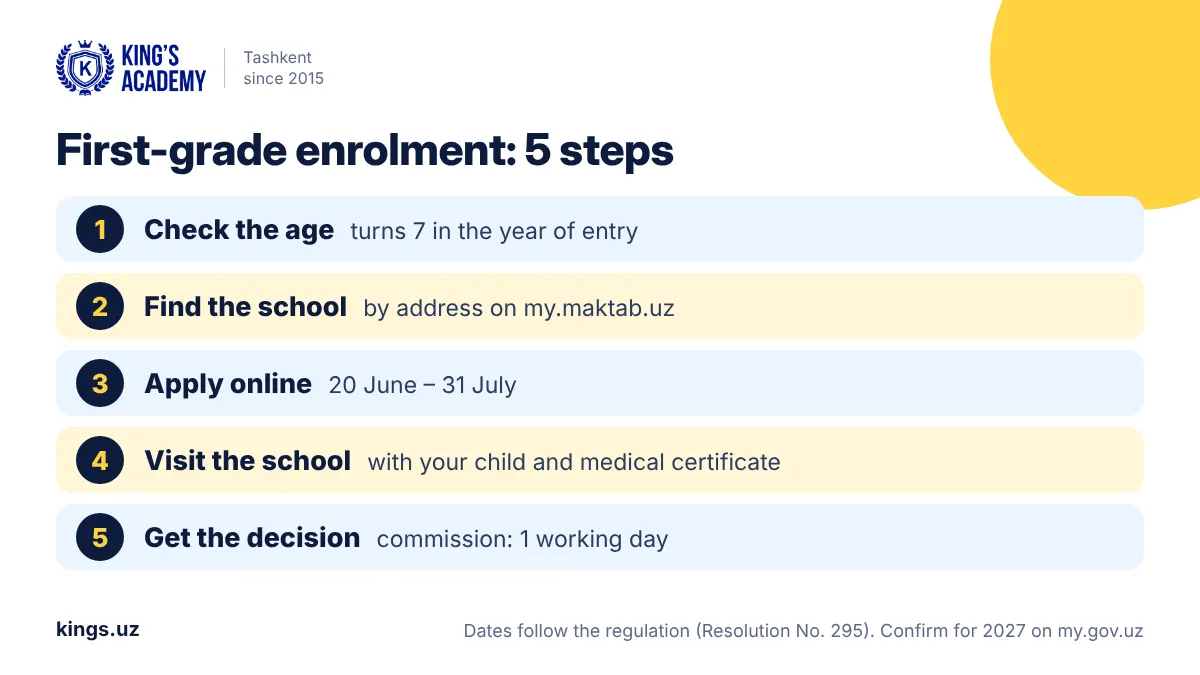
- How to apply on my.gov.uz: 6 steps
- Which documents you need
- If the school is full or you are refused
- Private schools and children of foreign citizens
- Is your child ready for school?
- Common mistakes
Every June the same question fills parents’ chats in Tashkent: “She is six and a half. Will they take her?” The second one follows quickly: “We live in Yunusobod but are registered in Chilonzor. Which school do we apply to?”
Both answers are written in the law and in the regulation for the state service, so there is no need to rely on rumours. This guide covers the whole path: age, dates, catchment area, the application on my.gov.uz and calm preparation for your child. Every rule was checked against the original documents on 13 November 2026.
What age do children start school in Uzbekistan?
In the year they turn seven. Article 9 of the Law “On Education” says that children are admitted to the first grade of a general secondary school in the year they reach the age of seven. The admission regulation repeats the same rule.
What counts is the calendar year, not 1 September. A child born on 30 December 2020 starts school in September 2027, aged six years and eight months. A child born on 2 January 2021 starts a year later.
For 2026/27 the ministry put it this way: children born on or before 31 December 2019 are admitted. For 2027/28 the same rule gives 31 December 2020, but the official order has not been published yet.
| Year of birth | Turns seven | First grade |
|---|---|---|
| 2019 | in 2026 | September 2026 (confirmed by the ministry) |
| 2020 | in 2027 | September 2027 (by law; order pending) |
| 2021 | in 2028 | September 2028 |
| 2022 | in 2029 | September 2029 |
Can a six-year-old be admitted?
Yes, if the child turns seven during the year of entry: on 1 September they may still be six. If the seventh birthday falls in the following year, the law does not provide for admission. The regulation has no exception for children who are “very ready”, and the age rule applies to private schools too.
For children aged six to seven the law provides for one compulsory year of preparation for school. Presidential Decree No. PF-19 of 5 February 2026 calls this year the first stage of compulsory general secondary education; from 2027/28, children who complete it receive an electronic certificate. The decree does not say whether that certificate is needed for first-grade enrolment, so ask the school.
Dates: how 2026 went and what is known for 2027
In 2026 applications were accepted from 20 June to 31 August, in two stages. These dates are not one-off: they are written into the administrative regulation approved by Cabinet of Ministers Resolution No. 295 of 1 June 2022 (as amended in 2025–2026) with the words “each year”.
| Stage | 2026/27 (what happened) | 2027/28 (by the regulation) |
|---|---|---|
| List of districts with online admission | 135 districts and cities, 5,690 schools | approved by the ministry by 1 May |
| Schools enter admission plan and catchment addresses | by 1 June | by 1 June |
| Admission within the catchment area | 20 June – 31 July | 20 June – 31 July |
| Admission outside the catchment area (free places) | 1–31 August | 1–31 August |
| Decision of the school admission commission | 1 working day | 1 working day |
Data checked: 13 November 2026. Dates and rules change: the ministry’s order for 2027/28 had not been published on that date. Before applying, confirm the dates on my.gov.uz, my.maktab.uz or at the school. The gov.uz advice page still shows the second stage as 1–15 August; the current text of the regulation says 1–31 August.
A few figures from 2026. According to ministry data reported by Ta’lim xabarlari, 600,065 children had been admitted to first grade by 20 July, 322,944 of them through online applications. In Tashkent city 32,293 children had been admitted by that date. In the capital, admission was fully online.
Catchment area: how to find your school
The catchment area (mikrohudud, or “micro-district”) is the territory attached to a school by a decision of the district or city hokimiyat: specific mahallas, streets and houses. A child whose family is registered at a place of residence in that territory and actually lives there must be admitted by that school.
You can find your school on my.maktab.uz in the school search: choose the district, mahalla, street, house number and language of instruction. When you apply, the school is filled in automatically from the applicant’s registered address.
Three situations that confuse parents most:
- You do not live where you are registered. The system takes the address from the state database. If it differs from what you enter, the regulation sends you to the migration and citizenship office to correct the record.
- Registration at a place of stay (temporary). These children are admitted to free places from 1 August.
- The address cannot be found. According to the ministry, if the home has no cadastral record, the online application is made from 1 August. The district department of preschool and school education and the my.maktab.uz call centre (+998 71 203-07-04) can help.
The regulation gives no priority to brothers and sisters of current pupils. If your older child attends a school outside your catchment area, the younger one applies there on the general terms in August.
Language of instruction: your choice and what is checked
Parents choose the language of instruction themselves, in the application form. If the catchment school has no class in that language, the system attaches the nearest school that does.
In classes taught in a language other than the state language, including Russian, the admission commission talks to the child to see whether they have basic speaking skills in the chosen language. It is not an exam: reading and counting are not required for entry. The ministry publishes the questionnaire for this conversation, and each school must display it by 20 June.
Check your child’s age and build your checklist
The checker applies one rule from the law: the year in which the child turns seven. Below it is an eight-step checklist.
Age checker and first-grade enrolment checklist
Choose your child’s date of birth and tap “Check”.
Checklist: documents and steps
Tick what is already done. Nothing is saved: this is just a reminder list.
Official service: first-grade application on my.gov.uz (the portal is in Uzbek and Russian).
The rule without the calculator: children who turn seven in 2027 (born in 2020) start first grade in September 2027. Children born in 2021 start in September 2028.
How to apply on my.gov.uz: 6 steps
- Log in. The service on the single portal is the first-grade school application. Login to my.gov.uz goes through the OneID identification system; the same application can be made on my.maktab.uz. Test your login in advance, not on 20 June.
- State your relationship to the child. If the applicant is not a parent, a document proving legal representation is attached.
- Check your details and address. They are pulled from state databases automatically.
- Enter the child’s details and choose the language of instruction. The catchment school is set automatically. Check everything and confirm the form.
- Wait for the review. The regional department reviews the form within three working days and either forwards it to the school or returns it with a reason.
- Go to the school. At the time given in the online queue, come with your child and the medical certificate. The commission decides within one working day and notifies you through the portal the same day.
You cannot apply to two schools at once: one catchment school in the first stage, and another school with free places in August (ministry explanation reported by UzA, 17 June 2026). The service is free of charge.
Which documents you need
Online, the form replaces almost everything: passport data, PINFL and the birth certificate details are entered in it. You bring one paper to the school: a medical certificate on the child’s health.
According to Tashkent’s chief paediatrician (published June 2025), the school needs medical form 026 and vaccination form 063. For children who did not attend kindergarten, the specialist check-ups take time, so it is better to start in spring. Confirm the exact list at your family polyclinic.
Where online admission has not been introduced, documents are handed in at the school: an application to the principal, a medical certificate and four colour photos, 3.5 × 4.5 cm, as listed on the gov.uz advice page. This did not apply to Tashkent in 2026.
What if the school is full or you are refused?
Your catchment school cannot refuse because it is short of places. The regulation names only three grounds for refusal:
- the medical certificate does not recommend study in a general school;
- the child has no basic speaking skills in the chosen language of instruction;
- the form contains incorrect information.
Right after this list the document says that refusal in any other case is not allowed. A refusal comes with its reason. You fix the problem and apply again, quoting the number of the earlier application.
A school outside your catchment area is different. It takes children only into free places, and an over-full school may not take outside children at all. If that school refuses, or you miss your queue slot, the child is assigned to the catchment school. No child is left without a place.
If you believe a refusal is unlawful, officials’ actions can be appealed in the manner set by law. In practice parents start with the district department of preschool and school education. A transfer to another school is also possible later: transfers run from 1 August to 25 May, if the class has places.
Private schools and children of foreign citizens
The my.gov.uz procedure covers only state schools in the ministry’s system. Private schools enrol on their own: their own dates, a contract and often an interview. The age rule in the law applies to them as well. See our guides Private schools in Tashkent 2026/27 and Private or state school.
For children of foreign citizens and stateless persons there is a separate free service. The application is made through my.gov.uz, my.maktab.uz or a public service centre between 1 August and 25 May. A commission of the regional education department reviews it within seven days and issues a referral to a school. For first grade a medical certificate is required; a transcript of grades and its translation are not.
Is your child ready for school? What really matters
State schools admit children without selection and regardless of their level of preparation. Nobody measures reading speed at enrolment, and there is no need to chase it.
UNICEF’s paper School Readiness: a conceptual framework (2012) describes a child’s readiness through five areas: physical well-being and motor development, social and emotional development, approaches to learning, language, and cognition and general knowledge, including mathematics. It adds two sides that are easy to forget: ready schools and ready families.
A study by Duncan and colleagues across six longitudinal data sets (Developmental Psychology, 2007) found that later achievement was best predicted by early maths concepts, then reading skills and the ability to pay attention. That means basic ideas and attention, not words per minute.
What helps by September
- Attention. Staying with one task for 15–20 minutes and listening to an instruction to the end.
- Self-care. Getting dressed, fastening shoes, packing a bag, using the toilet, asking an adult for help.
- Fine motor skills. Holding a pencil, cutting with scissors, modelling, colouring.
- Speaking. Telling what happened in full sentences, asking a question, knowing their own name, surname and address.
- Counting and quantity. Counting objects, comparing more and less, knowing the digits.
A calm plan until September
- Winter and spring. Reading aloud every day, board games with rules, modelling and drawing, counting in daily life: steps, apples, change in a shop.
- April – May. The polyclinic and the certificate. A walk to the school so the route feels familiar.
- June – July. The application. The daily routine moves gradually towards school hours.
- August. A backpack and uniform the child chooses and packs. Waking up by the alarm two weeks before the first day.
For most children the first weeks bring tiredness and tears over small things. That is adaptation, not a sign that the child “cannot cope”. Early bedtime, free time after lessons and the question “what was interesting today?” instead of “what mark did you get?” all help. Clubs are better added from the second term.
If you want group lessons, any calm preparation without a race for results will do. King’s Academy has a school-readiness course, Pochemuchka, and English for Kids aged 6–12; on when to start a language, see What age should a child start learning English? A first-grader needs no English certificates: those come much later, for university entry, and that is when our IELTS results check page becomes useful.
Common mistakes parents make
- Waiting for the order and not preparing. The certificate and a registration-address problem cannot be solved in one June day.
- Counting on a school outside the catchment area. Places there appear only in August and are not guaranteed. The fallback is always the school for your address.
- Entering inaccurate data. Incorrect information in the form is a lawful ground for refusal.
- Sending a child early. A child who turns seven only next year is not admitted to first grade, in a state or a private school.
- Measuring readiness by reading. A school needs a child who can listen, wait for a turn and ask for help. On choosing extra lessons without overload, see How to choose a learning centre for your child.
School readiness and English, without the rush
King’s Academy teaches in groups of up to 10, with printed books and close contact with parents. The first trial lesson is free. See the timetable or use the course finder.
Frequently asked questions
When does first-grade enrolment start in 2027?
Under the regulation in force, catchment-area applications are accepted each year from 20 June to 31 July, and applications outside the catchment area from 1 to 31 August. The ministry’s order for 2027/28 had not been published as of 13 November 2026, so confirm the dates in spring.
At what age does a child start school in Uzbekistan?
Children are admitted to first grade in the year they turn seven (Article 9 of the Law “On Education”). In September 2027 that means children born in 2020.
How much does first-grade enrolment through my.gov.uz cost?
Nothing. The regulation states that no fee is charged for this state service.
Can I enrol my child in a school outside our registered address?
Yes, but only in the second stage, from 1 to 31 August, and only if the chosen school has free places. If it has none, the child is assigned to the catchment school.
Is there an entrance exam for first grade?
No. State schools admit children without selection and regardless of preparation. The one exception: for classes taught in a language other than the state language, the commission checks basic speaking skills.
Can the catchment school refuse my child?
Only on three grounds: the medical certificate does not recommend a general school, the child has no basic speaking skills in the chosen language, or the form contains incorrect information. Refusal in other cases is not allowed.
How do expats enrol a child in a state school in Tashkent?
Through a separate free service on my.gov.uz, my.maktab.uz or at a public service centre, from 1 August to 25 May. A commission of the regional education department reviews the application within seven days.
Sources: lex.uz — Law “On Education”, Articles 8 and 9 · lex.uz — Cabinet of Ministers Resolution No. 295 of 01.06.2022, first-grade admission regulation · lex.uz — Presidential Decree No. PF-19 of 05.02.2026 · my.gov.uz — first-grade application service · my.maktab.uz — ministry portal · gov.uz — school admission advice page · UNICEF — School Readiness: a conceptual framework · ERIC — Duncan et al., 2007. 2026 admission statistics: ministry statements reported by Ta’lim xabarlari and UzA.
Author: Eldor Sattorov — founder and director of King’s Academy, MA TESL, CELTA, former Vice-Principal of a Presidential School in Tashkent.
What's next?
Take the first step — it's free or takes 2 minutes:
Other articles
Daily useful articles

Learning English After 30: Not Too Late, Right on Time
Think it’s too late to learn English after 30? Science says no. 6 reasons to start, common adult fears, and evening, online and company groups.

WIUT Academic Lyceum in Tashkent: How to Prepare for the Entrance Exam Without Burnout (2027 Guide)
WIUT Academic Lyceum admission in Tashkent: 2026 places, dates and tests, English certificate rules and a calm 6-month maths and English plan for Grade 9.

IELTS Myths Busted on Kun.uz: Eldor Sattorov and the British Council
On Kun.uz, Eldor Sattorov (King’s Academy) and Andrey Maksakov (British Council) explain how IELTS works and bust common myths. Watch the interview.

IELTS 9.0: how to get it, and do you even need it? An honest guide
The "niner" craze in Uzbekistan: do you need IELTS 9.0 for university, how parents can help without pressure, and a realistic roadmap to 9.0.

How to Write a Strong CV in Uzbekistan: What Employers Look For, 7 CVs That Get Rejected and a Free CV Builder
How to write a strong CV in Uzbekistan: what employers check first, 7 CV mistakes with examples, ready AI prompts and a free online CV builder with PDF.

Private Schools in Tashkent 2026/27: Fees, Curricula, Admission
What private schools in Tashkent cost in 2026/27: a verified table of 11 schools with fees, curricula, languages, districts, admission and a school finder.
Submit a request
Do you want to sign up for classes or become part of our team?
Request submitted
We will contact you within the working day.