


What Age Should Your Child Start Learning English? An Age-by-Age Guide from 3 to 12

In short
There’s no perfect age to start English: every age has its own strengths. At 3–5, songs and games at home for 5–10 minutes are enough. From 6, children are ready for group classes, and at 9–12 reading, writing and grammar come in. Regular practice, a real teacher and your child’s own interest matter more than age.
A normal weekday evening at our reception desk. The mother of a four-year-old boy asks, “Isn’t it too early for us?” Ten minutes later, the father of an eleven-year-old girl asks almost the same thing the other way round: “Have we left it too late?” We have conversations like this every week, and the answer for both parents is the same: it’s neither too early nor too late. You just need to teach differently at each age.
This guide explains what children can really do at 4, 7 or 11, how to tell if your child is ready for a group, and how to help at home even if you don’t speak English yourself.
The “earlier is always better” myth
Many parents believe that if you don’t start at three, the “window” closes. In reality it’s not that strict. British Council experts say plainly that there’s no certain ideal age, and each age has its own strengths (British Council). Little ones copy sounds easily and aren’t afraid of mistakes. Older children understand faster how the language works and can concentrate for longer.
An early start only helps if lessons are regular, enjoyable and frequent enough. One “lesson” a month at age three won’t do much; live classes three times a week from age seven will.
What works at each age
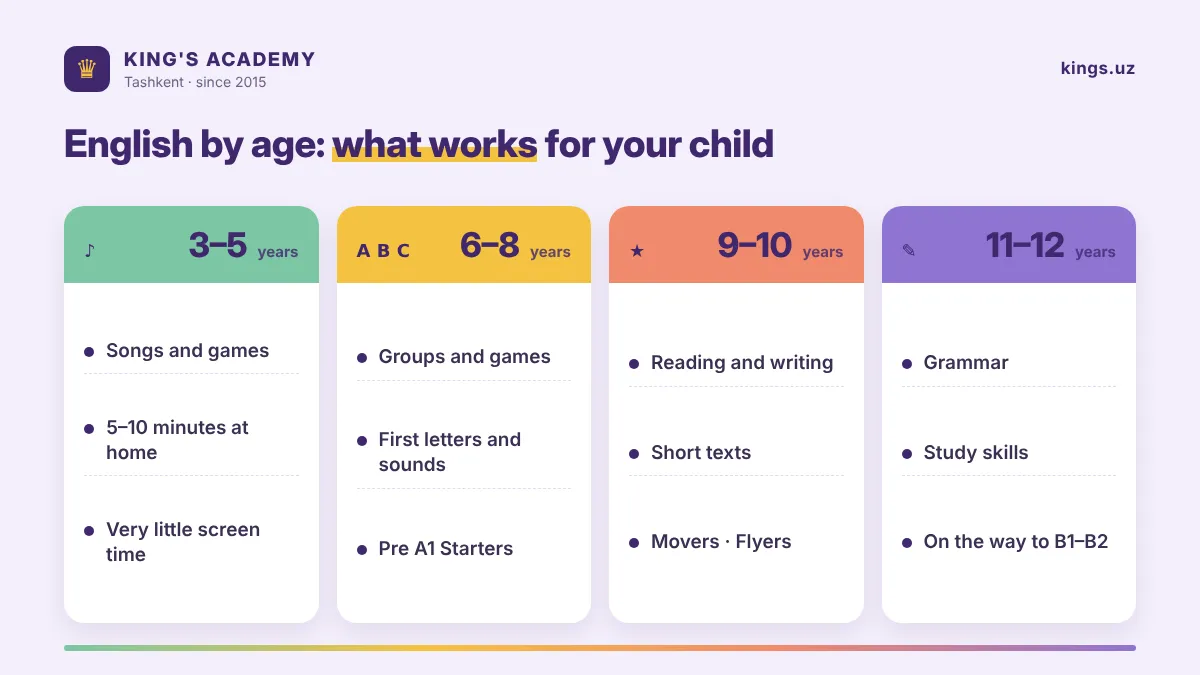
Ages 3–5: play, not lessons
At this age, English means songs, counting rhymes, picture cards with animals and colours, and simple cartoons. The goal isn’t to learn words for a grade but to make friends with the language. Keep it short: Cambridge suggests that 3–10 minutes at a time is enough for young children (Cambridge English).
Be careful with screens. The World Health Organization recommends no more than one hour of sedentary screen time a day for children aged 2–4, and less is better (WHO). An English song you sing together does more good than an hour of videos.
Ages 6–8: the best time for a group
Your child can now sit through a class, listen to the teacher and play by the rules. They’re starting to read in their own language, so they’re ready for their first English letters and sounds. Games, movement, stories and talking with other children work best. At this age, grammar isn’t explained with rules; children pick it up through phrases and situations.
A useful target at this stage is Cambridge’s children’s levels, such as Pre A1 Starters, which are linked to the international CEFR scale (Cambridge English).
Ages 9–10: reading and writing
Children start to enjoy books and stories and can write short texts about themselves and their family. You can gently explain why we say things one way and not another. Good goals are A1 Movers and A2 Flyers.
Ages 11–12: language becomes a tool
Pre-teens think more analytically and compare English with their own language. Grammar and study skills now become useful: how to take notes, how to plan time. If your child is only starting now, it isn’t too late: pre-teens have their own advantages, as they can study consciously and set their own goals. After that come B1, B2 and, if needed, CEFR or IELTS.
5 signs your child is ready for group classes
- They can focus on one activity for 20–30 minutes without getting distracted every minute.
- They stay calm without you in a new place.
- They play with other children by the rules.
- They know their letters or are starting to read in their own language.
- They show interest themselves: they repeat English words or ask, “How do you say this in English?”
If only two or three of these fit so far, don’t worry. Start at home with games and songs, and join a group a few months later.
How to help at home, even if you don’t speak English
- Praise the effort, not only the result. Children feel safer making mistakes at home than in class.
- Keep it short but daily. Ten minutes every day beats an hour on Sunday.
- Don’t correct head-on. If your child says “I goed”, just repeat it correctly: “Yes, you went!” The British Council recommends this too.
- Don’t give the answer straight away. Give them time to think, then check a dictionary or the textbook together.
- Don’t worry about your accent. Your child doesn’t need to copy your pronunciation, and your enthusiasm is catching.
To read more about why a real teacher and a printed book work better than apps, see Screens don’t teach. Teachers and books do.
English for Kids at King’s Academy
For children aged 6–12, we run our English for Kids course. Here’s how it works:
- Levels from A1 to B1, so your child grows with the course.
- Oxford Family & Friends books: printed books and notebooks, not just a screen.
- 3 lessons a week, 90 minutes each, in the morning, afternoon or evening, to fit around school.
- Small groups of up to 10 children, so the teacher knows every child.
- Games and real conversation instead of cramming: the main thing is that your child isn’t afraid to speak.
- Contact with parents: the teacher and the office keep you updated on how things are going.
We also have a library and study area, where children come to do homework, read and play board games in English. Our branches are in Alayskiy (Yunusobod, Kashgar, near Abdulla Qodiriy metro), at Buyuk Ipak Yuli 77, and in Sayram (Yunusobod-19).
And when your child grows up and reaches international exams, they’ll be able to check their IELTS scores on our Check your IELTS results page.
Come to a free trial lesson
See how your child learns and meet the teacher. Details are on the English for Kids course page. Group times are on the schedule, and fees are on the prices page.
Frequently asked questions
Won’t my child get confused with three languages?
No. Children in Tashkent often grow up with Uzbek and Russian, and a third language doesn’t get in the way. Cambridge suggests simply keeping separate times, for example English in class and for 10 minutes in the evening. Temporary “steps back” are normal and pass on their own.
How many times a week should my child study?
For visible progress, regularly: 2–3 times a week with a teacher, plus short practice at home. Long, rare lessons work worse than frequent ones.
When will my child start speaking?
First phrases about themselves usually appear after a few months of regular classes. Understanding always comes before speaking: first your child understands, then starts to answer.
We don’t speak English ourselves. Can we still help?
Yes. Your job isn’t to teach but to support: praise, ask what happened in class and keep things regular. The teacher will take care of the language.
Can we start with apps instead of a course?
As an extra, yes, but not for long. WHO advises no more than one hour of screen time a day for children aged 2–4. Children learn to speak with a real person.
Group or one-to-one lessons?
For children under 12, a small group is usually better: they play, talk and learn from each other. One-to-one lessons are good when a child needs to catch up or prepare for a specific exam.
Sources: British Council — When children start learning languages · Cambridge English — How parents can support English language learning · WHO — Guidelines for children under 5 · Cambridge English — Qualifications for young learners
What's next?
Take the first step — it's free or takes 2 minutes:
Other articles
Daily useful articles

How to Choose the Best IELTS Learning Centre in Tashkent: 5 Criteria to Look For
How to choose an IELTS centre in Tashkent: 5 criteria to check — teachers, mock exams, feedback, student support and real results, not just ads.

IELTS Writing Task 1 Line Graph: Write a Band 7 Overview and Never Misread a Number
IELTS Writing Task 1 line graph: the 4-paragraph plan, a 2-sentence overview formula, the margin check for numbers, trend verbs and a Band 7.5+ sample.

Computer-Delivered IELTS: How the Exam Works
How CD IELTS works in Tashkent: the screen layout, notes, word counter, the typing speed you need and how it differs from paper-based IELTS.

How IELTS Is Assessed: the 0–9 Band Scale, the Criteria and Your Overall Score
How IELTS is marked: the 0–9 band scale, Listening and Reading scores, Writing and Speaking criteria, how the overall band is rounded and where to check your result. Based on…

Tutors, Burnout and Your Child: How Many Extra Classes Are Too Many in Tashkent? A Parent’s Guide
How many tutors is too many? A Tashkent educator on burnout, sleep, realistic IELTS timelines and 8 checks to see if your child’s English course really works.
IDP or British Council: Where Is IELTS “Easier”? 9 Myths and One Inconvenient Truth
IDP or British Council — where is IELTS easier and the score higher? We check 9 popular myths (Speaking, “nines”, winter vs summer) against official IELTS sources and explain how…
Submit a request
Do you want to sign up for classes or become part of our team?
Request submitted
We will contact you within the working day.