


Uzbekistan University Entrance Test 2027 (DTM): Format, Scores, Plan
 Author: Eldor Sattorov⏱ 13 min read
In short
The entrance test for state universities in Uzbekistan (still widely called the DTM) had 5 subjects and 90 questions in 2026, with a maximum of 189 points and 180 minutes to finish. Under the regulation, registration runs every year from 5 to 25 June; the 2026 tests were held on 14–23 July. As of 13 November 2026 the rules for 2027 have not been approved.
In this article
- What is already known about the 2027 test
- Test format: subjects, questions, points
- Calendar: how 2026 admission ran
- How many points do you need for a grant?
- Which certificates replace a subject test
- Score calculator and mini-quiz
- A preparation plan from November
- Registration and test day, step by step
- Private and foreign universities
- Common mistakes
- Frequently asked questions
It is November of Year 11. School tests have started, the chemistry tutor is booked every evening, and at home the argument goes round again: add maths as well, sit a certificate exam, will there be enough time?
In most Tashkent families that conversation starts with the same question: what is actually on the test? The answer is simpler than it seems. The format has stayed the same for several years, and the official documents are public.
Everything below comes from the admission regulation and official announcements. Where nothing has been published for 2027 yet, the text says so.
What is already known about the 2027 test
As of 13 November 2026 there are no official parameters for 2027/2028 admission: the subject sets, the number of questions and the test dates have not been approved. That is normal. In the last cycle they were announced in February and March.
The tests are run by the Agency for Assessment of Knowledge and Skills (the former State Testing Centre, which is where the name “DTM” comes from). The procedure is set by the regulation approved by Cabinet of Ministers Resolution No. 578 of 13 September 2025 (in Uzbek). It fixes the things that do not depend on the year: registration from 5 to 25 June, the “test first, then choice” model, and up to five programmes at the second stage.
One possible change is worth keeping in mind. At a press conference on 18 August 2026 the Deputy Minister of Higher Education said the way maximum points are awarded for certificates is under review, according to Kun.uz. No decision has been announced. Admission news appears on the agency’s site uzbmb.uz, on its gov.uz page and in the my.uzbmb.uz personal account.
Test format: subjects, questions, points
In 2026 admission an applicant answered 90 questions in five subjects and could score at most 189 points. The Ministry of Higher Education, Science and Innovation approved these parameters by order in March 2026, and they were the same as in 2025 (as reported by Spot.uz, citing the ministry).
| Block | Subjects | Questions | Points per answer | Maximum |
|---|---|---|---|---|
| Compulsory | Native language (Uzbek, Russian or Karakalpak), mathematics, history of Uzbekistan | 30 (10 each) | 1.1 | 33 |
| First specialised | Set by the programme’s subject set | 30 | 3.1 | 93 |
| Second specialised | Set by the programme’s subject set | 30 | 2.1 | 63 |
| Total | 5 subjects | 90 | — | 189 |
Data checked: 13 November 2026. The table describes 2026 admission. Check the 2027 parameters against the official announcement: dates and rules change.
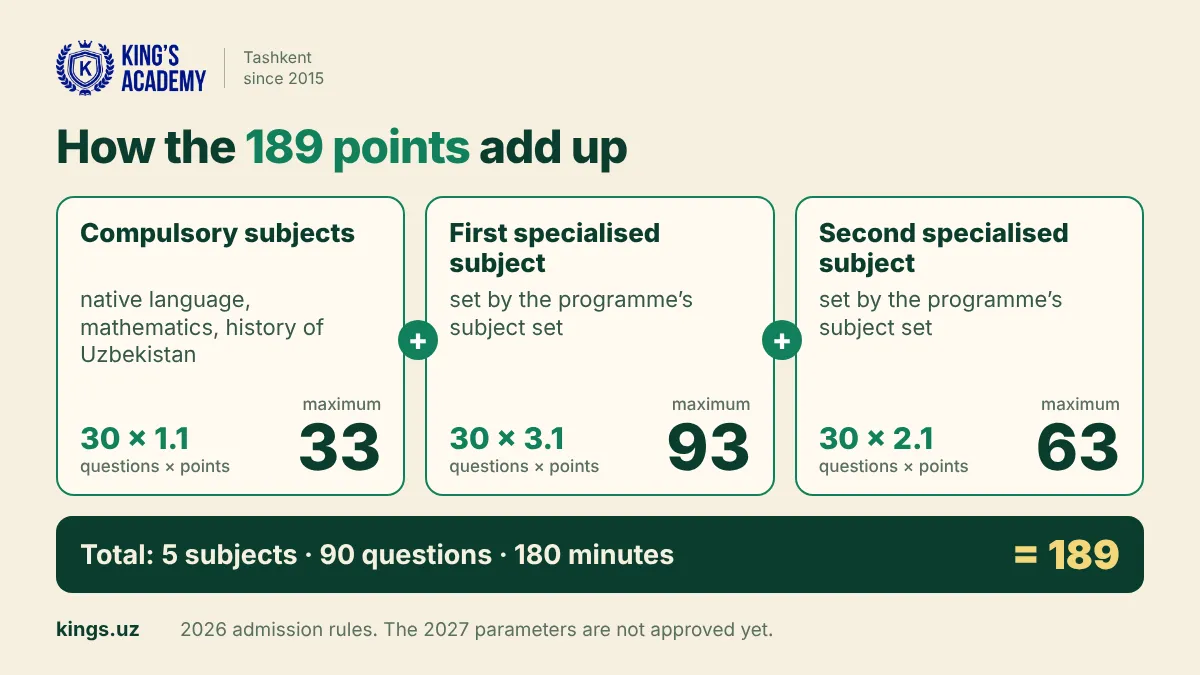
In 2026 applicants had 180 minutes for the whole test, and that includes filling in the answer sheet (according to Oliygoh.uz, citing the admission rules). If some subjects are covered by a certificate, the time is reduced.
The main lesson from the table: the specialised subjects carry 156 of the 189 points, more than 82%. One correct answer in the first specialised subject weighs almost as much as three answers in the compulsory block.
Which two subjects you sit depends on the subject set of the programme you choose. The sets for 2026 were approved in February; the 2027 list will be published separately. Programmes with a creative or professional exam follow their own rules.
Calendar: how 2026 admission ran
There are no exact dates for 2027 yet, so last year’s calendar is the best guide. The middle column shows what happened in 2026; the right one shows what already follows from the regulation.
| Stage | 2026 admission (actual) | What is known for 2027 |
|---|---|---|
| Subject sets | Approved in February 2026 | Not announced |
| Question counts and criteria | Ministry order, March 2026 | Not announced |
| Registration, stage 1 | 5–25 June | 5–25 June under the regulation, every year |
| Admission permits | From 8 July in my.uzbmb.uz | Not announced |
| Tests | 14–23 July, two shifts: 08:00 and 15:00 | Not announced; usually July–August under the regulation |
| Test scores | The day after the test | Same rule |
| Choosing a university, stage 2 | 25 July – 8 August | 15 days after the tests end |
| Final results (mandat) | 15 August | Within a week after stage 2 |
A few figures for scale. In 2026, 677.9 thousand people registered, 389.1 thousand qualified for the selection round, and about 13 thousand were exempted from the test because of their certificates, according to the Ministry of Higher Education (in Uzbek).
How many points do you need for a grant?
There is no single passing score for a state grant. Each university, programme, language of instruction and study form has its own, and it forms anew every year. Grant places are filled first, from the highest score down; then contract (fee-paying) places are filled within the quota.
There is a floor. In 2026 it was 56.7 points, or 30% of the maximum, and 233,935 applicants (37.54%) scored below it. The national average passing score in 2026 was 134.6 for a grant and 93.7 for a contract place; a year earlier it was 121.8 and 84.9 (ministry press conference, as reported by Kun.uz). An average is not a promise: popular programmes sit well above it and others below.
Look up last year’s passing score for a specific programme on mandat.uzbmb.uz, which has a search by university, programme, language and study form. If you miss the grant, a contract place remains; we covered the costs in our guide to university contract fees in Tashkent.
Which certificates replace a subject test
A certificate lets you skip a subject and receive its points in advance. The rules below applied in 2026 admission. They may change, so check them against the regulation before you register.
| Certificate | What it gives | Note |
|---|---|---|
| National certificate in a school subject, A+ or A | Maximum for the specialised subject (93 or 63) plus 11 points for the same compulsory subject | Valid for 3 years |
| National certificate, B+, B, C+ or C | Points by the percentage on the certificate (70.77% to 98.46% of the maximum) plus 11 points for the same compulsory subject | You may decline it and sit the test |
| Foreign language, B2 and above | Maximum: 93 or 63 points | The agency’s list includes IELTS 5.5+, TOEFL iBT 72+, Cambridge, Linguaskill, iTEP |
| Foreign language, B1 | 75% of the maximum: 69.75 or 47.25 points | Programmes with a foreign language admit only with a certificate of B1 or higher |
| SAT 1200 and above | Recommendation for an additional state grant | If the SAT subjects match the programme’s subject set |
| A level grade B or higher, IB 32 or more | Additional admission on the base contract fee | Only for programmes that include that subject |
The agency published the list of international certificates in July 2026 (in Uzbek). National certificates are found by the system automatically; international ones must be uploaded when you register. If certificates cover every subject, there is no test to sit at all: 12,997 applicants were in that position in 2026.
For English this means something simple: a B2 level confirmed before June brings 93 points without answering a single test question. We compared the two routes in Milliy sertifikat or IELTS, and the national exam format is described in our complete guide to the CEFR exam. If you have already taken IELTS, you can check your result online before uploading it.
Score calculator and mini-quiz
The calculator uses the 2026 admission scheme. When the 2027 parameters come out, check the question weights against them.
DTM score calculator
based on the 2026 admission rules
Enter the number of correct answers in each block and tap Calculate. If you hold a certificate, mark it.
Check yourself: 6 questions on the rules
Tap an answer. The explanation appears at once; your result comes after question six.
The formula without the calculator: (correct answers in the three compulsory subjects × 1.1) + (first specialised subject × 3.1) + (second specialised subject × 2.1). The maximum is 189 points.
A preparation plan from November
There are about eight months until the July tests. That is enough if you do not put off the diagnostic and do not try to learn everything at once.
- November. Pick two or three related programmes and look at their 2026 subject sets. Take a diagnostic test (an online version is available in my.uzbmb.uz) and write down your starting score for each block.
- December–January. Most of your time goes to the first specialised subject, worth 93 points. Work through the school syllabus topic by topic, with a 20–30 question test after each.
- February–March. Bring the second specialised subject up to full load. Watch the news: in the last cycle the subject sets and criteria were approved in these months.
- April–May. One full mock test a week: 90 questions, 180 minutes, an answer sheet. Keep an error notebook and return to it every weekend.
- June. Registration from 5 to 25 June. Check that your certificates show in your account. Do not start new topics; close the gaps.
- July. Light revision, sleep, the route to the test building, a printed permit.
Study load. On school days 1.5–2 hours is reasonable; at weekends 3–4 hours with breaks. Regular work beats record sessions: six short sessions a week do more than one all-day effort. Two sessions a week are enough for the compulsory subjects, but do not drop them. They are 33 points.
A certificate as a separate goal. National certificate exams run throughout the year. A subject settled in winter or spring frees time for the second one. If English is in your subject set, start with an honest level check: moving from a solid B1 to B2 usually takes several months of regular study.
Registration and test day, step by step
- 5–25 June. Register through my.gov.uz or my.uzbmb.uz. At this stage you choose the subject set, the test language and the region where you will sit the test.
- Pay the fee before registration closes. It equals 50% of the base calculation amount; in June 2026 that was 206,000 UZS. Current-year school leavers and several benefit categories do not pay. Check the 2027 amount on the official site.
- Confirm your certificates in your account if you want to use them instead of a test.
- Download your permit. It shows the address, date, shift and room. You cannot sit the test elsewhere or on another day.
- On test day bring your original passport or ID card and the printed permit. A copy of the passport is not accepted. Arrive at least an hour and a half before the start: latecomers are not admitted and there is no resit.
- Scores are published the next day.
- Stage two. Within 15 days after the tests end, choose up to five universities and programmes, the study form and your priority in my.uzbmb.uz. You can change your choices until the last day.
- Results arrive within a week after stage two: my.uzbmb.uz, mandat.uzbmb.uz or the agency’s official Telegram bots.
Appeals. According to the agency’s 2026 announcements, an appeal is filed through the personal account within 10 days after the final results and is reviewed with the applicant present. Check the 2027 procedure on the official site. The agency publishes the full list of prohibited items before the tests; in 2026 more than 70 people were removed for breaking the rules.
Private and foreign universities
Non-state and foreign universities admit by their own rules: their own exams, an interview, IELTS, SAT. Their deadlines differ too and are often earlier than the state ones, so check the conditions on each university’s website. Our overview of requirements is in the article on international universities in Tashkent. State universities admit only through the agency’s single test.
Common mistakes
- Splitting time equally across five subjects. Their weights differ: 93, 63 and 11 points each.
- Treating last year’s passing score as a guarantee. In 2026 the average grant score rose by almost 13 points in a year.
- Leaving the certificate until May. Seats and sessions can run out, and the result must be valid on the day you register.
- Not practising with an answer sheet. The time to fill it in is inside the 180 minutes.
- Learning the rules second-hand. The primary sources are the regulation on lex.uz and the agency’s announcements.
Is English in your subject set?
Start with the free level test to see how far you are from B2. The first trial lesson at King’s Academy is free as well. After that the course finder will help.
Frequently asked questions
When is the university entrance test in Uzbekistan in 2027?
Exact dates had not been announced as of 13 November 2026. Under the regulation, registration runs from 5 to 25 June and the tests are usually held in July–August. In 2026 they ran from 14 to 23 July.
How many questions are there and what is the maximum score?
Under the 2026 admission rules: 90 questions in five subjects and a maximum of 189 points — 33 for the compulsory subjects, 93 and 63 for the specialised ones.
How many points do you need for a state grant?
There is no single number: each programme has its own passing score and it changes yearly. The national average in 2026 was 134.6 for a grant and 93.7 for a contract place. Check exact scores on mandat.uzbmb.uz.
Does IELTS replace the English test?
Yes. In 2026 admission a certificate at B2 or above (IELTS 5.5+) gave the maximum for the subject, and B1 gave 75% of the maximum. The certificate is uploaded at registration.
How many programmes can an applicant choose?
Up to five programmes and study forms with the same subject set. The choice is made after the test, within 15 days.
What happens if you score below the minimum?
In 2026 the threshold was 56.7 points. Applicants below it did not take part in the competition for university places.
Where will the official 2027 rules appear?
On the agency’s site uzbmb.uz, on its gov.uz page, in the my.uzbmb.uz account, and on lex.uz if the admission regulation is amended.
Sources: Lex.uz — Cabinet of Ministers Resolution No. 578 of 13.09.2025 · Agency for Assessment of Knowledge and Skills — stage two, 25.07.2026 · Agency — list of certificates, 15.07.2026 · Ministry of Higher Education — admission results, 18.08.2026 · Spot.uz — test parameters, 17.03.2026 · Kun.uz — press conference, 20.08.2026 · mandat.uzbmb.uz
Author: Eldor Sattorov — founder and director of King’s Academy, MA TESL, CELTA, former Vice-Principal of a Presidential School in Tashkent.
What's next?
Take the first step — it's free or takes 2 minutes:
Other articles
Daily useful articles

Learn English on Your Own: 5 Daily Habits and Websites
Learn English on your own: 5 daily habits, free podcast and audiobook websites, and a 30-minute daily plan. Tips from King’s Academy, Tashkent.

Learning English After 30: Not Too Late, Right on Time
Think it’s too late to learn English after 30? Science says no. 6 reasons to start, common adult fears, and evening, online and company groups.

First-Grade Enrolment in Tashkent 2027: How to Apply on my.gov.uz
First-grade enrolment in Tashkent 2027: age rule, dates, documents, catchment area and the my.gov.uz application step by step, with an age checker.

WIUT Academic Lyceum in Tashkent: How to Prepare for the Entrance Exam Without Burnout (2027 Guide)
WIUT Academic Lyceum admission in Tashkent: 2026 places, dates and tests, English certificate rules and a calm 6-month maths and English plan for Grade 9.
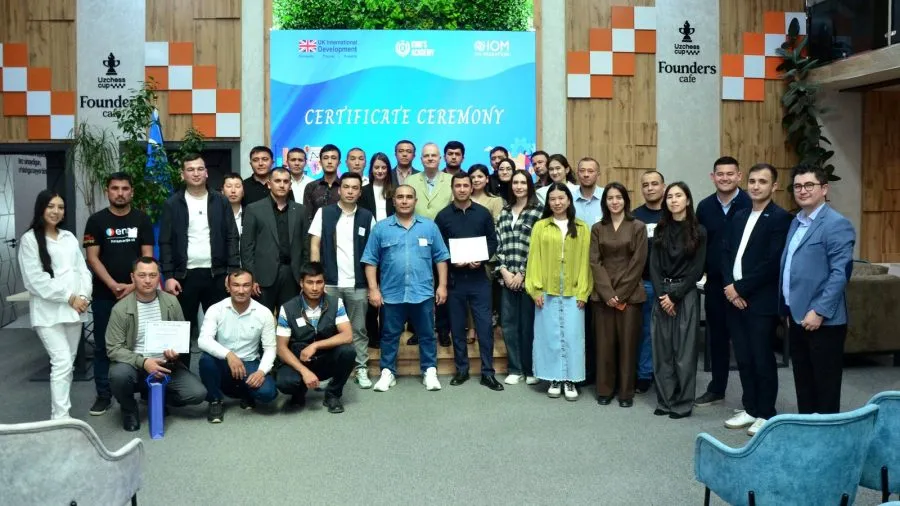
King’s Academy and IOM: English for Uzbek Seasonal Workers Going to the UK, 240 Video Lessons and Financial Literacy for Migrants
Over 5 months, King’s Academy taught English to more than 120 Uzbek migrants preparing for seasonal work in the UK, in cooperation with IOM, the UN Migration Agency, with support…

IELTS Writing Task 1 Line Graph: Write a Band 7 Overview and Never Misread a Number
IELTS Writing Task 1 line graph: the 4-paragraph plan, a 2-sentence overview formula, the margin check for numbers, trend verbs and a Band 7.5+ sample.
Submit a request
Do you want to sign up for classes or become part of our team?
Request submitted
We will contact you within the working day.