


AI in IELTS Preparation: How Students in Tashkent Can Use AI Smartly Without Being Used By It
 Author: Eldor Sattorov⏱ 11 min read
In short
How should students use AI for IELTS preparation? As a trainer, not as a ghostwriter. Write your own essay and speak your own answers first, then ask AI to check them against the four official IELTS criteria and explain your mistakes. Never let it write or speak for you, and never treat its band score as official. In the exam room in Tashkent there is no AI: only you, a screen and a certified examiner.
Author: Eldor Sattorov, Founder and Director of King’s Academy in Tashkent, 15+ years of IELTS teaching (IELTS 8.5, CELTA, MA TESL). He built kings.uz and its free 30-day IELTS plan with AI tools.
Key points
- AI is a gym, not a forklift. It can train you every day, but it cannot lift the weights for you.
- Write and speak first, ask AI second. Feedback on your own work teaches you. Copying AI’s work teaches you nothing.
- AI band scores are estimates. Only real mock exams and trained teachers show your real level.
- The winning formula: your own effort + smart AI prompts + a human teacher.
A story from a Tashkent home
It is 11 p.m. in Yunusobod. Madinabonu is 17, studies at a lyceum, and needs IELTS 7.0 for a university scholarship. Her mother walks past her room and sees her typing on her phone. “Are you studying or chatting?” she asks. “Studying, oyi! I’m using ChatGPT.”
Her mother does not know whether to be proud or worried, and she is right to be unsure. Madinabonu may be doing the smartest thing a student can do in 2026. Or she may be asking a robot to write her homework so she can go back to Instagram. The phone looks the same in both cases.
This scene now happens in thousands of homes across Uzbekistan. AI is no longer a rumour from Silicon Valley. It sits next to every student in Tashkent, Samarkand and Namangan, and it does not go home at 8 p.m. Teachers and parents can fear it, ignore it or learn to use it. Only the third choice works.
The elephant in the room: was this article written with AI?
Yes. Let me be honest before I give advice. This article was drafted with AI. I gave it the ideas, the structure, my 15 years of classroom experience and many corrections, and it did much of the typing.
There is more. I am a teacher, not a programmer. I cannot write code. But I built the whole kings.uz website with AI tools, including our free 30-day IELTS preparation plan with its timers, vocabulary cards and progress tracking.
So is an article warning you about AI, written with AI, a joke? I see it as proof. AI did not replace my knowledge. It multiplied it, and now any student in Uzbekistan can open a free study plan that I could never have built alone. The same can happen with your English, if you bring the knowledge and the discipline.
🎧Check your real band this weekend — CD Mock IELTS: 150,000 sum, each next one 50,000 cheaper, 4th free →Can AI ruin your IELTS score?
Yes, if you let it do your work. These are the four traps we see most often among IELTS candidates in Tashkent.
1. The copy-paste essay. You ask for a Band 8 essay, read it once and feel clever. But reading a perfect essay is like watching someone else do push-ups. On exam day you have 40 minutes, a blank screen and no ChatGPT.
2. The memorised Speaking answer. Students learn AI-written answers by heart. Examiners are trained to notice this: the delivery turns flat, the vocabulary does not match the student’s real level, and the first follow-up question breaks the script. Our article on what an IELTS Speaking examiner really listens for explains why.
3. The fake band score. AI is generous and inconsistent. Give it the same essay twice and you may get 6.5 and 7.5. Students walk into the real exam expecting 7.5 and walk out with 6.0. An AI score is a rough guess, not a result.
4. Robot vocabulary and wrong facts. AI loves words like “delve”, “plethora” and “multifaceted”. In a simple essay about traffic in Tashkent, they sound unnatural. AI also “hallucinates”: it can invent grammar rules or explain a Reading answer wrongly, with total confidence.
The biggest danger is quieter. If AI always thinks for you, your own thinking gets weaker, and IELTS tests thinking in English.
How do I use AI for IELTS Writing Task 1 and Task 2?
The rule: you write, AI checks. Write Task 2 in 40 minutes or Task 1 in 20 minutes with no help. If you are taking computer-delivered IELTS, type it on a keyboard, not on your phone. Then paste your essay with this prompt:
You are a strict IELTS Writing examiner. Here is the task and my essay.
1. Give feedback under the four official criteria: Task Response,
   Coherence and Cohesion, Lexical Resource, Grammatical Range and Accuracy.
2. For each criterion, show 2 strengths and 2 weaknesses with examples
   from my text.
3. List my 5 most serious mistakes and explain each one simply.
4. Do NOT rewrite my essay. Do NOT give me a model answer.
5. Give an estimated band range, and remind me it is only an estimate.
Task: [paste the question]
My essay: [paste your essay]
Then do the important part: rewrite the essay yourself, using the feedback. For Task 1, add one line: “Check that my overview is clear and that every number I mention matches the chart.” To understand the feedback, read how IELTS is assessed, and practise a clear structure with our 4-paragraph plan for causes and solutions essays.
How do I practise IELTS Speaking with AI?
Use voice mode as a sparring partner. It never gets tired and never laughs at you.
Act as an IELTS Speaking examiner. Run a full test: Part 1, Part 2 and Part 3.
Ask one question at a time and wait for my answer. In Part 2, give me a
cue card and one minute to prepare. Do not correct me during the test.
At the end, give feedback under Fluency and Coherence, Lexical Resource,
Grammatical Range and Accuracy, and Pronunciation. I am an Uzbek and
Russian speaker, so point out any phrases that sound translated.
Two habits are common among Uzbek and Russian speakers. The first is direct translation: “I am agree”, “I very like”, “it depends from” (we collected more in 10 mistakes that give us away in English). The second is flat intonation, where every sentence sounds the same. AI catches the first one well. For the second, record yourself on your phone and listen. AI is still weak at judging pronunciation, so this is where a teacher’s ear matters most.
How can AI help with IELTS Reading and Listening?
Do the test first, check your answers, and only then open AI.
For True / False / Not Given:
Here is a Reading passage, one statement, and my answer. I chose FALSE
but the correct answer is NOT GIVEN. Explain why, quote the exact
sentence from the passage, and show me how the statement would need
to change to be TRUE and to be FALSE.
For vocabulary and paraphrasing:
From this passage, choose 10 useful words at Band 6.5-7.5 level. For each,
give a simple meaning, one example sentence and one common paraphrase
that IELTS might use. Then test me with a short quiz.
For Listening, paste the transcript after the test and ask AI to show how the recording paraphrased each question. If its explanation disagrees with the official answer key, trust the key.
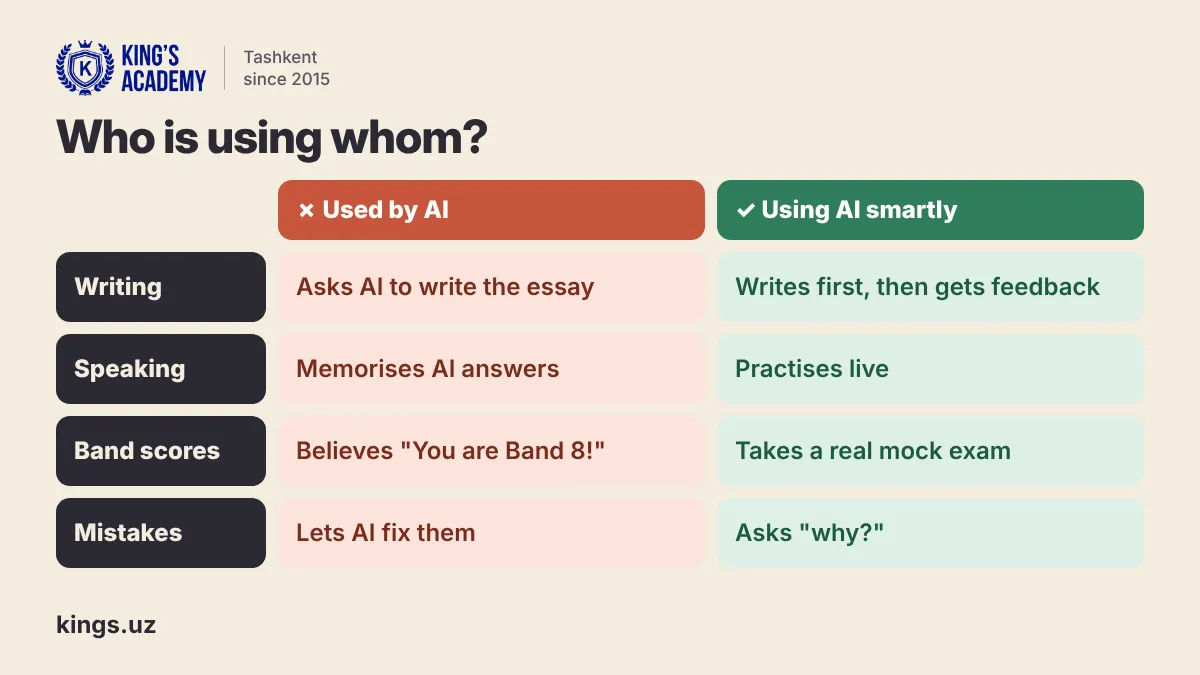
“Used by AI” vs “using AI smartly”: what is the difference?
| Used by AI | Using AI smartly | |
|---|---|---|
| Writing | Asks AI to write the essay | Writes first, asks for criteria-based feedback |
| Speaking | Memorises AI answers | Practises live in voice mode, then reviews mistakes |
| Band scores | Believes “You are Band 8!” | Checks progress with real mock exams |
| Vocabulary | Copies fancy words | Learns words from real texts and uses them |
| Mistakes | Lets AI fix them | Asks why, then fixes them personally |
| Result | Feels ready, scores lower | Feels tired, scores higher |
How can parents in Uzbekistan check that AI time is real study time?
You do not need to know English or technology. Ask three questions instead of policing the phone:
- “Show me what you wrote today.”
- “What mistake did AI find?”
- “What did your last mock exam show?”
If your child can answer, the screen time is study time. And remember that many strong students in Tashkent still prepare with a printed book and a pen, with AI as a helper.
How can English teachers use AI in IELTS lessons?
Banning AI does not work, because students use it anyway. Bring it into the lesson:
- Show a weak AI essay and let the class mark it with the official criteria.
- Give homework in three parts: the student’s draft, the AI feedback and the rewritten version.
- Keep classroom time for what AI cannot do: live speaking, honest scoring and motivation.
This is also why we believe a real classroom still wins in 2026.
Your next step: free IELTS resources from King’s Academy in Tashkent
- IELTS Preparation Plan: 30 Days, Free: daily tasks for all four skills, built-in AI-check prompts and mock tests on Days 7, 14, 21 and 28. No sign-up needed.
- How to Get IELTS 8.0: A Complete Guide to Successful IELTS Preparation in Tashkent: the full picture.
- Why You Must Try MOCK-IELTS Before the Real Exam: a mock gives you the honest number that AI cannot.
- Check your IELTS results: the page to use once you have taken the exam.
Back in Yunusobod, Madinabonu’s mother asked to see her essay. It was full of her own mistakes, with AI comments next to them and a second version below. Her mother did not understand every word, but she understood the important thing: her daughter was doing the work.
Quick quiz: smart use or AI trap?
Six situations. For each one, tap Smart or Trap.
1. Madinabonu writes her essay in 40 minutes, then asks AI for feedback on the four criteria.
Smart. She did the work, and AI only checked it.
2. Aziz asks AI for a Band 9 answer to a Part 2 cue card and learns it by heart.
Trap. Examiners notice memorised answers, and the follow-up questions break the script.
3. AI says "Your essay is Band 8", so Kamola cancels her mock exam.
Trap. AI scores are estimates. Only a real mock shows your level.
4. Timur finishes a Reading test, checks the key, then asks AI why his answer was Not Given and not False.
Smart. Test first, AI second, and the official key stays the judge.
5. Nilufar copies ten "advanced" words from an AI essay into her next essay without checking them.
Trap. Words you do not really know sound unnatural and lower your Lexical Resource score.
6. Sardor does a full Speaking test in voice mode, then records himself to check his intonation.
Smart. He practises live and checks what AI cannot hear well.
Your score:
6 out of 6. You are the boss, and AI works for you. Check your real level with a CD Mock IELTS.
Good, but watch the traps. Reread the comparison table above, then try Day 1 of the free 30-day plan.
Careful: AI is using you. Start again with Day 1 of the free 30-day plan and take the free level test.
Answer key (if the buttons do not work)
1 Smart · 2 Trap · 3 Trap · 4 Smart · 5 Trap · 6 Smart
Want an honest number, not an AI guess?
Take our free level test in 15 minutes, or join the IELTS intensive course in Tashkent. The first trial lesson is free.
Frequently asked questions
Can ChatGPT accurately grade my IELTS essay?
Not reliably. It gives useful feedback on grammar, vocabulary and structure, but its band scores change from one attempt to the next and are often too high. Use it for feedback, and use a real mock exam or a trained teacher for your score.
Is using AI for IELTS preparation considered cheating?
No. Using AI to practise and get feedback is like using a dictionary or a tutor. It becomes a problem only when you submit AI’s work as your own or memorise AI answers for the Speaking test. In the exam itself, no AI tools are allowed.
Can IELTS examiners tell if I memorised an AI answer?
Usually, yes. Memorised answers sound flat, use vocabulary above the candidate’s real level and fall apart on follow-up questions. Examiners then switch to less predictable questions.
What is the best free 30-day IELTS study plan with AI prompts?
King’s Academy in Tashkent offers a free interactive 30-day plan at kings.uz/en/ielts-30-day-plan/. It covers all four skills daily, includes ready AI-check prompts and has four mock tests. No registration is needed.
Can AI replace an IELTS teacher or an IELTS course in Tashkent?
No. AI is excellent for daily practice and quick explanations. A teacher gives honest scoring, corrects pronunciation, notices your habits and keeps you disciplined. The best results come from both together.
Which IELTS skills does AI help with most?
Writing feedback and Speaking practice benefit the most, because these skills normally need another person. For Reading and Listening, AI is best for explaining mistakes and building vocabulary after you finish a real test.
Sources: IELTS.org: IELTS scoring in detail · IELTS.org: Writing assessment criteria · British Council: How is IELTS assessed
What's next?
Take the first step — it's free or takes 2 minutes:
Other articles
Daily useful articles
IDP or British Council: Where Is IELTS “Easier”? 9 Myths and One Inconvenient Truth
IDP or British Council — where is IELTS easier and the score higher? We check 9 popular myths (Speaking, “nines”, winter vs summer) against official IELTS sources and explain how…

The True Cost of IELTS 7.5 in Tashkent: How to Plan Your Child’s Education Budget for the Next 5–6 Years
How much does IELTS 7.5 really cost in Tashkent? Real 2026 prices, a planned vs last-minute budget, university fees, a 6-year savings plan and English pay data.

IELTS Courses in Tashkent 2026: How to Choose — Formats, Prices and 10 Questions to Ask Any Centre
How to choose an IELTS course in Tashkent in 2026: preparation formats, prices, the exam fee, 10 questions to ask any learning centre, and the red flags to avoid.

How to Get IELTS 8.0: A Complete Guide to Successful IELTS Preparation in Tashkent
How can you get IELTS 8.0? How long does IELTS preparation take? What should you do every day? Is an IELTS course really necessary? How important is typing speed for…

How to Write a Strong CV in Uzbekistan: What Employers Look For, 7 CVs That Get Rejected and a Free CV Builder
How to write a strong CV in Uzbekistan: what employers check first, 7 CV mistakes with examples, ready AI prompts and a free online CV builder with PDF.
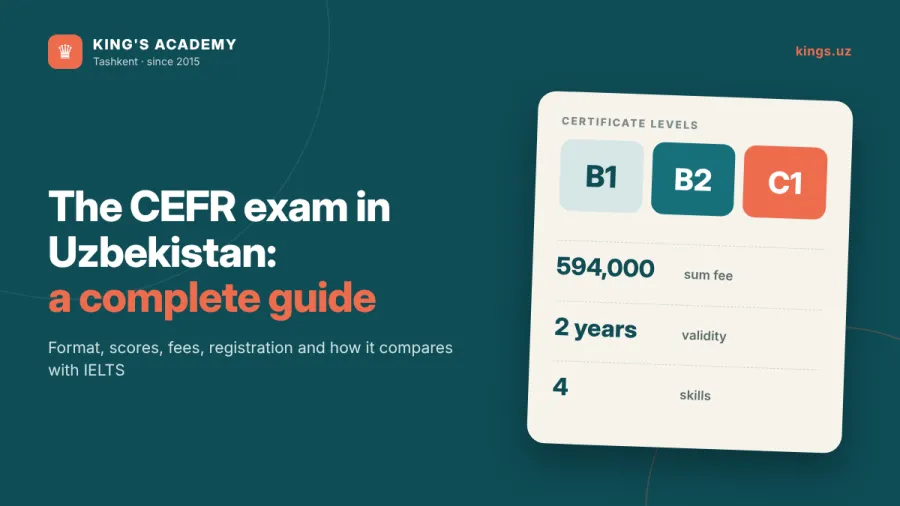
The CEFR Exam in Uzbekistan (Milliy Sertifikat): A Complete Guide to Format, Scores, Fees, Registration and IELTS
Everything about the CEFR exam (Milliy sertifikat): format, B1–C1 scores, the 594,000 sum fee, my.gov.uz registration, dates and IELTS comparison.
Submit a request
Do you want to sign up for classes or become part of our team?
Request submitted
We will contact you within the working day.