


IELTS Matching Headings in 4 Steps: How to Stop Losing 5 Marks in Passage 3

Short answer
Matching Headings tests one skill: can you see the main idea of a whole paragraph? Read the headings first, sum up each paragraph in 5 words, match by meaning (not by one shared word), cross out every heading you use, and spend about 1 minute per paragraph. There are always more headings than paragraphs, and no heading is used twice.
📊 FROM OUR MOCK RESULTS
In our September 2026 CD Mock IELTS in Tashkent, 5 of 7 candidates lost 3–5 marks each on one Matching Headings task in Passage 3: 20 marks in total. Their English was good enough. The method was the problem. In Academic Reading, 3 marks can move your score by half a band.
1. What the task looks like
- You get a list of headings (i, ii, iii…) and a text with paragraphs A, B, C…
- There are always more headings than paragraphs, so 2–3 headings are never used. They are there to trick you.
- No heading can be used twice. Sometimes one paragraph is already matched as an example: cross that heading out at once.
- It is usually the first task for its passage, so doing it first gives you a map of the whole text.
2. Why good students still lose marks
- The one-word trap. A paragraph says “electricity” and you choose the heading “How trams are powered”. One shared word is not a match.
- The detail trap. The heading describes one example or one sentence, not the whole paragraph.
- Reading every word. You run out of time for the other 7–9 questions in the passage.
- Not crossing out. You use the same heading twice and lose two marks instead of one.
3. The 4-step method
Step 1. Read the headings first (2 minutes)
Before you look at the text, read all the headings. Underline the key idea in each one: abandoned, changed their minds, divides opinion. Look for pairs of similar headings, because the exam often gives two that look alike, e.g. “rising costs” vs “expensive investment”. Cross out the example heading.
Step 2. Find the main idea, not a matching word
Read the first 1–2 sentences and the last sentence of the paragraph, then skim the middle. Ask yourself: “What is this whole paragraph about?” and answer in 5 words or fewer. Watch for words like however, yet, but. The main idea often comes right after them.
Step 3. Match and cross out
Compare your 5-word summary with the headings. Choose the heading that covers the whole paragraph. Cross it out. Do the easy paragraphs first: every heading you cross out makes the hard ones easier, because fewer options are left.
Step 4. Watch the clock
The Reading test is 60 minutes for 40 questions, so aim for about 20 minutes per passage and about 1 minute per paragraph for headings. Passage 3 is the hardest, so don’t spend more than 20 minutes on Passages 1 or 2. On the paper test there is no extra time to copy answers to the answer sheet. Stuck? Guess and move on, because a wrong answer costs nothing.
💡 Quick test for any heading
Could this heading be the title of the whole paragraph in a newspaper? If it only fits one sentence, it is a trap.
4. The 4 traps in one table
| Trap | What it looks like | What to do |
|---|---|---|
| One-word match | Same word in the heading and the text | Check meaning: does the heading describe the whole paragraph? |
| Detail | Heading fits one example or number | Find the topic sentence and match that |
| Twins | Two headings look almost the same | Find the one key difference (cause vs result, past vs now) |
| Leftovers | Extra headings that fit nothing | Expect 2–3 unused headings. That is normal |
5. Practice: 8 questions, 8 minutes
The text below is real IELTS style (about Band 6.5–7). Start the timer by answering, read the headings first, then the paragraphs. As you choose a heading, it is crossed out automatically, just as you should do on paper.
✍️ Matching Headings practice
· Answered: 0
READING PASSAGE · ~400 WORDS · BAND 6.5–7
Why Cities Are Bringing Back the Tram
A At the beginning of the twentieth century, trams ran through the centre of almost every large European city. Yet by the 1960s many of these networks had disappeared. Buses were cheaper to buy, cars were becoming affordable for ordinary families, and city councils saw the old tracks as an obstacle to modern traffic. In many places the rails were torn up or simply covered with asphalt, and for several decades the tram was remembered as a symbol of the past.
B Over the last forty years, however, the tram has made a remarkable comeback, and the reason is largely practical. Traffic jams cost city economies enormous sums in lost working hours, while exhaust fumes have made air quality a serious public health concern. A modern tram, which runs on electricity, produces no emissions on the street itself and can carry several hundred passengers at once, far more than a bus. For planners trying to move large numbers of people without widening roads, it offers an attractive solution.
C The main argument against trams is their price. Laying track, moving underground pipes and cables, and building depots can make a single kilometre of tram line many times more expensive than a kilometre of bus lane. Critics argue that the same money would buy a far larger fleet of buses, which could start running within months rather than years. Supporters reply that a tram line lasts for decades and that its higher capacity makes it cheaper per passenger in the long run.
D What surprised many researchers was the effect on the streets around the new lines. Because rails cannot be moved overnight, shop owners and investors tend to see a tram as a permanent commitment by the city. Several studies have found that shops along new routes attract more customers on foot, and that property prices near tram stops often rise faster than in other areas.
E Bringing trams back also creates new risks. Unlike trains, trams share the street with cars, cyclists and pedestrians, and a heavy vehicle on rails cannot swerve to avoid someone who steps out without looking. Cities have responded in different ways: some give trams their own lanes separated by kerbs, others reduce speeds in busy shopping areas, and many use distinctive bells and lighting so that people notice an approaching tram.
List of Headings
- i The invention of the first tram
- ii A form of transport that was once abandoned
- iii Why planners have changed their minds
- iv How trams are powered
- v An expensive investment that divides opinion
- vi Unexpected benefits for local businesses
- vii The rising cost of city-centre housing
- viii Keeping people safe on shared streets
Some answers are empty. In the real exam a blank is always 0, so guess! Press Check again to see results.
A → ii. Trams were removed and forgotten (“disappeared”, “symbol of the past”). i is a trap: the paragraph mentions the early 1900s but says nothing about the invention.
B → iii. After “however”: the tram came back for practical reasons, so planners changed their view. iv is the one-word trap: “electricity” is only a detail.
C → v. High price + critics vs supporters = “divides opinion”.
D → vi. “What surprised…” = unexpected; shops get more customers. vii is the detail trap: property prices are just one supporting fact.
E → viii. New risks on streets shared with people, and how cities keep them safe.
6. You have 8 headings and 5 paragraphs. How many headings will you NOT use?
7. Which part of a paragraph should you read first?
8. Paragraph B contains the word “electricity”, and one heading says “How trams are powered”. What should you do?
Your score
Don’t worry, this is exactly why we practise. Reread Step 2 (main idea vs one word), then try again without looking at the key.
Good! Look at the ones you missed: usually it is the one-word trap or the detail trap. Fix that and you’ll have it.
Excellent: you read for the main idea like a Band 7+ candidate. Now practise this speed with full Passage 3 texts.
6. What to do after the practice
- All correct? Time yourself on full Passage 3 texts: 20 minutes, all questions.
- Missed 1–2? For each mistake, write the 5-word summary you should have made. This trains the habit fast.
- Missed 3+? The problem is often vocabulary for paraphrase (“abandoned” = “disappeared”). Read B2–C1 articles and note synonyms.
Check your Reading in real exam conditions
We run CD Mock IELTS in the real computer-delivered format every weekend at our Alayskiy branch: all 4 sections in one day, feedback on every skill and a recording of your Speaking. The first mock is 150,000 sum, each next one is 50,000 cheaper, and the fourth is free. 10 seats per date. Want a step-by-step plan? Join our CD IELTS course or the IELTS 7.0+ intensive. Already have a result? Check your IELTS results online.
Read next
- True/False/Not Given: strategy and a 6-question test
- What 400 CD Mock IELTS results show
- How IELTS is assessed
Frequently asked questions
How many headings are there in IELTS Matching Headings?
There are always more headings than paragraphs, so some are never used. Usually 2–3 are extra.
Can I use the same heading twice?
No. Each heading can be used only once. That is why crossing out used headings helps.
Should I read the whole paragraph?
Read the first 1–2 sentences and the last sentence, then skim the middle to confirm. Read every word only if two headings still seem possible.
How much time should Matching Headings take?
About 1 minute per paragraph. Keep the whole passage to about 20 minutes, because Reading is 60 minutes for 40 questions.
Is there extra time to transfer answers in Reading?
No. On the paper test you must copy your answers within the 60 minutes. On the computer test you type them directly.
Is Matching Headings different on the computer-delivered test?
The rules are the same. On the computer you choose headings on screen and can highlight words in the text.
Do I lose marks for a wrong answer?
No. There is no penalty for wrong answers, so never leave a question blank.
Sources
- IELTS.org — IELTS Academic Reading: test format
- IELTS.org — How to prepare for the Matching Headings task
Already taken IELTS? Check your IELTS results →
What's next?
Take the first step — it's free or takes 2 minutes:
Other articles
Daily useful articles
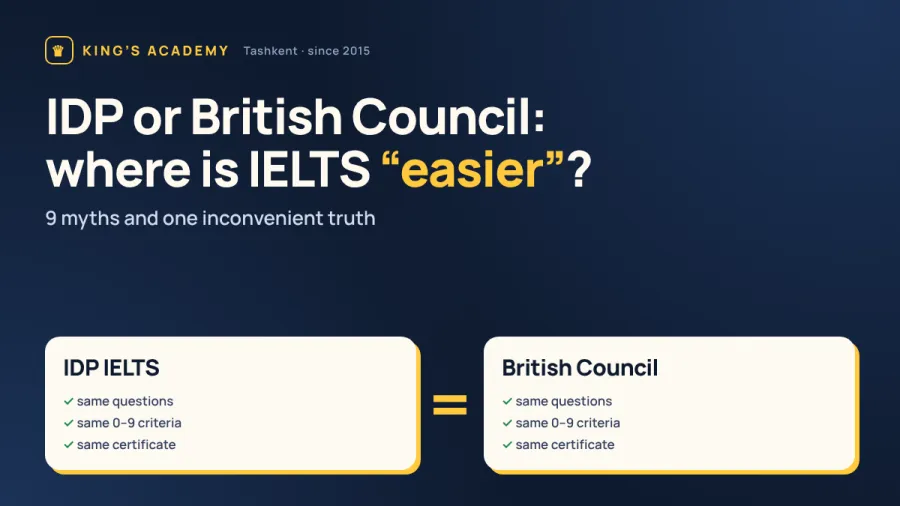
IDP or British Council: Where Is IELTS “Easier”? 9 Myths and One Inconvenient Truth
IDP or British Council — where is IELTS easier and the score higher? We check 9 popular myths (Speaking, “nines”, winter vs summer) against official IELTS sources and explain how…

IELTS Courses in Tashkent 2026: How to Choose — Formats, Prices and 10 Questions to Ask Any Centre
How to choose an IELTS course in Tashkent in 2026: preparation formats, prices, the exam fee, 10 questions to ask any learning centre, and the red flags to avoid.
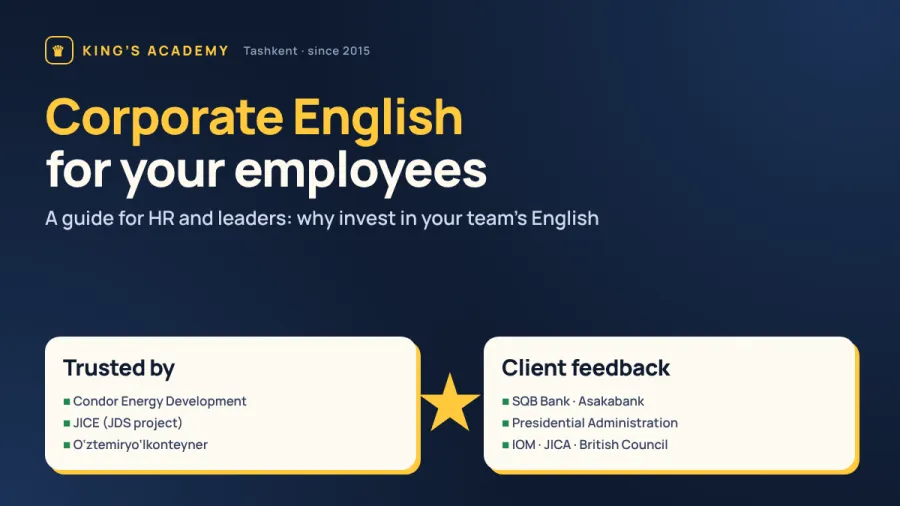
Corporate English for Employees: Why Companies Should Invest in It — A Guide for HR and Business Leaders
How corporate English (ESP, Business English) improves employee loyalty, growth and efficiency: formats, launching a programme in 6 steps, KPIs for HR and real client feedback for…

How to Choose the Best IELTS Learning Centre in Tashkent: 5 Criteria to Look For
How to choose an IELTS centre in Tashkent: 5 criteria to check — teachers, mock exams, feedback, student support and real results, not just ads.
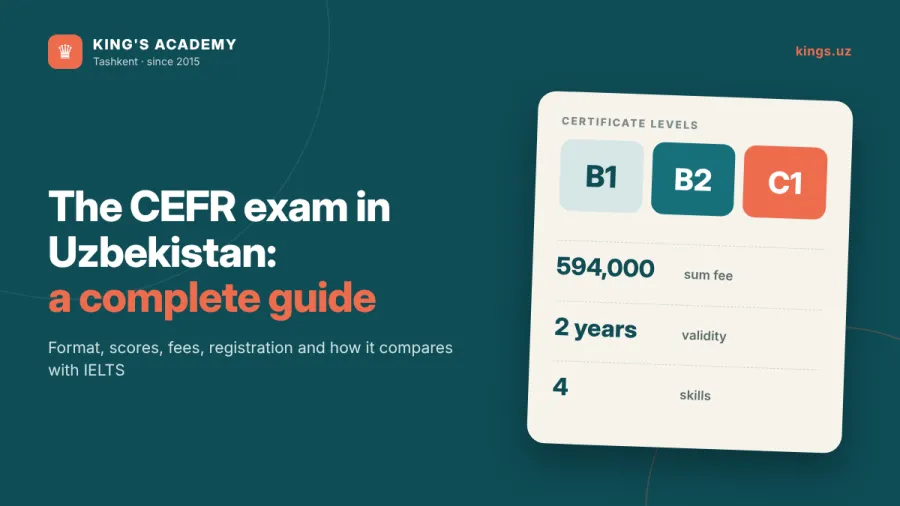
The CEFR Exam in Uzbekistan (Milliy Sertifikat): A Complete Guide to Format, Scores, Fees, Registration and IELTS
Everything about the CEFR exam (Milliy sertifikat): format, B1–C1 scores, the 594,000 sum fee, my.gov.uz registration, dates and IELTS comparison.

Learn English on Your Own: 5 Daily Habits and Websites
Learn English on your own: 5 daily habits, free podcast and audiobook websites, and a 30-minute daily plan. Tips from King’s Academy, Tashkent.
Submit a request
Do you want to sign up for classes or become part of our team?
Request submitted
We will contact you within the working day.