


Presidential Schools in Uzbekistan: How to Prepare Your Child for the Entrance Exam Without Burnout (2027 Guide)

Short answer for parents
Presidential Schools are 14 free, boarding schools (one in each region, including Tashkent) run by the Agency for Specialized Educational Institutions with a Cambridge-designed admission test. In 2026 they admitted pupils who had finished Grade 4 with an annual mark of “5” in mathematics and natural science. Admission has two test stages: Stage 1 — mathematics (30 questions); Stage 2 — mathematics: critical thinking and problem solving (40 questions, 90 min) + English: grammar and reading (40 questions, 40 min). In 2026 there were 60,169 applications — about 179 per place. Preparation that works is 12 months of calm, regular practice in maths reasoning, reading and English — not cramming.
Why I am writing this
In 2019 I worked as a vice-principal at the Presidential School in Tashkent, in its very first year. Before the school opened, our team went through the Presidential Schools’ Induction Programme for Teachers and Leaders, run with Cambridge Assessment International Education. I saw from the inside who gets selected, what the school expects from a ten-year-old, and which children thrive there — and which children arrive already exhausted.


This guide is for parents. It covers the official rules for the 2026 intake, what each stage really tests, and how to prepare a child for one of the most competitive selections in Uzbekistan without turning childhood into a test-prep camp.
What are Presidential Schools?
- 14 schools — one in each region of Uzbekistan, including Tashkent city. The first four opened in 2019 (Tashkent, Nukus, Namangan, Khiva).
- Free education and boarding, according to Cambridge University Press & Assessment, which designed the admission test.
- Curriculum: Cambridge programmes alongside Uzbek national curriculum subjects, with a STEAM focus (science, technology, engineering, arts and maths).
- Managed by the Agency for Specialized Educational Institutions (call centre 1206).
Who can apply in 2026–2027?
- Pupils who have finished Grade 4 apply for Grade 5.
- Annual Grade 4 marks in mathematics and natural science must be “5”.
- You apply only to the Presidential School in your own region — for families in Tashkent, the Presidential School in Tashkent.
- Documents: a recent photo (taken within 2 months), birth certificate, the Grade 4 report card (certified copy or e-report card with QR code), a parent’s passport details and phone numbers.
- Where: online at my.gov.uz or ariza.piima.uz. In 2026 the window was 25 May – 14 June.
How does the Presidential Schools entrance exam work?
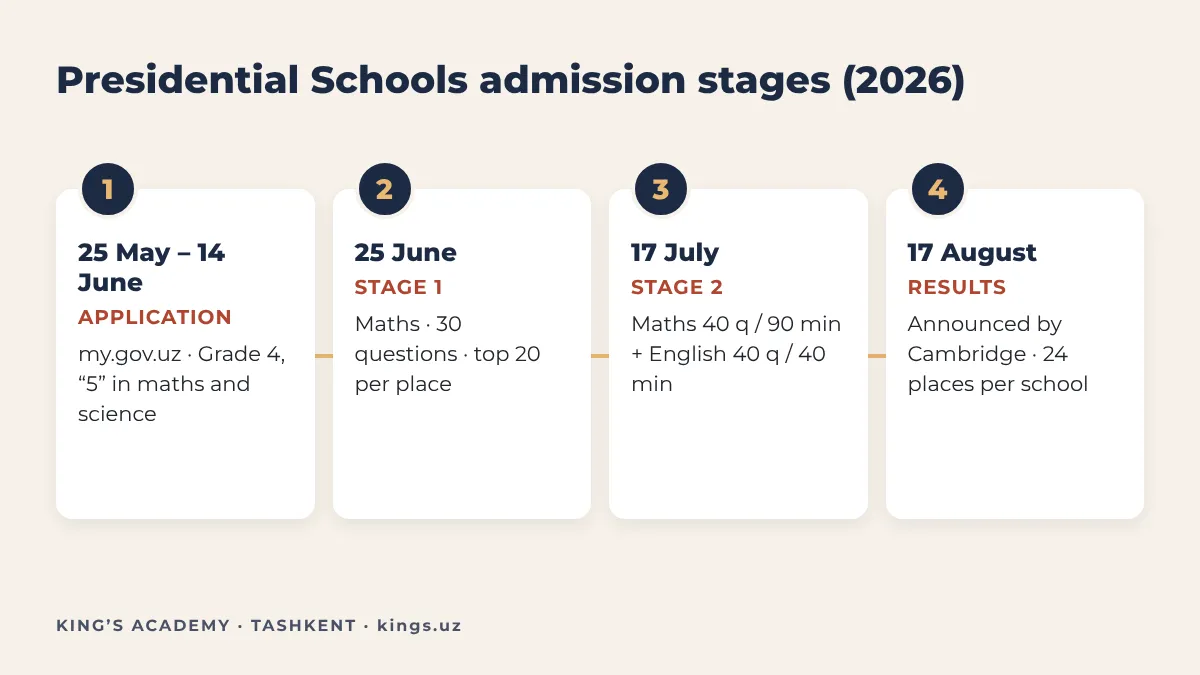
| Stage | 2026 date | What is tested | How selection works |
|---|---|---|---|
| Application | 25 May – 14 June | Documents and Grade 4 marks | Online via my.gov.uz / ariza.piima.uz |
| Stage 1 (screening) | 25 June | Mathematics: 30 questions (10 easy, 10 medium, 10 hard) | Top 20 candidates per place go through — 480 per school for 24 places |
| Stage 2 (main exam) | 17 July | Maths: critical thinking and problem solving, 40 questions, 90 min. English: grammar and reading, 40 questions, 40 min | Ranking by score; no extra time for the answer sheet; no retakes |
| Results | 17 August | Announced by Cambridge Assessment International Education by personal ID | Highest scores within the quota are admitted |
Source: official announcements for the 2026/2027 intake. Dates for 2027 will be announced in spring 2027.
Ties at Stage 1 are broken by the score on hard questions, then medium, then easy; if still tied, the younger child ranks higher. The Agency’s published specification lists three areas: English, Mathematics and Thinking Skills — the “thinking skills” are built into the maths reasoning questions.
How competitive is it?
- 2026: 60,169 applications — about 179 per place. In 2025: 49,924 applications, about 148 per place.
- Stage 1 passing scores in 2025: 70.0 in Tashkent city and Fergana (the highest), 61.8 in Tashkent region, 55.3 in Karakalpakstan.
- Tashkent is one of the two hardest regions. Plan for that from the start.
What does the exam really test?
From my years inside the system, here is the honest version: the test rewards thinking, not memorised school rules. A child who has done 500 textbook exercises but has never met an unfamiliar problem will struggle. A child who reads a lot, likes puzzles and can explain why an answer is right usually does well.
- Maths reasoning: multi-step word problems, patterns and sequences, logic, reading tables and diagrams, fractions and proportional thinking at a Grade 4–5 level, often presented in an unfamiliar way.
- English: grammar and reading comprehension. A child needs a solid A2 level — understanding short texts and answering questions about them.
- Concentration: Stage 2 lasts 130 minutes in a row. That is a skill in itself for a ten-year-old.
A 12-month preparation plan (Grade 3 to Grade 4)
| Period | Focus | Weekly time |
|---|---|---|
| Months 1–3 (spring of Grade 3) | Daily reading in Uzbek or Russian; maths puzzles and logic games; English from the basics | 4–5 hours |
| Months 4–6 (summer) | Word problems every day; English reading of short stories; one ‘thinking’ game a day | 4–5 hours |
| Months 7–9 (autumn of Grade 4) | Exam-style maths sets; English grammar and reading tasks; timed 30-minute sessions | 5–6 hours |
| Months 10–12 (winter–spring of Grade 4) | Mock tests at full length, review of mistakes, keep school marks at “5” | 5–6 hours |
These are totals per week, spread over 5–6 days. More is not better at this age.
Mathematics: build reasoning
- Ask “why?” after every answer. If your child can explain it, they understand it.
- One or two non-standard problems a day are better than twenty routine exercises.
- Use board games and logic puzzles (chess, Sudoku for kids, tangrams) — they train exactly the thinking the test checks.
English: reading first
- Fifteen minutes of English reading a day with simple graded books.
- Grammar in context: after a short text, find all the past-tense verbs, all the questions, all the plurals.
- Aim for a solid A2 by the spring of Grade 4.
Exam skills: only in the last 3 months
- Practise sitting still and focused for 90 minutes — first 30, then 60, then 90.
- Teach your child to skip a hard question and come back, instead of freezing.
- Do a full mock in real conditions at least twice before Stage 1.
How to avoid burnout
I have seen ten-year-olds arrive at the exam already tired of learning. They rarely do their best — and even when admitted, they find the first year hard. A Presidential School is a marathon, not a sprint.
- Sleep comes first. Children aged 6–12 need 9–12 hours of sleep a night (American Academy of Sleep Medicine). A tired brain cannot solve logic problems.
- Move every day. The WHO recommends an average of 60 minutes of physical activity a day for children aged 5–17 (WHO).
- Keep weekly study time sensible: 4–6 hours of extra preparation a week, not 4–6 hours a day.
- One day a week with no preparation at all.
- Talk about the exam calmly. “Let’s see how far you can get” works better than “You must get in.”
- Have a plan B. Specialized schools, creative schools and strong regular schools exist too. A child who knows that one exam does not decide their life performs better.
Warning signs: when to slow down
- Headaches or stomach aches before lessons.
- Loss of interest in things your child used to enjoy.
- Tears or anger over small mistakes.
- Sleep problems or nightmares about tests.
If you see these, cut the workload by half for two weeks and talk to your child. A calm child with 80% preparation beats an anxious child with 100%.
Prepare calmly and in good time
Check your child’s current English level with our free level check, see English for kids and maths courses in Tashkent, or find a group on the timetable.
Frequently asked questions about Presidential Schools admission
Which grade can apply to Presidential Schools in 2026–2027?
Pupils who have completed Grade 4 apply for Grade 5.
What school marks are required?
In 2026, the annual Grade 4 marks in mathematics and natural science had to be “5” (excellent).
Can a family from another region apply to the Presidential School in Tashkent?
No. Applicants may apply only to the Presidential School in their own region.
What subjects are in the Presidential Schools entrance exam?
Stage 1 is mathematics (30 questions). Stage 2 is mathematics — critical thinking and problem solving (40 questions, 90 minutes) — and English grammar and reading (40 questions, 40 minutes).
How many children are admitted to each Presidential School?
The 2026 quota was 24 places per school, with 20 candidates per place (480) going through to Stage 2.
How competitive is admission?
In 2026 there were 60,169 applications, about 179 per place. Tashkent city had one of the highest Stage 1 passing scores in 2025 (70.0).
Is studying at a Presidential School free?
Yes. According to Cambridge, Presidential Schools provide free general secondary education and boarding.
Who checks the exam and announces the results?
In 2026 the main exam results were announced by Cambridge Assessment International Education, by each applicant’s personal ID number.
How many hours a week should a Grade 4 child prepare?
About 4–6 hours of extra preparation a week, spread over 5–6 days, with one free day and 9–12 hours of sleep a night.
When should we start preparing?
Ideally about 12 months before the exam — in the spring of Grade 3 — with reading, maths reasoning and English, and exam-style practice only in the last 3 months.
Related: WIUT Academic Lyceum: how to prepare without burnout · How long does it take to learn English from zero? · Check your IELTS results.
About the author
Eldor Sattorov — founder and director of King’s Academy in Tashkent (since 2015). Former vice-principal at the Presidential School in Tashkent (2019). MA in TESL (Webster University), BA in International Relations with Politics (University of York, UK). CELTA-qualified, former Cambridge English Speaking examiner.
Read also: Private or state school in Tashkent: which is better · First-grade enrolment in Tashkent via my.gov.uz
Sources
- Ta’lim xabarlari — Presidential schools 2026/27 admission opens (25 May 2026)
- Ta’lim xabarlari — Entrance exam subjects and order (30 May 2026)
- Ta’lim xabarlari — Stage 1 results and selection to Stage 2
- InfoEdu — Stage 2 exam on 17 July 2026
- Ta’lim xabarlari — 2025 Stage 1 passing scores by region
- Ta’lim xabarlari — Main exam results announced by Cambridge (17 Aug 2026)
- Agency for Specialized Educational Institutions — Exam specification 2026
- Cambridge University Press & Assessment — Presidential Schools case study
- American Academy of Sleep Medicine — Recommended sleep for children
- WHO — Physical activity fact sheet
What's next?
Take the first step — it's free or takes 2 minutes:
Other articles
Daily useful articles

Job interview in English: 15 questions and how to answer them
The 15 most common job interview questions in English, with short sample answers, the STAR method and the mistakes Uzbek and Russian speakers make.

IELTS Speaking Part 2: How to Talk for 2 Full Minutes Without Running Out of Ideas
IELTS Speaking Part 2: a 1-minute plan, 5 time-buying phrases, stronger words than “very good”, Band 6 vs Band 8 answers and timed practice.

Private or State School in Tashkent: Which Is Better for Your Child?
An honest comparison of private and state schools in Tashkent: class size, teachers, languages, cost, admission. With a table and a family-fit tool.
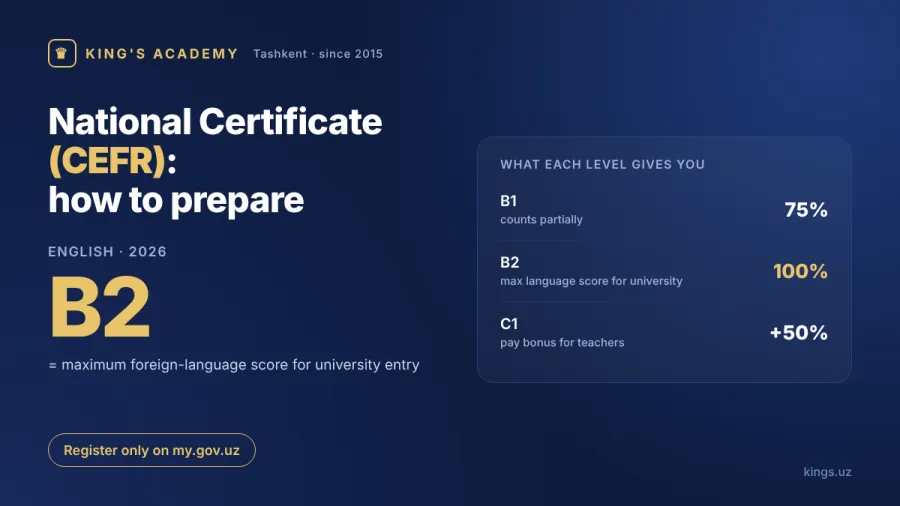
Uzbekistan’s National Certificate (Milliy sertifikat, CEFR) in English: How to Prepare in Tashkent (2026)
What the Milliy sertifikat (CEFR) is, what B2 and C1 give you, how to register on my.gov.uz and how to prepare in 2–4 months. Dates, format and tips from King’s Academy.

Corporate English Courses for SQB Bank Employees: ESP Banking & Finance Training by King’s Academy
King’s Academy specializes in English for Specific Purposes (ESP). For SQB Bank employees, the curriculum is customized around authentic banking and finance scenarios rather than…

Causes and Solutions Essays in IELTS: The 4-Paragraph Plan That Answers Both Questions
IELTS Task 2 causes and solutions essay: decode the question, the 4-paragraph plan, a solution for each cause, 10 collocations and a Band 7.5+ sample.
Submit a request
Do you want to sign up for classes or become part of our team?
Request submitted
We will contact you within the working day.