


What 400 CD Mock IELTS Results in Tashkent Show: Average Bands and Where Students Lose Points

Key findings
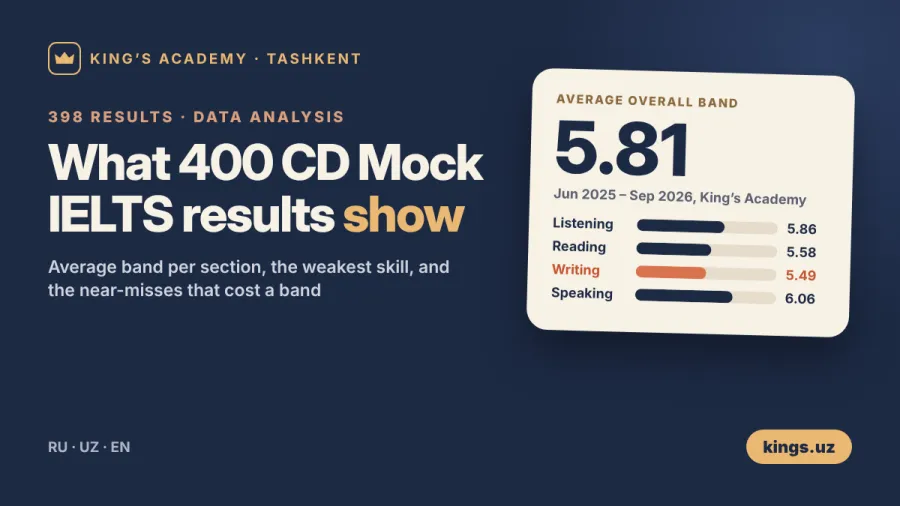
We analysed 398 complete CD Mock IELTS results from King’s Academy (June 2025 – September 2026). The average overall band was 5.81. Speaking was the strongest section (6.06) and Writing the weakest (5.49). Grammar was the lowest criterion in both Writing and Speaking. Two in three students were only 1–2 correct answers away from a higher Listening or Reading band, and for 28% half a band more in just one section would have raised the overall score.
Every weekend students sit our CD Mock IELTS: all four sections in one day, on computer, with a live Speaking interview. Over time this has produced something more useful than any single result: a large set of scores from real students in Tashkent, preparing for the real exam.
So we went through them. Below is what the numbers say, where points are really lost, and what to do about it — section by section, band by band.
What we analysed
- 398 complete results with all four sections scored, from 122 mock dates between 16 June 2025 and 27 September 2026.
- 84 more sessions were left out because a section was missing or a technical problem was recorded on that date.
- The overall band was calculated with the standard IELTS rounding. No names or personal data were used — only scores.
- These are mock results of students who are still preparing, not official IELTS scores. They show where people are on the way, which is exactly what makes them useful.
Average band per section
| Section | Average band | What it means |
|---|---|---|
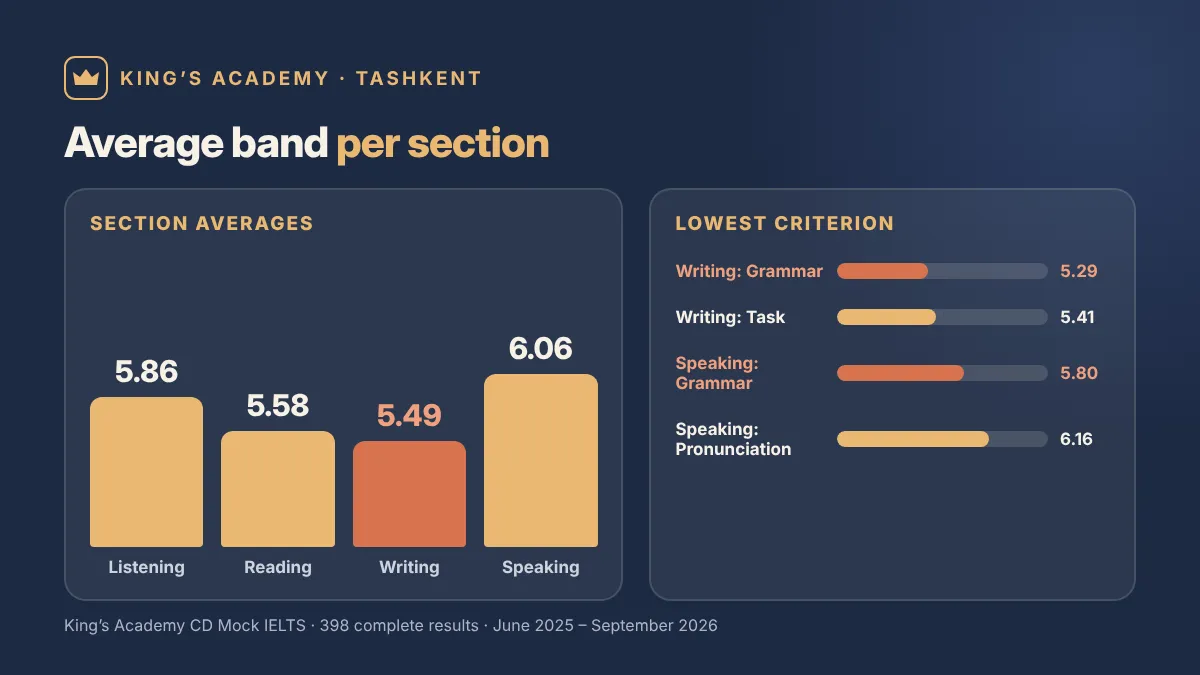
| Listening | 5.86 | Average 22.8 correct answers out of 40 |
| Reading | 5.58 | Average 21.4 correct out of 40 — lower than Listening for most students |
| Writing | 5.49 | The weakest section; 57% scored 5.5 or below |
| Speaking | 6.06 | The strongest section |
| Overall | 5.81 | 54% reached 6.0+, 31% reached 6.5+, 15% reached 7.0+ |
King’s Academy CD Mock IELTS, 398 complete results, June 2025 – September 2026.
Where students lose points: six findings
1. Writing is the bottleneck
Writing was the lowest (or joint-lowest) section for 51% of students. Even among those who scored 7.0+ overall, Writing averaged 6.45 — a full band below their Listening (7.57). Writing is the section that most often decides whether you get your target.
2. Grammar is the weakest criterion — in Writing and in Speaking
In Writing, the four criteria averaged: Task Achievement/Response 5.41, Coherence and Cohesion 5.49, Lexical Resource 5.44 and Grammar 5.29. In Speaking: Fluency 6.06, Vocabulary 5.86, Grammar 5.80, Pronunciation 6.16. Grammar was the lowest or joint-lowest criterion for 70% of students in Writing and 76% in Speaking. The issue is rarely “not knowing grammar”. It is accuracy under time pressure: articles, verb tenses, agreement, and complex sentences that fall apart halfway.
3. You can say it, but can you write it?
Speaking was higher than Writing for 66% of students, by 0.57 of a band on average. Many students communicate well but haven’t trained the slower skill: planning, paragraphing and checking their own text.
4. Reading trails Listening
Reading was the weakest section for 48% of students and lower than Listening for 52%. In our reports the cause is usually time: students read every word of the passage, run out of minutes on the last section and guess the final 8–10 questions.
5. Most students are one or two answers from the next band
This is the most encouraging number. In Listening, 70% of students were within 2 correct answers of a higher band, and 34% were within one. In Reading, the figures were 66% and 32%. Those answers are usually lost on spelling, plurals, word limits or a question skipped in a hurry — not on English level.
6. Unbalanced profiles cost the overall band
For 85% of students, the gap between their best and worst section was a full band or more; for 60% it was 1.5 or more. And for 28%, just half a band more in any one section would have lifted the overall score. Polishing your strongest skill feels good, but raising the weakest one pays.
Roadmaps: what to do from your current band
From 5.0–5.5 to 6.0 (8–10 weeks)
- Grammar first: articles, tenses and subject–verb agreement. Keep an error log and rewrite every corrected sentence.
- Writing: two Task 2 essays a week with the same structure (introduction, two body paragraphs, conclusion), checked by a teacher.
- Listening and Reading: one timed section every other day; after each, find why every wrong answer was wrong.
- Speaking: answer Part 1 questions in 2–3 full sentences, never one word. Record yourself and count the pauses.
From 6.0 to 6.5 (6–8 weeks)
- Writing: work on Task Response — answer the exact question, give a clear position and develop each idea with an example.
- Reading: practise skimming and set a time limit per passage (about 20 minutes each), so the last section isn’t a guess.
- Listening: spelling and plurals drill, because this is where the “one answer away” points are.
- Take a mock every 3–4 weeks to check that the weakest section is actually moving.
From 6.5 to 7.0+ (6–10 weeks)
- Writing: accurate complex sentences and precise vocabulary. Compare your essay with an improved band 7+ version paragraph by paragraph.
- Speaking: longer, developed Part 3 answers — reason, example, contrast — without memorised phrases.
- Reading: aim for 30+ correct answers. True/False/Not Given and matching headings decide this band.
- Two to three full mocks before the real exam, at least two weeks apart.
Why one mock is not enough
Among our students who reached 7.0+ in the real exam, 99% took our mock IELTS more than once. That is not a coincidence. The first mock shows your level. The second shows whether your preparation is working. The third is usually the one where nerves stop getting in the way.
Exam stress is real: shaking hands in Listening, a blank mind in Speaking, panic when the clock shows ten minutes left in Reading. It goes down with exposure. Research on retrieval practice found that most students felt less anxious about tests after regular practice testing (Agarwal et al., 2014). A mock in real exam conditions — the room, the headphones, the timer, a stranger asking you questions — trains exactly that.
Speaking deserves a special mention. In our mock it is face to face with a professional IELTS instructor, just like the real exam. Talking to a person you don’t know is a different skill from talking to your teacher or your phone.
Computer skills: the part nobody practises
Almost all IELTS in Uzbekistan is now taken on computer. That changes more than people think:
- Typing speed. Writing needs at least 400 words in 60 minutes, plus planning and checking. We recommend 35–40 words per minute. At 20 words per minute, typing alone eats most of your planning time.
- Highlighting and notes. In Reading you can highlight text and add notes on screen. If you have never used them, you won’t on exam day.
- Word counter and spelling. The word count is shown on screen, but there is no spell check. Every spelling mistake is yours.
- Listening. Answers are typed while you listen, with a short time to check at the end. Navigation between questions must be automatic.
Free ways to train typing: Typing.com, Keybr, Monkeytype. Fifteen minutes a day for a month makes a visible difference. For the exam interface itself, try the free computer-delivered IELTS familiarisation test from the British Council, and read our guide Computer-Delivered IELTS: How the Exam Works.
Time management: a simple plan per section
- Listening (about 30 minutes): read the next questions while the recording pauses; never stay on a missed answer — move on.
- Reading (60 minutes, no extra time): about 20 minutes per passage. If a question takes more than 90 seconds, mark it and come back.
- Writing (60 minutes): 20 minutes for Task 1, 40 for Task 2, because Task 2 counts twice as much. Keep 3–5 minutes at the end to check.
- Speaking (11–14 minutes): in Part 2 use the full minute to plan and speak until the examiner stops you.
Don’t just look at the score — read the report
The most common mistake after a mock is to look at the overall band, feel happy or sad, and close the file. The score is the least useful part. The value is in the details.
After every King’s Academy CD Mock IELTS you receive a full report on all four sections:
- Listening and Reading: every mistake, with the correct answer and the type of error;
- Writing: scores for each criterion, the mistakes in your text, and an improved version of your writing so you can see what a higher band looks like;
- Speaking: scores for each criterion and the audio recording of your Speaking session;
- concrete suggestions and a roadmap for your next weeks of preparation.
How to use it, in five steps:
- Write down your weakest section and your weakest criterion.
- Sort your Listening and Reading mistakes: spelling, time, vocabulary or understanding. The biggest group is your priority.
- Rewrite your essay using the improved version — don’t just read it.
- Listen to your Speaking recording and note every long pause and every repeated word.
- Pick two goals for the next 3–4 weeks and book your next mock to check them.
Book your CD Mock IELTS
Mocks run every weekend in Tashkent: all 4 sections in about 4 hours, live Speaking, results in 1–2 days. The price is 150,000 sum, and your 4th mock is free. Book a date online, or start with our free level check.
Frequently asked questions
How often should I take a mock IELTS?
Every 3–4 weeks while you prepare, and two or three times in the last two months before the real exam. Less often, and you can’t see progress; more often, and there’s no time to fix what the report shows.
Is the mock score the same as the real IELTS score?
Not exactly. The mock follows the real format, timing and marking criteria, but your result on a given day can vary. Treat your mock band as a range of about half a band either way.
Which section should I improve first?
The weakest one. In our data, raising the weakest section lifts the overall band faster than polishing the strongest.
What typing speed do I need for computer-delivered IELTS?
We recommend 35–40 words per minute so that typing doesn’t eat your planning and checking time in Writing.
How do I check my real IELTS result?
See our step-by-step page Check your IELTS results, or estimate your band with the IELTS score calculator. How each section is marked is explained in How IELTS Is Assessed.
Sources: British Council — IELTS test format · British Council — free computer-delivered IELTS familiarisation test · IDP — How to prepare for computer-delivered IELTS · Agarwal et al. (2014) — Retrieval practice reduces students’ test anxiety, Journal of Applied Research in Memory and Cognition · Typing.com — free typing lessons · Keybr — free touch-typing trainer · Monkeytype — free typing speed test
What's next?
Take the first step — it's free or takes 2 minutes:
Other articles
Daily useful articles
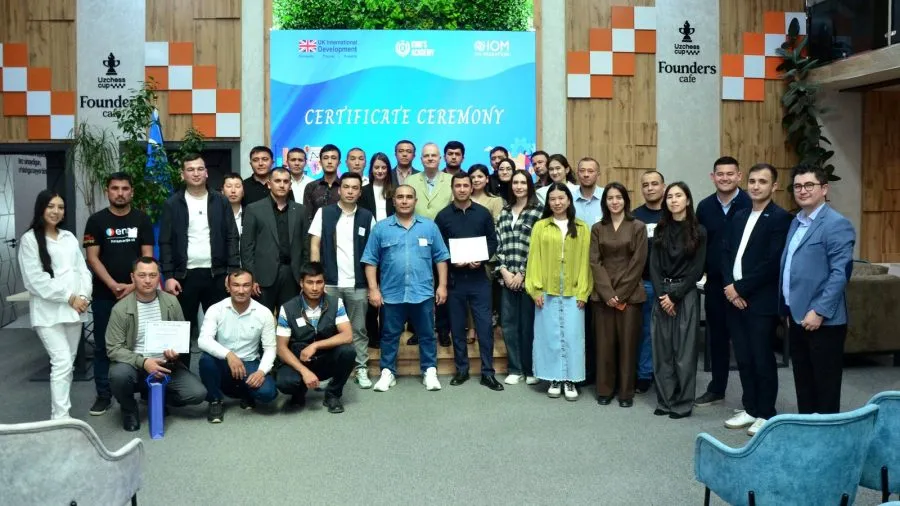
King’s Academy and IOM: English for Uzbek Seasonal Workers Going to the UK, 240 Video Lessons and Financial Literacy for Migrants
Over 5 months, King’s Academy taught English to more than 120 Uzbek migrants preparing for seasonal work in the UK, in cooperation with IOM, the UN Migration Agency, with support…

WIUT Academic Lyceum in Tashkent: How to Prepare for the Entrance Exam Without Burnout (2027 Guide)
WIUT Academic Lyceum admission in Tashkent: 2026 places, dates and tests, English certificate rules and a calm 6-month maths and English plan for Grade 9.

Causes and Solutions Essays in IELTS: The 4-Paragraph Plan That Answers Both Questions
IELTS Task 2 causes and solutions essay: decode the question, the 4-paragraph plan, a solution for each cause, 10 collocations and a Band 7.5+ sample.

IELTS Matching Headings in 4 Steps: How to Stop Losing 5 Marks in Passage 3
IELTS Matching Headings strategy in 4 steps: read the headings first, find the main idea, cross out used headings, manage time. Free 8-minute test.

Job interview in English: 15 questions and how to answer them
The 15 most common job interview questions in English, with short sample answers, the STAR method and the mistakes Uzbek and Russian speakers make.

IELTS One Skill Retake in Uzbekistan (2026): Rules, Cost, How to Register
IELTS One Skill Retake in Uzbekistan: who can retake one skill, the 60-day rule, cost, how to register with the British Council or IDP, and what happens to your TRF.
Submit a request
Do you want to sign up for classes or become part of our team?
Request submitted
We will contact you within the working day.