


The Degree and AI: What Families Are Really Paying For
 Author: Eldor Sattorov⏱ 8 min read
The short version
Almost every student uses AI, and that is not bad in itself. It is bad when AI does the thinking for you: then you pay for a degree but don’t gain knowledge, and knowledge is exactly what employers increasingly test. The good news: checking whether you are learning or just copying is easy, and fixing it can start today.
In every family with a student, the same quiet conversation is going on right now: “Did they really write this themselves?” Parents pay, students hand in work, lecturers give grades. And everyone pretends AI isn’t in the room.
Let’s say out loud what usually goes unsaid, and calmly work out what it means for money, knowledge and future jobs. No accusations: the questions here are for everyone, students, parents and universities alike.
1. First, a fact: almost everyone uses AI
In 2026, British researchers surveyed more than a thousand students. 94 out of 100 use AI to help with assessed work. But only 12 out of 100 paste AI-written text straight into their work. The rest ask it to explain, check and hint.
The picture is similar in the US: 57% of students use AI for coursework at least weekly. Most often they ask it to explain something they don’t understand (64%) and to check answers (60%). Asking it to write whole papers is about a third (36%).
Notice that universities often act as if AI isn’t there. In Gallup’s survey, about half of students say their college discourages or bans AI, and they use it anyway. That is not a reason to panic, but it is a reason for an honest conversation.
2. The good news: AI can teach better than a textbook
Researchers gave nearly a thousand school students maths problems. Some could use an ordinary AI chat, others got AI acting as a tutor that doesn’t write the answer but guides with questions.
The “tutor” group solved practice problems 127% better than those who studied without AI. And in the exam without AI, it scored the same as the normal group: no harm, and more practice.
3. The bad news: AI as a crutch takes the skill away
Now the uncomfortable part. Those who used the ordinary chat and received ready answers solved practice problems 48% better. Great, it seems. But in the exam without AI, they scored 17% worse than students who never used AI at all.
It is like going to the gym and asking a hoist to lift the bar. The bar went up, the report is handed in, and the muscles did not grow. The weight was never for the report; it was there to make you stronger.
A small MIT study gave a similar signal: people who wrote essays with AI were later worse at quoting their own text. An honest caveat: only a few dozen people took part, and it has not yet been fully peer reviewed. But the direction is the same.
💡 A simple rule
If AI helped you understand, that is learning. If AI did it instead of you, that is a report without learning.
4. What a family is really paying for
A degree gives three things. The first is knowledge and skills. The second is a “pass”, a paper that shows an employer the person got through several years of study. The third is environment and time: contacts, mentors and years to grow up.
If AI does the assignments, the first thing suffers first. And the second, the “pass”, is weakening before our eyes: employers trust grades less. In the US in 2019, 73% of employers used grades to screen candidates; now it is 42%, and 70% use skills-based hiring for entry-level roles.
But a degree is still needed. In Uzbekistan in 2024, about 112,000 vacancies in the state database required higher education. So the conclusion is not “a degree isn’t needed”, but “a degree alone is not enough”.
5. What employers check instead of grades
Increasingly they look at what a person can do right now: a test task, a conversation, a mini-project. US employers weigh skills such as teamwork and critical thinking when hiring, and you can’t learn these while a machine thinks for you.
At the same time, employers do want people to use AI: more than a third of entry-level jobs in the US already require AI skills. So the sin is not AI itself. The sin is not understanding what it gave you and not being able to check its answer.
6. Honest questions for everyone
For students: “Can I explain this work in my own words with the laptop closed?” If not, it isn’t yours, and you paid for it in vain.
For parents: “Do I ask my child about grades or about what they have learned?” A grade is easy to get now; understanding is not.
For universities: “Are we still setting tasks AI finishes in a minute?” In the British survey only 48% of students said staff help them build AI skills for their future jobs, while 68% consider this skill essential. There is a gap, and closing it will take everyone.
A simple plan: how to make the degree worth it
- The “me first” rule. Try to solve or write it yourself first, even badly. Then bring in AI to check and hint.
- Ask AI to explain and ask questions, not to write the finished thing. “Explain it as if I’m 12 and check my answer” works better than “do the assignment”.
- Close the laptop once a week. Say out loud what you studied to a parent, a friend or yourself. If it doesn’t come out, go back to the topic.
- Collect proof. Projects, presentations, internships, certificates. They tell an employer more than grades.
- Parents: ask “what did you understand?” rather than “what was your grade?”. Ask them to explain a topic in simple words. It takes five minutes.
- Choose the programme and university by how they teach and assess: exams, oral answers, practice, projects. Before paying, read our article on university contract fees in Tashkent and ask how the university treats AI.
The good news
The degree has not lost its value; it has become more honest. It used to be possible to get one just by sitting through lectures; now what you can really do matters more and more. Those who learn with AI rather than instead of themselves have more opportunities than any generation before.
If you are a parent, you now have a simple question to ask at dinner tomorrow. If you are a student, you have a way to turn every hour with AI into real knowledge. Read also our article on who to become in the age of AI.
💡 🔁 Share it, it’s free
Know a student or a parent who should think about this? Send them the article. It is better to start this conversation in time.
Knowledge that stays with you
English is tested live: in an interview, in conversation, in an exam. Find out your level free in 10 minutes. If you need IELTS, you can also check your IELTS results online.
Read also
- University contract fees in Tashkent 2026–2027: what a degree costs
- Who to Become in the Age of AI: Honest Advice for 16–20-Year-Olds
- How to choose a career for your child: a simple plan for parents
- DTM 2027: entrance tests, format, scores and preparation
- Milliy sertifikat (CEFR) or IELTS: which to choose
Frequently asked questions
Is university worth paying for if AI does the assignments?
You should pay for knowledge and skills, not for paper. If you study with the help of AI and can explain the material yourself, the money works. If AI does everything for you, you pay for a degree with nothing inside.
Can I use AI for studying?
Yes, as a tutor: to explain, check and ask questions. But first learn your university’s rules, as they differ.
How can a parent tell if a child is learning rather than copying?
Ask them to explain a recent topic in their own words and without a phone. If the explanation is coherent, all is well.
Do I still need a degree if there is AI?
For many careers and vacancies, yes. But a degree alone is increasingly not enough: employers look at skills and projects.
Should I ban my child from using AI?
Bans work badly. It is better to agree a rule: me first, then AI as a helper, and always explain the result out loud.
Where do I start today?
Ask one question: “Explain what you learned this week.” Then introduce the “me first” rule.
Sources (data as of 22 November 2026)
- HEPI — Student Generative AI Survey 2026 (Report 199; 1,054 UK undergraduates)
- Gallup — AI Is Routine for College Students, Despite Campus Limits
- Bastani et al. — Generative AI Without Guardrails Can Harm Learning, PNAS 2025
- Wharton Knowledge — Without guardrails, generative AI can harm education
- MIT Media Lab — Your Brain on ChatGPT (Kosmyna et al., 2025, preprint)
- NACE — Skills-based hiring grows, but college students don’t fully understand it (2026)
- NACE — Ready or reluctant: employer expectations for AI skills meet student skepticism (2026)
- Spot.uz — 2024 graduates and vacancies, figures of the Minister of Employment (12.08.2024)
The HEPI (UK), Gallup and NACE (US) surveys reflect their own countries and samples. The MIT study is small and not yet fully peer reviewed. The school experiment gave results for school mathematics, so conclusions for universities should be applied with care.
Already taken IELTS? Check your IELTS results →
What's next?
Take the first step — it's free or takes 2 minutes:
Other articles
Daily useful articles

Mock IELTS in Tashkent: Computer-Delivered Practice | King’s Academy
Take a computer-delivered mock IELTS at King’s Academy, official British Council partner in Tashkent. Full feedback on all four skills and an audio recording of your exam.
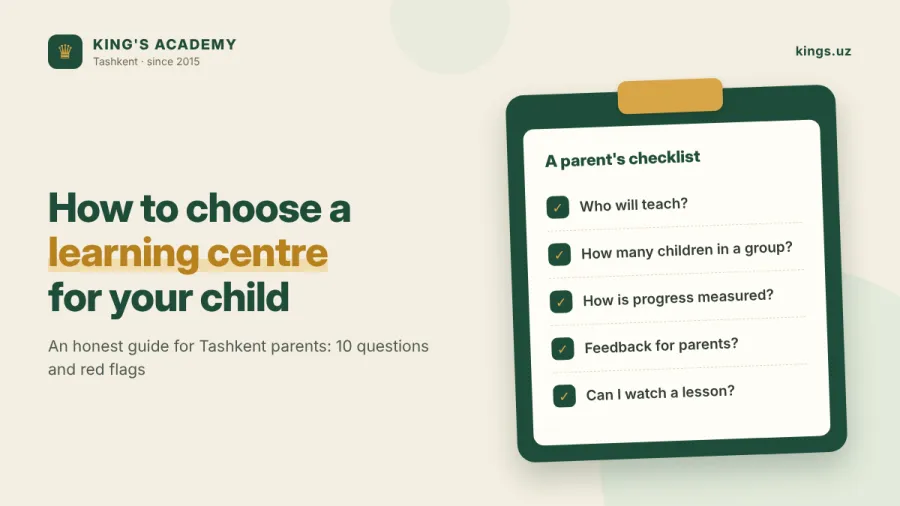
How to Choose a Learning Centre for Your Child in Tashkent: An Honest Guide for Parents
How to choose a learning centre for your child in Tashkent: 10 questions to ask any centre, red flags, and why an app can't replace a teacher.

Private Schools in Tashkent 2026/27: Fees, Curricula, Admission
What private schools in Tashkent cost in 2026/27: a verified table of 11 schools with fees, curricula, languages, districts, admission and a school finder.
How Much Does IELTS Preparation Cost in Tashkent in 2026? Course and Exam Prices
How much IELTS costs in Tashkent in 2026: the official exam fee, course prices, your total budget and practical ways to save money.

How Long Does It Take to Learn English from Zero to IELTS?
How long does it take to learn English from zero to IELTS 6.0–7.0? Realistic timelines by level, free tools, and King’s Academy courses in Tashkent.
Who to Become in the Age of AI: Honest Advice for 16–20-Year-Olds
Will AI take over professions, and how to choose your path at 16–20: what is true, what not to fear, and a simple six-step plan.
Submit a request
Do you want to sign up for classes or become part of our team?
Request submitted
We will contact you within the working day.