


How to Get IELTS 7.0+ Through Self-Study: A Realistic, No-Nonsense Roadmap

In short
You don’t need an IELTS teacher to score 7.0, 8.0 or even 8.5 — if you build real English and keep a strict daily routine. That means 90–120 minutes of English every day for months: academic reading, listening with shadowing, reading aloud, vocabulary with spaced repetition, an English diary and English-only video. Exam format comes last. Self-study has two weak spots, Writing and Speaking: without some feedback, mistakes turn into habits.
My story: 6.5 without trying, then 8.0 and 8.5
I never had an IELTS teacher and never took a preparation course. In 2007, on a university foundation course in the UK, our teacher mentioned that we would sit an exam at the end of the course. We sat it. I got 6.5 — nothing impressive, right? — and completely forgot about the certificate.
In 2011 I came back to Uzbekistan after five years of studying and living in the UK, and suddenly everyone was talking about IELTS. No exaggeration: I didn’t even know which exam they meant until I saw a certificate and thought, “Wait a second, I’ve seen this before.” I registered and walked in without serious preparation — a few Listening and Reading practice tests to see the format, nothing for Writing or Speaking. I got 8.0. Then 8.5. Then high scores again, many times.
My case can’t be compared with most readers’. I had five years of full academic and daily immersion in English. The exam simply measured the language I already had. If you are studying at home without that environment, you cannot wing it. You have to build that immersion yourself — through daily habits.
What 7.0 actually means
- Listening and Reading: about 30 correct answers out of 40 in each.
- Writing and Speaking: band 7 means a variety of complex sentences, frequent error-free sentences, less common vocabulary used naturally, and clear, developed ideas. Read the official Writing band descriptors once; they show exactly what examiners reward.
- Level: 7.0 sits at C1. From 5.5 (B2) that is one full CEFR level — a serious but realistic climb.
Why tricks and templates don’t get you to 7.0
Memorised essay templates, “magic” linking phrases and answer-guessing strategies can lift a 5.5 to a 6.0. They stop working at 7.0, because band 7 is about flexible, accurate English that you produce on the spot. Examiners recognise memorised language and mark it down. Tricks save time in the exam; only English gives you the score.
Realistic expectations
Cambridge English uses a rough rule of about 200 study hours to move up one CEFR level. At 90–120 minutes a day, that is several months of real work:
| Where you start | Daily study | Typical time to 7.0 |
|---|---|---|
| 6.5 | 60–90 min | 2–3 months |
| 6.0 | 90 min | 4–6 months |
| 5.5 | 90–120 min | 6–9 months |
| 5.0 or below | 2 hours | 9–12 months, reaching B2 first |
Rough estimates for consistent daily study. Missed weeks push the date back.
If someone promises 7.0 in a month from 5.5, they are selling hope, not a method.
Where are you now?
Before you plan, know your starting point. Check your current English level — free online test →
The mindset: drop by drop, a lake forms
There is an Uzbek proverb: “Tomchi-tomchi koʻl boʻlur” — drop by drop, a lake forms. James Clear’s Atomic Habits says the same thing in modern language: small actions, repeated every day, compound into big results. Fifteen minutes a day is more than 90 hours a year; 90 minutes a day is more than 500. That is how a band changes — not in a weekend, but in a calendar full of crosses.
- Make it non-negotiable and tiny on bad days. One page, one minute of shadowing, three words. Never zero.
- Attach it to something you already do. Podcast with breakfast, diary with tea before bed.
- Never miss twice. Missing one day is life. Missing two is the start of quitting.
- Track it on paper. A cross for every completed day. Don’t break the chain.
- Give it time. In a study on habit formation, it took participants 66 days on average for a new behaviour to become automatic (Lally et al., 2010). The first two months are the hardest.
The skill-by-skill system
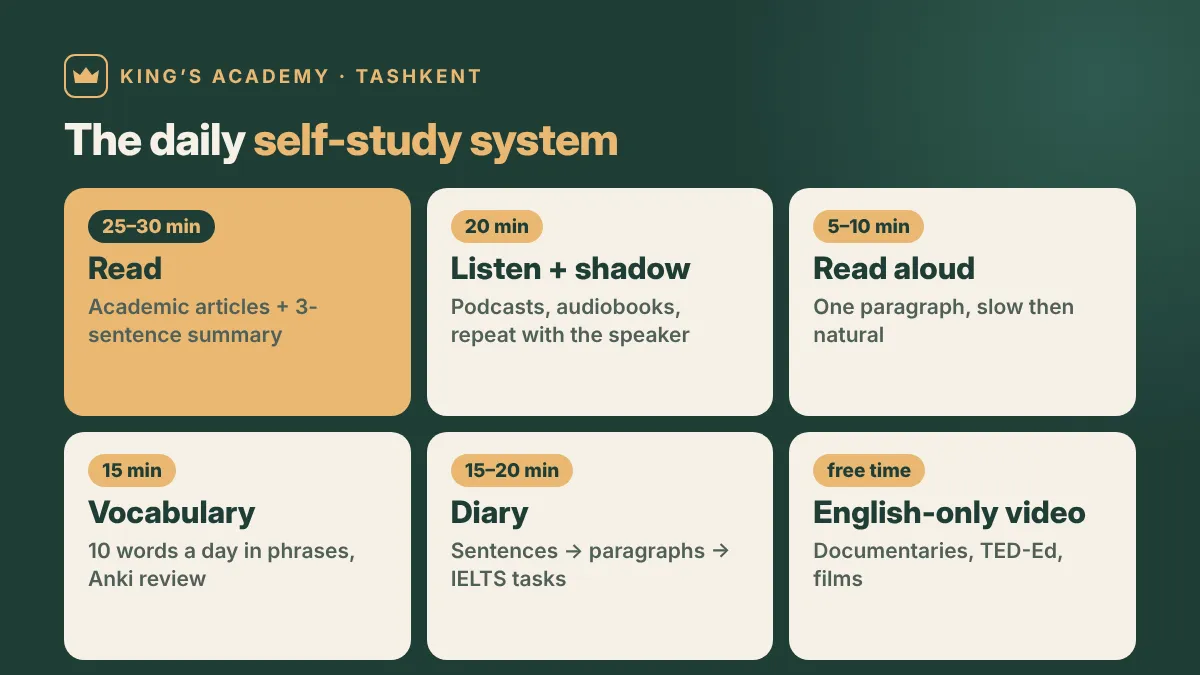
1. Reading and vocabulary: the old-fashioned secret weapon
In the age of Reels and TikTok, “read every day” sounds boring and old-fashioned. It is still the biggest single difference between a 6.0 and a 7.0+. Reading builds vocabulary, grammar and speed at once, and IELTS Reading passages are academic texts.
- 25–30 minutes a day. Start with BBC News or The Guardian; move to BBC Future, The Conversation, National Geographic, The Economist, The Guardian Long Read and Nature news. The more academic, the better.
- One real book a month: non-fiction first (psychology, history, science), then novels.
- After each article, write a 3-sentence summary. If you can’t summarise it, you didn’t understand it.
- Read aloud for 5–10 minutes: one paragraph slowly, then at natural speed. It trains pronunciation, pacing and the mouth muscles you need in Speaking.
- Vocabulary, 15 minutes: 10 new words a day from what you read and hear — 3,600 a year. Learn phrases, not single words (“have a significant impact on”, not “impact”). Check examples in the Cambridge Dictionary, use the Oxford 3000 and 5000 lists to see which words matter, and review with Anki (free spaced repetition). Then use each new word in your diary the same day.
2. Listening and speaking: shadowing and immersion
- 20 minutes a day of podcasts or audiobooks. Start with BBC 6 Minute English, move to TED talks and podcasts on your interests. Free audiobooks: LibriVox.
- Shadowing: play one minute; play it again and speak along with the speaker, copying intonation, stress, connected speech and rhythm. Repeat until you keep up. It trains Listening, pronunciation and fluency together.
- Switch 100% of your video to English: YouTube, films, series. Documentaries and explainers are best — TED-Ed, science, history, interviews. English subtitles first, none once you follow 70–80%.
- Use dead time: bus, metro, cooking, walking. Replace your usual content; don’t add extra hours.
3. Writing: a diary before essays
- Stage 1 (weeks 1–2): two or three sentences or a short paragraph every night. Simple is fine.
- Stage 2 (weeks 3–6): structured prompts — What was the highlight of my day? What is one new thing I learned today? What challenging problem did I solve today?
- Stage 3 (week 7 onwards): timed IELTS Writing Task 1 and Task 2, then self-correction against the band descriptors: did I answer the exact question, are my paragraphs clear, which grammar mistakes repeat?
- Once a week, reread an old entry and correct it. You’ll see mistakes you couldn’t see before — that is progress.
The daily routine (90–120 minutes)
| When | What | Minutes |
|---|---|---|
| Morning | Podcast or audiobook + 1–2 minutes of shadowing | 20–25 |
| Commute / lunch | Anki review + 10 new words in phrases | 15 |
| Evening | One academic article + 3-sentence summary | 30 |
| Evening | Read a paragraph aloud | 10 |
| Before bed | Diary entry, using today’s new words | 15–20 |
| Free time | English-only YouTube, documentaries or a film | as you like |
Weekends: one timed test section and one longer reading or documentary session.
A 12-week roadmap to 7.0+
This plan suits a starting point of 6.0–6.5. From 5.5, run it twice: the first 12 weeks to reach a solid 6.5, the second to reach 7.0+.
| Weeks | Focus | Milestone |
|---|---|---|
| 1–2 | Start all daily habits; one free practice test for a baseline | Routine running every day; starting band known |
| 3–4 | News → long-form articles; diary Stage 2 | Read a full long-form article without stopping |
| 5–6 | Shadowing every day; first timed Listening and Reading sections | Listening and Reading at 26–28/40 |
| 7–8 | Diary Stage 3; one Task 2 essay a week; Speaking: record a Part 2 answer daily | 250-word essay in 40 minutes |
| 9–10 | Two timed Writing tasks a week; one full practice test | Listening and Reading at 28–30/40 |
| 11–12 | Full practice tests in exam conditions; fix your weakest section | Two tests at 7.0 level — book the exam |
Keep the daily habits until exam day. Exam practice is the top layer, not a replacement.
If you take the computer-delivered exam, practise typing and the screen layout too — see how computer-delivered IELTS works.
Test yourself in real exam conditions
A full test under time pressure feels different from practice at home. Take a CD Mock IELTS exam →
Your free toolkit
- Official practice: British Council free IELTS Academic practice tests, IDP’s free sample tests, and the Cambridge IELTS Academic books (volumes 12–20) — the closest thing to the real exam.
- Marking criteria: IELTS Writing band descriptors.
- Reading: BBC Future, The Conversation, The Economist, The Guardian Long Read, National Geographic.
- Listening: BBC Learning English, TED, TED-Ed, LibriVox.
- Vocabulary: Anki, Cambridge Dictionary, Oxford 3000 and 5000.
Where self-study runs out
- Writing: you can’t see your own repeated mistakes. Swap essays with a study partner, compare yours with model answers, and get an expert check at least a few times before the exam.
- Speaking: recording yourself helps; a real face-to-face conversation with an examiner-style partner helps more.
- Common traps: doing only practice tests (they measure English, they don’t build it), learning word lists without context, skipping Writing because it’s uncomfortable, and studying four hours on Sunday and nothing on weekdays.
Prefer guided preparation?
If you want a faster route with regular feedback on Writing and Speaking, explore intensive IELTS courses →
Own the process
Nobody can learn English for you — not a teacher, not an app, not a template. The good news is that nobody can stop you either. Ninety minutes a day. One article, one podcast, ten words, one diary entry. Some days it will feel pointless. Do it anyway. Drop by drop, the lake forms — and one day you open your result and see the number you wrote on your calendar months ago.
Frequently asked questions
Can you really get IELTS 7.0 through self-study?
Yes, if you study 90–120 minutes every day for several months and get some feedback on Writing and Speaking. Without feedback, Writing is where most self-learners get stuck.
How long does it take to get from 6.0 to 7.0 on your own?
Usually 4–6 months of daily study. From 5.5, expect 6–9 months.
What is the best free material for IELTS self-study?
Official British Council and IDP practice tests for the format, plus real English for the language: BBC, The Conversation, TED, podcasts and books. You can check an official result on our page Check your IELTS results.
About the author
Eldor Sattorov — founder and director of King’s Academy. MA in TESL (Webster University), BA in International Relations with Politics (University of York, UK). CELTA-qualified, former Cambridge English Speaking examiner, has taken the official IELTS more than 10 times with scores of 8.0–8.5.
Sources: IELTS — Writing band descriptors (official) · British Council — Free IELTS Academic practice tests · BBC Learning English — 6 Minute English · The Conversation — research explained by academics · LibriVox — free public-domain audiobooks · Anki — free spaced-repetition flashcards · Oxford Learner’s Dictionaries — Oxford 3000 and 5000 · Cambridge Dictionary · Lally et al. (2010) — How are habits formed, European Journal of Social Psychology
What's next?
Take the first step — it's free or takes 2 minutes:
Other articles
Daily useful articles

Building Global Bridges: Japanese students studying at King’s Academy
King’s Academy in Tashkent exemplifies modern, globally integrated education through its robust international partnerships, active institutional ties with JICA and the…

What Age Should Your Child Start Learning English? An Age-by-Age Guide from 3 to 12
What age should your child start English? What works at 3–5, 6–8, 9–10 and 11–12, signs they're ready for a group, and how to help at home.

Job interview in English: 15 questions and how to answer them
The 15 most common job interview questions in English, with short sample answers, the STAR method and the mistakes Uzbek and Russian speakers make.
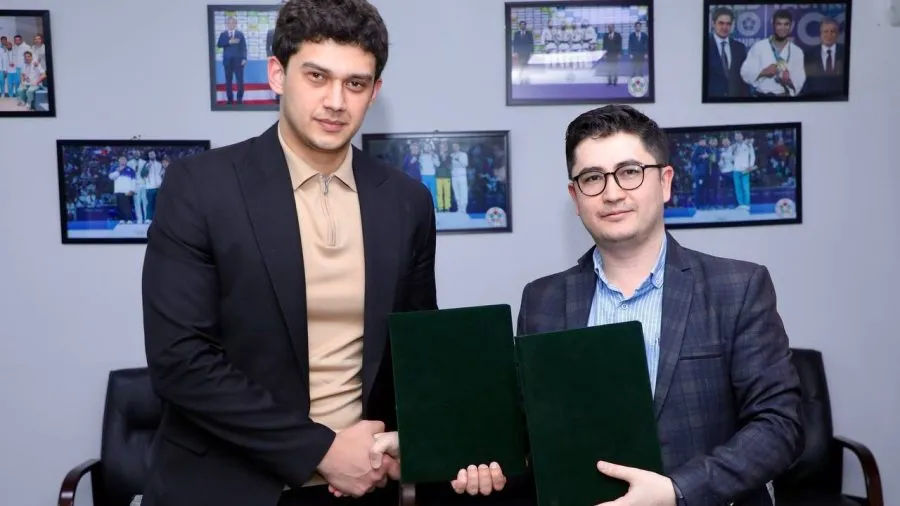
King’s Academy Signs Memorandum with the Uzbekistan Judo Federation: English for Uzbek Judokas
King’s Academy has signed an official memorandum with the Uzbekistan Judo Federation to teach English to Uzbek judokas, helping them communicate with international coaches,…

IELTS Courses in Tashkent 2026: How to Choose — Formats, Prices and 10 Questions to Ask Any Centre
How to choose an IELTS course in Tashkent in 2026: preparation formats, prices, the exam fee, 10 questions to ask any learning centre, and the red flags to avoid.

How to Get IELTS 8.0: A Complete Guide to Successful IELTS Preparation in Tashkent
How can you get IELTS 8.0? How long does IELTS preparation take? What should you do every day? Is an IELTS course really necessary? How important is typing speed for…
Submit a request
Do you want to sign up for classes or become part of our team?
Request submitted
We will contact you within the working day.