


Learning English After 30: Not Too Late, Right on Time

In short
It is not too late to start learning English after 30 — or after 40, or 50. Research shows that adults progress faster than children at the start, and you don’t need a “perfect” accent to communicate freely. What matters is a clear goal, regular practice and real conversation. That is why adults learn best in small groups of people their own age: in the evening after work, online, or right at the office.
“I’m already 34 — isn’t it a bit late for English?” We hear this a lot. Usually from someone who runs a department, raises children and understands loans and taxes — yet is convinced that for English, “the moment has passed”.
Good news: only one thing has passed — the chance to learn English for free in school lessons. Everything else is still on the table. Let’s look at why 30, 40 and even 50 are perfectly normal ages to start.
“It’s too late after 30”: what the research actually says
In 2018, scientists at MIT analysed answers from almost 670,000 people and found that the ability to learn grammar to a native-speaker level stays strong until about 17 or 18. Sounds gloomy? Only at first glance. That finding is about sounding indistinguishable from a native speaker. To negotiate, travel, watch series without subtitles or pass IELTS, you don’t need that level.
What’s more, adults have a speed advantage. Researcher Carmen Muñoz, summarising many studies, writes that older learners advance faster in the first stages of learning a language. An adult understands rules, can plan, and sees straight away why each new word matters. A child first needs to be told why Present Perfect exists at all. (To be fair, so do some adults.)
6 reasons to start right now
1. You have a goal.
A promotion, talks with partners, travel, your children studying abroad — a clear goal motivates better than any alarm clock.
2. You know how to learn.
Discipline, experience and the confidence to ask questions — adults already have them. Nobody needs to check your homework diary.
3. You’re faster at the start.
Adults move through the first levels faster than children: you understand the logic of the language instead of just memorising.
4. It’s a workout for your brain.
In a 2013 study (Neurology, 648 patients), people who spoke two or more languages developed dementia on average 4.5 years later. The study looked at lifelong speakers of several languages, but the message is clear: the brain loves language work.
5. Your career.
English opens doors to international companies, projects and business trips — and makes you more valuable to your current employer.
6. An example for your children.
The best argument for a child to learn English is a parent who is learning it too.
What adults are afraid of — and what’s really true
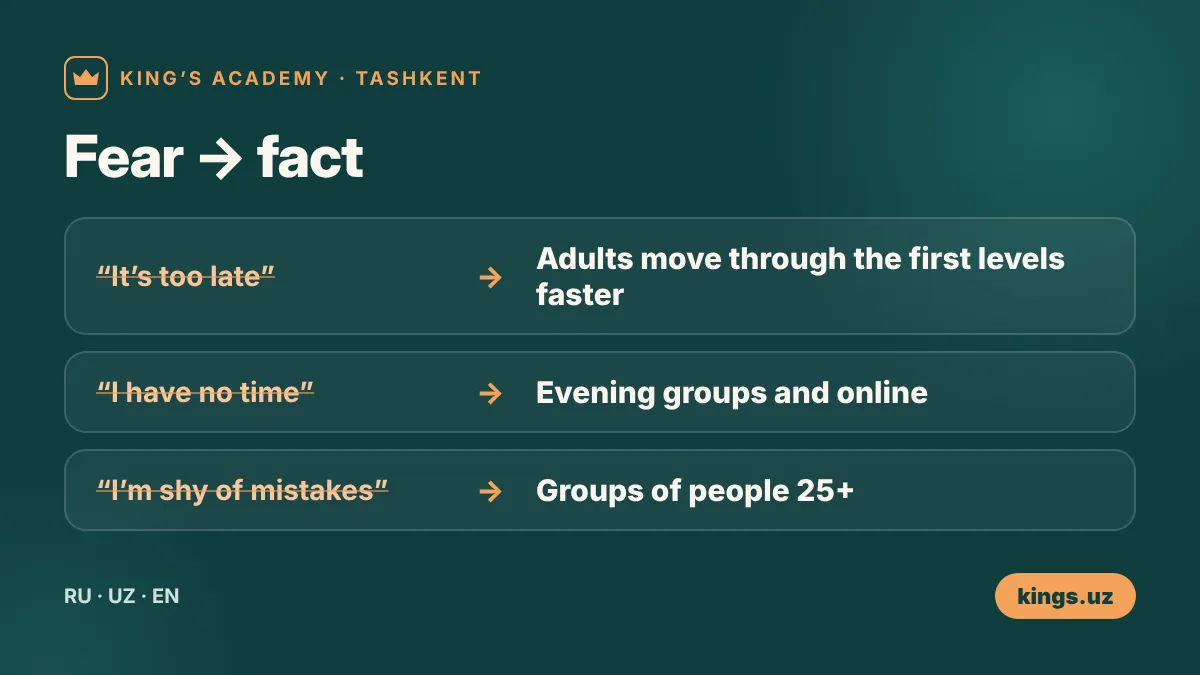
| Fear | Fact |
|---|---|
| “I’ll be the oldest in the group” | King’s Academy has separate groups for adults aged 25+. You’ll study with people whose goals and schedules are like yours. |
| “I don’t have time” | Evening groups after work, 3 times a week — or online lessons from home or the office at a time that suits you. |
| “I’ve forgotten my school English” | A free test shows your real level, and the adult course starts at A1 — right from the beginning. |
| “I’m embarrassed to make mistakes” | Mistakes are a normal part of learning. Teachers correct you gently and to the point, and in a group everyone is in the same boat. |
| “It’s expensive” | 700,000 sum a month at our BIY and Sayram branches, 900,000 sum at Alayskiy. Your first lesson is free. |
If speaking is the part that scares you most, read “Afraid to speak English?”, where we explain where the fear comes from and give simple steps to get past it.
Why adults learn better in a group
Learning words in an app is useful. But you only learn to speak by speaking. Researcher Rebecca Adams notes in a paper for Cambridge that when students talk with each other, they speak more and try out new words and structures more boldly, and the atmosphere is more relaxed than in a conversation with the teacher.
- More speaking practice. In a group you talk, not just listen.
- Regularity. Your group expects you on Monday. An app will happily wait until next year.
- Motivation. Your classmates’ progress is contagious: if they can do it, so can you.
- New people. A group is an easy place to meet like-minded people and useful contacts.
- Sensible price. A group lesson costs less than a private one.
How adults learn at King’s Academy: 3 formats
🌙 Evening groups for adults
Groups for ages 25+, up to 10 people, 3 times a week for 90 minutes, levels A1 to C1. Morning, daytime and the most popular after-work evening groups at our Alayskiy, BIY and Sayram branches.
💻 Online
One-to-one lessons on Zoom: 3 times a week for 60 minutes, at a time that suits you. There are online groups too — they’re marked in the schedule.
🏢 For companies
Corporate English for employees: at your office, online or at our centre, with a programme built around your business needs. For example, we teach staff of SQB bank and local staff of the U.S. Embassy in Tashkent.
What if you need IELTS? Many adults start with General English and then move on to IELTS preparation. Already taken the exam? We explain how to check your official result on our “Check your IELTS results” page.
How to start: 3 simple steps
- Take the free level test — about 12 minutes.
- Pick a group that suits you in the schedule.
- Come to a free trial lesson. If the group isn’t the right level, we’ll offer another one and a second free trial.
Start this month — not “next Monday”
King’s Academy is a learning centre in Tashkent founded in 2015 and an official British Council partner. We’ll find a group that fits your level and schedule. Call +998 90 900 79 66 or message us on Telegram: @kingsacademy_uz.
Frequently asked questions
Can I start from zero at 40 or 50?
Yes. The adult course starts at A1, and groups are formed by level, so you’ll study with others who are just starting too.
How long until I can speak?
It depends on your starting level and how regularly you study. The adult course runs 4–12 months, and simple everyday conversations usually come within a few months of regular classes.
Will I lose my accent?
A slight accent may stay, and that’s fine. Clear pronunciation matters more: even IELTS assesses how easy you are to understand, not whether you have an accent.
Group or one-to-one — which is better for an adult?
A group gives you more speaking practice and motivation, and it costs less. One-to-one online lessons suit very busy schedules or narrow goals.
Do you have evening classes?
Yes. After-work evening groups run at all three branches: Alayskiy, BIY and Sayram.
Can my employer pay for my studies?
Yes, if your company joins a corporate programme. Show your HR team our guide to corporate English.
Sources: MIT News — Cognitive scientists define critical period for learning language (2018) · C. Muñoz — On how age affects foreign language learning (2010) · ScienceDaily — Speaking a second language may delay different dementias (Neurology, 2013) · R. Adams — Enhancing student interaction in the language classroom (Cambridge Papers in ELT, 2018)
What's next?
Take the first step — it's free or takes 2 minutes:
Other articles
Daily useful articles

The True Cost of IELTS 7.5 in Tashkent: How to Plan Your Child’s Education Budget for the Next 5–6 Years
How much does IELTS 7.5 really cost in Tashkent? Real 2026 prices, a planned vs last-minute budget, university fees, a 6-year savings plan and English pay data.

U.S. Ambassador Jonathan Henick Visits King’s Academy in Tashkent: ESP, Youth Internships and U.S.–Uzbekistan Education Ties
U.S. Ambassador Jonathan Henick visited King’s Academy in Tashkent to discuss English for Specific Purposes (ESP), teaching standards and youth internships with American Councils.…

“River” or “Rivers”? 10 Tiny IELTS Listening Mistakes That Lower Your Band (From Real Tashkent Mock Results)
10 small IELTS Listening mistakes that cost marks: spelling, plurals, word limits, numbers and blanks. 30 commonly misspelt words and a free audio test.
How to Choose an English Teacher in Tashkent: Beyond IELTS Scores
How to choose an English teacher in Tashkent: what IELTS scores don’t show, whether age matters, trial lessons, real results and red flags.

What Age Should Your Child Start Learning English? An Age-by-Age Guide from 3 to 12
What age should your child start English? What works at 3–5, 6–8, 9–10 and 11–12, signs they're ready for a group, and how to help at home.
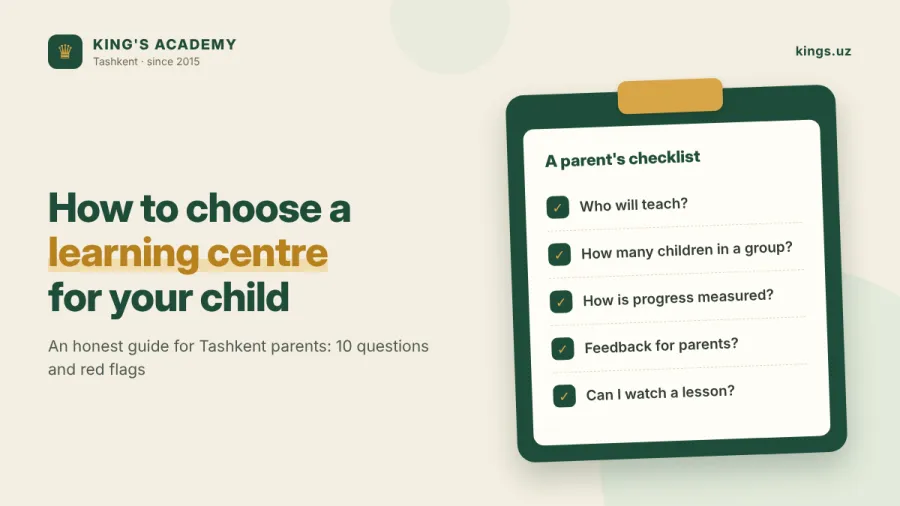
How to Choose a Learning Centre for Your Child in Tashkent: An Honest Guide for Parents
How to choose a learning centre for your child in Tashkent: 10 questions to ask any centre, red flags, and why an app can't replace a teacher.
Submit a request
Do you want to sign up for classes or become part of our team?
Request submitted
We will contact you within the working day.