


IELTS 9.0: how to get it, and do you even need it? An honest guide

In short
IELTS 9.0 is possible, and it is fine to aim for it. But almost nobody needs it to get into university: even Cambridge usually asks for 7.5. Treat IELTS as an exam and one step on a long staircase, not as a life goal. Below is an honest talk about the “niner” craze, and a realistic roadmap for those who still want 9.0.
Family dinner. Mum’s phone buzzes: another congratulation in the parents’ group chat, with a photo of a certificate. “Our niner!” Mum slowly turns to her son. The son, who has a 7.5 and already holds an offer from a good university, understands: dinner is over.
If you smiled, you have probably seen this yourself. Over my years as a teacher and IELTS examiner, I have watched this exam in Uzbekistan turn from a tool into something bigger: a status symbol, a reason for comparison, and sometimes a source of real stress. Let’s calmly separate what is true from what is just noise.
Where the “niner” craze came from
Not long ago, 7.0 was an excellent result. Now social media is full of words like “niner” and phrases like “8.5 is almost a failure”. Certificates go up in stories, get discussed in school chats, and make relatives three generations away proud.
There is something good in this. A 9.0 really is a huge amount of work, and the person who gets it deserves sincere respect. But there is another side. When a score becomes a way to show who is “better”, respect turns into a race. A teenager starts to believe that 8.0 is a failure. Yet on the official scale, 8.0 means “fully operational command of the language with only occasional unsystematic inaccuracies”. That is a very high level, and something to be proud of.
Do we even need 9.0? An honest answer
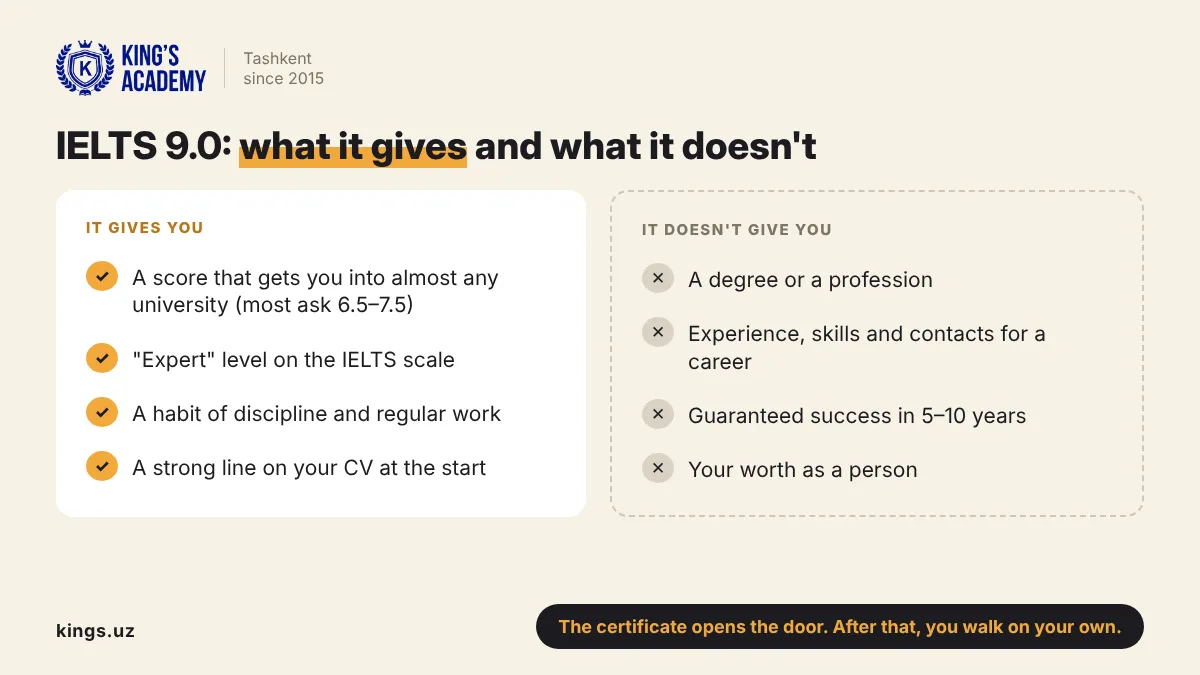
Let’s look at the facts. For undergraduate study, the University of Cambridge usually asks for IELTS Academic 7.5, with at least 7.0 in each element. Uzbekistan’s state scholarship El-yurt umidi asks for 7.0 for master’s study. Most good universities around the world ask for something between 6.5 and 7.5. Programmes where 9.0 is a requirement are almost impossible to find.
And here is something people rarely say out loud. Once you are admitted, your IELTS score stops interesting anyone almost immediately. Your university lecturer looks at your essays. Five years later, an employer asks what you can do and what you have done. The certificate opens the door, but after that you walk on your own.
And yet, why not?
I am not against high goals. Quite the opposite. A student who aims for 9.0 reads more, listens more and writes more carefully. Even if the result is 8.5, they come out with English good enough to study at any university and work in an international team. The official description of band 9 says the language is “appropriate, accurate and fluent, and shows complete understanding”. English like that is real capital. But the capital is the language, not the number on the paper.
The difference is why you are trying. For the skill: wonderful. For stories and other people’s approval: you will burn out fast.
Don’t become an “IELTSaholic”
I have met students who took the exam again and again to turn an 8.5 into a 9.0, even though their university would have happily accepted a 7.0. Time, money and nerves all went into half a band that changed nothing in their lives.
Picture a staircase. At the bottom are your first words in English. Then school, IELTS, university, your first job, a profession, your own projects. IELTS is one step, and quite an early one. It matters to stand on it firmly. But nobody builds a house for the sake of one step. If you make IELTS your life goal, a few years later you may be surprised by how little the certificate itself gave your career. Knowledge, the habit of learning and the people you meet along the way give you far more.
For parents: the neighbour’s daughter, a colleague’s son and the cat in the street
Dear parents, we understand you. It is hard to stay calm when the neighbour’s daughter got 8.5, a colleague’s son got 9.0, and it seems even the cat in the street has a certificate by now. And out it comes: “They can do it, so why can’t you?!”
But that sentence almost never works. A child doesn’t hear “I believe in you”. They hear “you are worse than others”. Some start to fear the exam; some stop trying at all. Here is what really helps:
- Compare your child with themselves three months ago, not with the neighbours.
- Instead of “What’s your score?”, ask “What did you read in English today?” and “What was difficult?”
- Praise effort and regular work. The score follows them.
- Find out what score your child actually needs for their goal. Often it is 6.5–7.5, and the pressure drops at once.
- Stay in touch with the teacher. They see progress better than any parents’ chat.
If 9.0 is still your goal: a realistic roadmap
How the overall score is calculated
Your overall band is the average of the four sections, rounded to the nearest half band. Under the official IELTS rules, an average ending in .25 is rounded up to the next half band, and one ending in .75 is rounded up to the next whole band. So you can get 9.0 overall without a perfect 9 in every section. For example, 9.0, 9.0, 8.5 and 8.5 give an average of 8.75, which becomes 9.0. But 9.0, 8.5, 8.5 and 8.5 give 8.625, which is 8.5.
Listening and Reading: almost no mistakes
As a guide, band 8.0 needs about 35 correct answers out of 40 on average. For 9.0 you need an almost perfect answer sheet. Marks are lost not on the hardest questions but on small things: an extra or missing letter, a plural ending, or misreading True / False / Not Given. The best practice is reading real articles and books every day, not only practice tests.
Writing: the hardest part
Writing is marked on four criteria: task response, coherence and cohesion, vocabulary and grammar. The difference between 8 and 9 lies in those “occasional” errors and in sounding natural. Typical traps for Uzbek and Russian speakers are articles, sentences that are far too long, and memorised templates such as “In this day and age…”. Examiners see phrases like that hundreds of times a day. Write simply and precisely, and always get feedback from a real teacher.
Speaking: an examiner’s view
When I examined Speaking myself, the best answers sounded like a conversation, not a speech. Memorised idioms like “It’s raining cats and dogs” don’t impress anyone when they don’t fit. Band 9 is when you think in English, correct yourself easily and are easy to listen to. An accent is not a problem. We wrote more about this in What IELTS Speaking examiners really listen for.
How long it takes
If you are a steady 8.0, the road to 9.0 is months of daily immersion, not a week of “secret strategies”. If you are at 6.5 now, aim for 7.5 first: that already opens most doors. It’s best to check your current level with a mock exam, and you can find the results of past attempts on our Check your IELTS results page. We explain how every section is marked in How IELTS is assessed.
A step, not the summit
Here is what I want to say to every student who is looking at other people’s certificates right now and feeling not good enough. Your score is the result of one exam on one day. It doesn’t measure your intelligence, your character or your future. Get what you need for the next step, and keep climbing: read, study, try new things, meet interesting people.
In ten years, nobody will remember who had 8.5 and who had 9.0. They will remember who you became.
At King’s Academy we prepare students for IELTS in groups of up to 10, with printed books. We keep in close touch with parents and try to keep the exam what it is: an exam. After class, students stay in our library and study zone to read, do homework and play board games in English. That’s where the language actually lives, not just gets tested.
Find your real level, without the race
Take a free level check or a weekend CD Mock IELTS. If you need to reach 7.0+ quickly, there is our IELTS intensive; see the schedule and prices.
Frequently asked questions
Do I need IELTS 9.0 to get into university?
Almost never. Most universities ask for 6.5–7.5; Cambridge usually asks for 7.5 with at least 7.0 in each element for undergraduate study. Always check your own programme’s requirements.
How is the overall IELTS score calculated?
Add the four section scores and divide by four. The average is rounded to the nearest half band; .25 rounds up to the next half band and .75 rounds up to the next whole band.
How long does it take to prepare for 9.0?
It depends on where you start. From a steady 8.0, expect months of daily reading, writing with feedback and real speaking. From 6.5, it makes more sense to reach 7.5 first.
Is it worth retaking an 8.5 to get 9.0?
Only if you truly need it for a specific goal, or you simply want to test yourself. If your university has already accepted your score, your time is better spent on your actual subject.
What should I do if my child is behind their peers?
Don’t compare. Find out what score their goal really needs, check their real level with a mock exam, and support regular study. A calm child performs better than a frightened one.
Sources: IELTS: scoring in detail · British Council: how IELTS is assessed · University of Cambridge: entry requirements
What's next?
Take the first step — it's free or takes 2 minutes:
Other articles
Daily useful articles

King’s Academy and IOM: English for Uzbek Seasonal Workers Going to the UK, 240 Video Lessons and Financial Literacy for Migrants
Over 5 months, King’s Academy taught English to more than 120 Uzbek migrants preparing for seasonal work in the UK, in cooperation with IOM, the UN Migration Agency, with support…

How to Get IELTS 8.0: A Complete Guide to Successful IELTS Preparation in Tashkent
How can you get IELTS 8.0? How long does IELTS preparation take? What should you do every day? Is an IELTS course really necessary? How important is typing speed for…

Causes and Solutions Essays in IELTS: The 4-Paragraph Plan That Answers Both Questions
IELTS Task 2 causes and solutions essay: decode the question, the 4-paragraph plan, a solution for each cause, 10 collocations and a Band 7.5+ sample.

First-Grade Enrolment in Tashkent 2027: How to Apply on my.gov.uz
First-grade enrolment in Tashkent 2027: age rule, dates, documents, catchment area and the my.gov.uz application step by step, with an age checker.

Offline vs Online IELTS Preparation: Why a Real Classroom Still Wins in 2026
Offline or online IELTS preparation? See the honest comparison, a step-by-step plan, and why Tashkent students reach 7.0+ in class at King’s Academy.

IELTS Courses in Tashkent 2026: How to Choose — Formats, Prices and 10 Questions to Ask Any Centre
How to choose an IELTS course in Tashkent in 2026: preparation formats, prices, the exam fee, 10 questions to ask any learning centre, and the red flags to avoid.
Submit a request
Do you want to sign up for classes or become part of our team?
Request submitted
We will contact you within the working day.