


Learn English on Your Own: 5 Daily Habits and Websites

In short
A course gives you structure, a teacher and practice in a group, but a language settles in between lessons. Small daily habits work best: 20 minutes of listening, 10 minutes of reading, 10 minutes of vocabulary review, 5 minutes of speaking aloud and a few sentences of writing. Below are 5 ways, free websites for each, a 30-minute daily plan, and why learning with other people matters more than it seems.
Why small daily habits work
We acquire a language through a large amount of understandable input: texts and speech slightly above our level (linguist Stephen Krashen’s idea of “comprehensible input”). Three lessons a week give structure, but the amount of English between lessons is almost always too small.
Spaced review is remembered better than cramming in one evening (the spacing effect, known since Hermann Ebbinghaus’s research). That is why 20–30 minutes every day does more than 3 hours once a week.
A habit is easier to keep when you attach it to something you already do: the commute, the metro, Tashkent traffic, waiting in a queue.
5 ways to learn English on your own every day
1. Listen to English for 20 minutes a day: podcasts and audiobooks
Listen on the way to work, on a walk or while doing chores. Choose material where you understand 70–80%. If you understand almost nothing, it is too difficult.
- BBC Learning English: the “6 Minute English” podcast, short episodes with transcripts.
- LearnEnglish (British Council): audio and video by level, with exercises.
- VOA Learning English: news in slow, clear English.
- LibriVox: free audiobooks of classic literature; listen along with the text from Project Gutenberg.
- TED: talks with English subtitles (for B1 and above).
✅ Habit: start an episode as soon as you sit down in the bus, metro or taxi.
2. Read for 10–15 minutes a day
Reading builds vocabulary and grammar in context. Start with graded texts, then move to news and books.
- News in Levels: one news story at three levels of difficulty.
- Breaking News English: news lessons with activities and audio.
- Graded readers, such as the Oxford Bookworms or Penguin Readers series: printed books are perfect for reading before bed.
✅ Habit: one article with your morning tea, or 5 pages of a book before sleep.
3. Review new words for 10 minutes: a notebook and flashcards
Write down whole phrases from what you read and hear, not single words. Review them at spaced intervals.
- Anki: free flashcards with spaced repetition.
- Cambridge Dictionary: meanings, examples and pronunciation (British and American).
- YouGlish: hear how native speakers say a word in real videos.
✅ Habit: 5 new phrases a day is about 150 a month and 1,800 a year.
4. Speak aloud every day, and always with other people too
Speaking does not improve from listening alone. Start with shadowing: play a short clip and repeat after the speaker, copying the intonation. Record yourself on your phone for 1–2 minutes and listen back.
- Shadow the presenters of BBC Learning English or TED.
- Language exchange: the Tandem and HelloTalk apps connect you with native speakers learning your language.
- Conversation clubs, study groups and friends who agree to speak only English together.
✅ Habit: 5 minutes aloud every day, plus at least one real conversation a week.
5. Write a few sentences every day
Writing turns passive words into active ones. Keep a short English diary: what happened today, what you plan, what you read.
- Write & Improve (Cambridge): free writing feedback with a level estimate.
- Preparing for IELTS? Try our Writing Task 2 topics with sample essays.
✅ Habit: 3–5 sentences in the evening, in your phone notes or a notebook.
Why learning with other people matters
Language is communication. Self-study gives you words and understanding, but confidence in speaking only comes from real conversation: when you have to understand someone, answer quickly and ask again.
In a group you hear different mistakes and solutions, learn from others and keep a rhythm: it is harder to skip a lesson when people expect you. A teacher notices mistakes you cannot see yourself.
The best results come from a combination: a course 2–3 times a week for structure and speaking practice, plus 30 minutes of self-study every day.
If talking to other people still feels scary, start with the small steps in “Afraid to speak English? Why it happens and what to do about it”.
A 30-minute daily plan
| When | How long | What to do |
|---|---|---|
| Morning commute | 20 minutes | Podcast or audiobook |
| Lunch | 5 minutes | Review Anki flashcards |
| Evening | 5 minutes | Shadowing, or 3–5 diary sentences |
| Before sleep | optional | 5 pages of an English book |
| Once a week | 30–60 minutes | Real conversation: class, club or exchange partner |
Common mistakes
- Learning only with an app and never speaking aloud.
- Choosing material that is too hard and giving up after a week.
- Memorising single words without context.
- Studying 3 hours once a week instead of 20–30 minutes every day.
- Avoiding conversations because of fear of mistakes.
Frequently asked questions
Can I learn English on my own?
You can get far, especially in understanding and vocabulary. But confident speaking and accurate writing need feedback and practice with people, so the best approach is to combine self-study with a course.
How many minutes a day should I study?
20–30 minutes every day works better than several hours once a week. Regularity matters most.
Which free websites are best for listening?
BBC Learning English (“6 Minute English”), British Council LearnEnglish, VOA Learning English, LibriVox audiobooks and TED talks.
How can I practise speaking English in Tashkent?
Join a course with speaking practice in small groups, go to conversation clubs, use the Tandem and HelloTalk language exchange apps, and practise shadowing every day.
Where do I start if I don’t know my level?
Take King’s Academy’s free online level test (20–30 minutes, instant result) and choose materials for your level.
Already taken IELTS? How to check your IELTS results online · Want to check your level before the exam? CD Mock IELTS practice exam, every Saturday and Sunday at 9:00.
Start today
🇬🇧 King’s Academy is an official British Council partner
We have taught English in Tashkent since 2015: three branches in Yunusobod (Alayskiy, BIY, Sayram), groups of up to 10 and teaching with printed textbooks. The course gives you structure and live practice, and the habits in this article help the results stick between lessons.
info@kings.uz
Already taken IELTS? Check your IELTS results →
What's next?
Take the first step — it's free or takes 2 minutes:
Other articles
Daily useful articles

Corporate English Courses for SQB Bank Employees: ESP Banking & Finance Training by King’s Academy
King’s Academy specializes in English for Specific Purposes (ESP). For SQB Bank employees, the curriculum is customized around authentic banking and finance scenarios rather than…
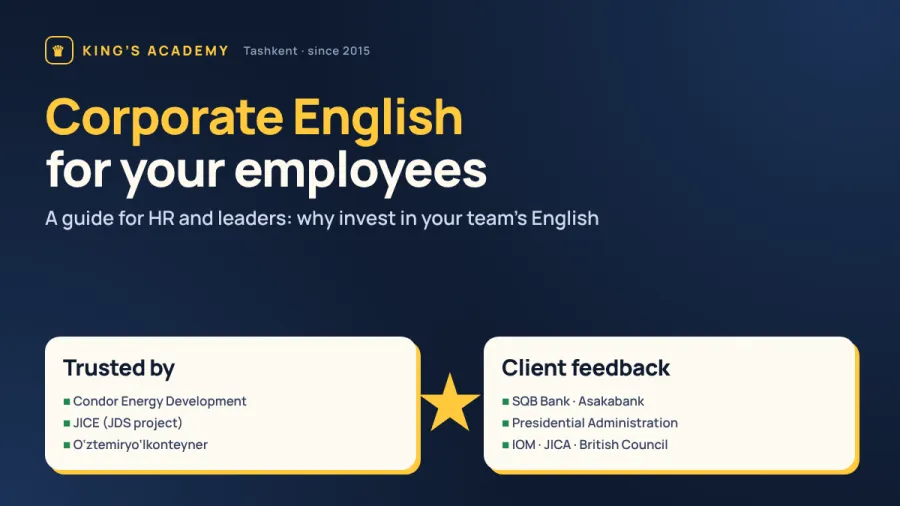
Corporate English for Employees: Why Companies Should Invest in It — A Guide for HR and Business Leaders
How corporate English (ESP, Business English) improves employee loyalty, growth and efficiency: formats, launching a programme in 6 steps, KPIs for HR and real client feedback for…
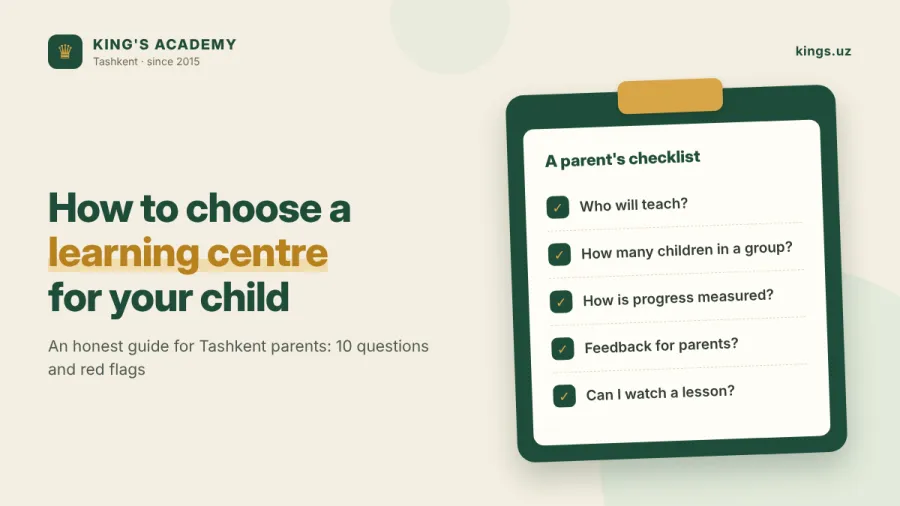
How to Choose a Learning Centre for Your Child in Tashkent: An Honest Guide for Parents
How to choose a learning centre for your child in Tashkent: 10 questions to ask any centre, red flags, and why an app can't replace a teacher.
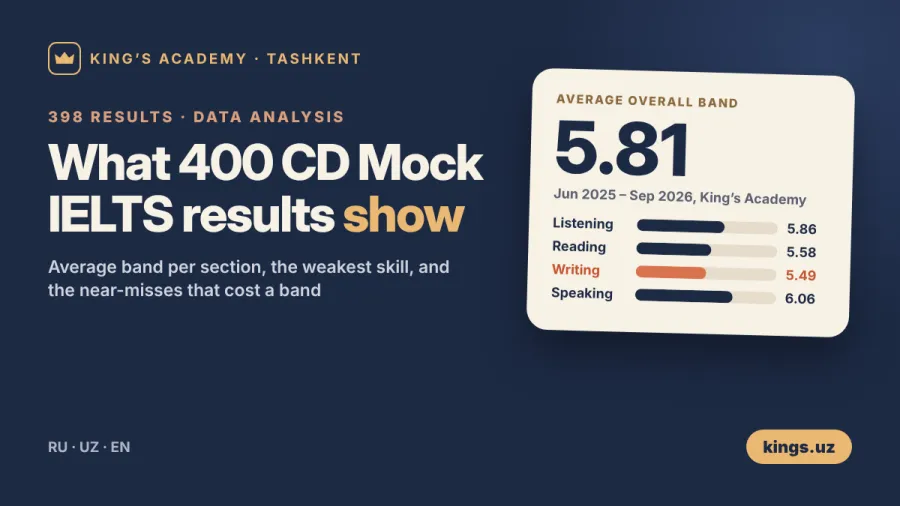
What 400 CD Mock IELTS Results in Tashkent Show: Average Bands and Where Students Lose Points
We analysed 398 CD Mock IELTS results from Tashkent: average band per section, the weakest skill, near-misses that cost a band, and a roadmap to improve.

Study abroad on a scholarship: which English certificate 6 top programmes ask for
El-yurt umidi, Chevening, GKS, MEXT, Türkiye Bursları, Stipendium Hungaricum: what IELTS you need, who sets the bar, and a backwards plan.

King’s Academy and American Councils YPIP: Five Years of Launching Young Professionals in Uzbekistan
What Is the American Councils Young Professional Internships Program (YPIP)? The Young Professional Internships Program (YPIP) is run by American Councils for International…
Submit a request
Do you want to sign up for classes or become part of our team?
Request submitted
We will contact you within the working day.