


IDP or British Council: Where Is IELTS “Easier”? 9 Myths and One Inconvenient Truth

In short
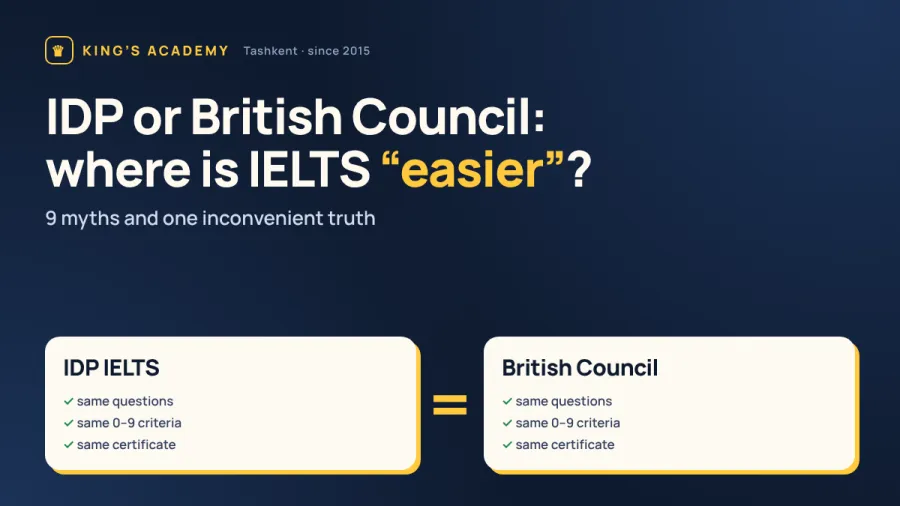
IELTS is the same exam whoever runs it. The test is jointly owned by the British Council, IDP IELTS and Cambridge University Press & Assessment: the questions, format, assessment criteria and 0–9 band scale are identical, examiners are trained and certified to the same standards, and the certificate is recognised in exactly the same way. Only the dates, venue, price and service differ. So choose your provider for convenience, and raise your score through preparation. Already taken the test? Here is how to check your IELTS results.
Every week a student asks us, with the seriousness of a scientific conference, the same question: “Teacher, where is it actually easier — IDP or the British Council?”
Then come the “proofs”: a classmate’s brother got 7.5 for Speaking at IDP; all the “nines” in a Telegram channel somehow come from the British Council; and examiners are kinder in winter — it’s the holidays, after all. Let’s sort it out calmly, with official sources and a little irony.
For transparency: King’s Academy is a British Council partner in the IELTS Partnership programme, and our students take the exam with both providers. Below we explain why this makes no difference to the score.
Who are IDP and the British Council?
- IELTS is owned by three organisations at once: the British Council, IDP IELTS and Cambridge University Press & Assessment, as stated on the official ielts.org website.
- The questions are produced centrally. They are written by specialists from the UK, Australia, Canada, New Zealand and the USA, and the difficulty of every test version is checked and balanced before it ever reaches an exam room.
- The British Council and IDP are the test providers. They handle registration, venues, running the test and customer service.
- Put simply: one film, two ticket offices. A comedy doesn’t get funnier depending on which window sold you the ticket.
What is the same and what is different
| Aspect | IDP and British Council | Can it differ? |
|---|---|---|
| Questions and format | identical | no |
| Assessment criteria and 0–9 scale | identical, public band descriptors | no |
| Examiners | same training, certification and regular monitoring | no |
| Recognition of the certificate | the same everywhere | no |
| Dates, venue, times | each has its own | yes |
| Price and extra services | each has its own | yes |
| Service, support, preparation materials | each has its own | yes |
One more shared fact for Uzbekistan: since July 2025, IELTS with both providers is taken on computer (Listening, Reading, Writing), while Speaking is face-to-face with an examiner.
🎧Check your real band this weekend — CD Mock IELTS: 150,000 sum, each next one 50,000 cheaper, 4th free →9 myths about IDP and the British Council — and the reality
We collected the most popular “legends” we hear from students and checked them against official IELTS information.
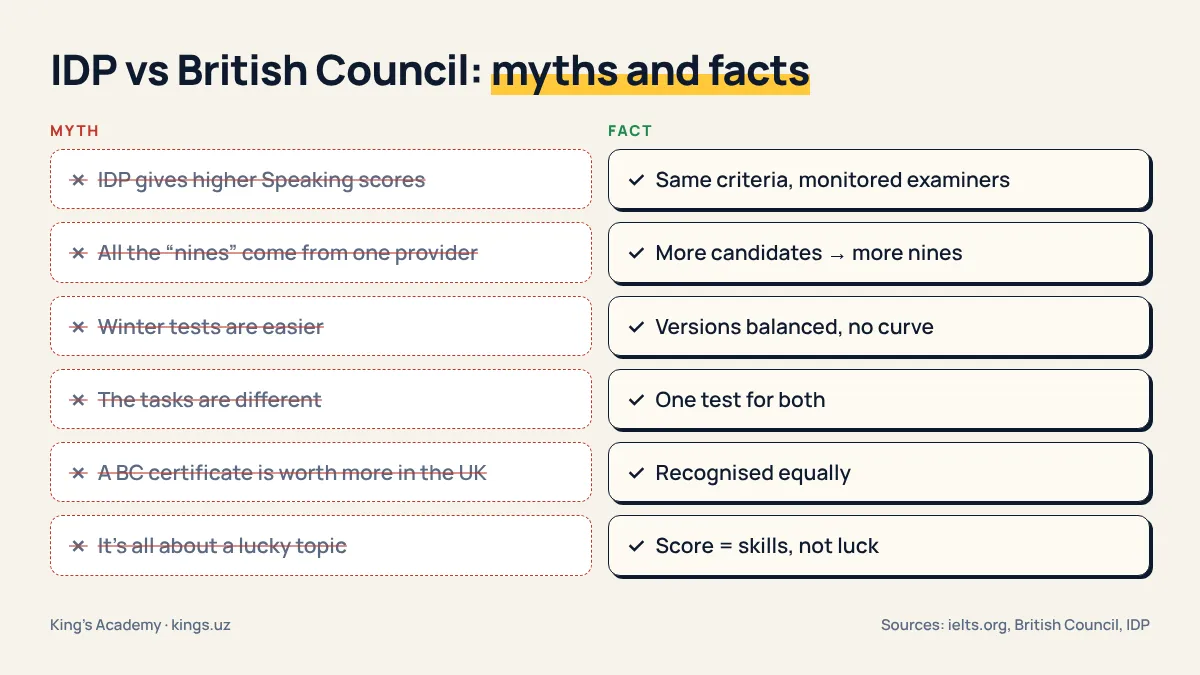
Myth 1: «IDP gives higher Speaking scores»
Reality. All examiners mark against the same public criteria: Fluency and Coherence, Lexical Resource, Grammatical Range and Accuracy, and Pronunciation. To examine, they must be certified, re-certified every two years, and their work is regularly monitored. Speaking is recorded, so a senior examiner can re-mark it if there is any doubt. Examiners get no bonus for generosity — if anyone really “marked higher”, it would be a worldwide scandal, not a Telegram life hack.
Myth 2: «All the “nines” come from IDP (or from the British Council)»
Reality. This is classic survivorship bias. The more people take the test with one provider in a city, the more high scores that provider has — simply by numbers. And people post their 9.0 on social media, not their 5.5. If most weddings in Tashkent happen on Saturdays, it doesn’t mean Saturday marriages last longer.
Myth 3: «It’s easier in winter than in summer (or the other way round)»
Reality. Every test version is trialled in advance so that the same band means the same ability on any version. IELTS isn’t marked on a curve: your score doesn’t depend on how many people sit the test that day or how strong they are. The season only affects your preparation — and the traffic on the way to the venue.
Myth 4: «IDP and the British Council use different tasks — one is harder»
Reality. It is one test for both providers, and the difficulty of versions is balanced beforehand. A version usually feels “hard” when the topic is unfamiliar — and that is about vocabulary and practice, not the logo on the door.
Myth 5: «Examiners at one centre are stricter — “they fail you there”»
Reality. Examiner strictness is exactly what gets monitored: their marks are regularly checked against the standard. If you are sure your score is too low, there is an official route — the Enquiry on Results: a senior examiner re-marks your test, and the fee is refunded if your score goes up.
Myth 6: «When there are lots of candidates, they mark to a quota»
Reality. There are no quotas. Writing and Speaking are assessed against band descriptors, Listening and Reading by the number of correct answers. Nobody decides that “we’ve had enough nines for today”.
Myth 7: «A British Council certificate is worth more in the UK, an IDP one in Australia»
Reality. There is one IELTS certificate, recognised in the same way whoever ran the test. What matters is the test type — Academic, General Training or IELTS for UKVI (for UK visas) — not the provider.
Myth 8: «A British accent and a smile earn extra points»
Reality. The Pronunciation criterion assesses how easily and clearly you can be understood, not whether you sound “British”. A smile helps you relax, but it isn’t in the criteria. Nor is your opinion marked as right or wrong — it’s the language you use to express it that counts.
Myth 9: «It all comes down to a lucky topic and a lucky examiner»
Reality. A favourite topic may feel worth half a band, but it won’t show in the result: a 6.5-level candidate writes a 6.5-level essay even on their “dream” topic. Your score reflects consistent skills, not luck.
The inconvenient truth: choosing a provider is the most convenient excuse
Hunting for the “easy centre” looks a lot like preparation: you read reviews, compare, ask in group chats. Your score just doesn’t move. It’s a polite form of procrastination — and a handy way to shift responsibility: if the result is low, it was “the wrong centre”; if it’s high, “I’m brilliant”.
In reality, your score is decided by things you control:
- vocabulary range and grammatical accuracy;
- managing time in Reading and Writing;
- essay structure and answering the actual question;
- fluency and extended answers in Speaking;
- experience of the exam in its real computer format.
If you have spent more time choosing between IDP and the British Council than reviewing the mistakes in your essays, we have news for you. Good news: it can be fixed.
How to choose a provider sensibly
There are rational reasons to choose one provider over the other — they just aren’t about your score:
- Date. The nearest date that meets your deadline (university, visa, job).
- Location and time. A convenient venue and time mean less stress and no rushing.
- Price and services. Compare fees and extra services on the official websites.
- Timing and options. When results arrive, and whether One Skill Retake and Enquiry on Results are available.
- Comfort. If you feel calmer in a familiar building, that’s a good, rational reason. A myth isn’t.
What actually raises your score
- Find out your real level — the free level test takes 20–30 minutes.
- Write regularly and get your Writing marked against the official criteria, not just “not bad overall”.
- Practise Speaking with feedback on your mistakes, not just “conversation practice”.
- Take a mock in the same format as the real exam — CD Mock IELTS on computer every weekend.
- Learn how IELTS is assessed — and stop believing myths.
If your result feels unfair
- Enquiry on Results. An official re-mark by a senior examiner; you can usually apply within 6 weeks of the test. If your score goes up, the fee is refunded. Check exact deadlines and fees with your provider.
- One Skill Retake. A chance to retake one section instead of the whole test — check whether your provider offers it.
- First check the result itself — how to check IELTS results with IDP and the British Council.
Stop picking a “lucky” centre — let’s prepare
King’s Academy has been a learning centre in Tashkent since 2015 and is a British Council partner in the IELTS Partnership programme. Groups of up to 10, Writing marked against the official criteria and CD IELTS mock exams every weekend. Start with the free level test or book a CD Mock IELTS.
Frequently asked questions
IDP or British Council: where is IELTS easier?
Neither. It is the same exam with the same questions, criteria and examiner training. Only the dates, venue, price and service differ.
Is it true that IDP gives higher Speaking scores?
No. All examiners mark against the same public criteria, are certified and re-certified every two years, and are regularly monitored. Speaking is recorded and can be re-marked.
Are IDP and British Council certificates recognised equally?
Yes. Universities, employers and immigration authorities accept the IELTS certificate in the same way regardless of the provider. What matters is choosing the right test type: Academic, General Training or IELTS for UKVI.
Does the season or day of the week affect my score?
No. Test versions are balanced for difficulty in advance, and IELTS isn’t marked on a curve: your score doesn’t depend on other candidates.
Can I prepare with a British Council partner and take the test with IDP?
Of course. Preparation isn’t tied to a provider: you are preparing for the IELTS exam, not for a particular building.
What should I do if I disagree with my score?
Apply for an Enquiry on Results with your provider — a senior examiner will re-mark your test. If your score goes up, the fee is refunded. Also ask about One Skill Retake.
Where can I check my IELTS result?
Step-by-step instructions for IDP and the British Council are on our “How to check your IELTS results” page.
Sources: IELTS.org — official IELTS website (joint ownership) · IELTS.org — How we develop the test · British Council — IDP IELTS vs British Council IELTS · British Council — 5 key facts · IDP IELTS — Is IELTS different from country to country? · IDP IELTS — Understanding IELTS examiners · IELTS Australia (IDP) — Enquiry on Results · IDP Uzbekistan — IELTS One Skill Retake · Kun.uz — IELTS in Uzbekistan moves to computer-only (July 2025)
Already taken IELTS? Check your IELTS results →
What's next?
Take the first step — it's free or takes 2 minutes:
Other articles
Daily useful articles

Learning English After 30: Not Too Late, Right on Time
Think it’s too late to learn English after 30? Science says no. 6 reasons to start, common adult fears, and evening, online and company groups.

IELTS Matching Headings in 4 Steps: How to Stop Losing 5 Marks in Passage 3
IELTS Matching Headings strategy in 4 steps: read the headings first, find the main idea, cross out used headings, manage time. Free 8-minute test.

Learn English on Your Own: 5 Daily Habits and Websites
Learn English on your own: 5 daily habits, free podcast and audiobook websites, and a 30-minute daily plan. Tips from King’s Academy, Tashkent.
Corporate English for Employees: Why Companies Should Invest in It — A Guide for HR and Business Leaders
How corporate English (ESP, Business English) improves employee loyalty, growth and efficiency: formats, launching a programme in 6 steps, KPIs for HR and real client feedback for…

What an IELTS Speaking Examiner Really Listens For (and What They Ignore)
A former IELTS examiner explains what really affects your Speaking score: accent, opinions, memorised answers, plus a simple plan for this week.

IELTS Courses in Tashkent 2026: How to Choose — Formats, Prices and 10 Questions to Ask Any Centre
How to choose an IELTS course in Tashkent in 2026: preparation formats, prices, the exam fee, 10 questions to ask any learning centre, and the red flags to avoid.
Submit a request
Do you want to sign up for classes or become part of our team?
Request submitted
We will contact you within the working day.