


Afraid to speak English? Why it happens and what to do about it

In short
Being afraid to speak English is a normal reaction, and very many people feel it, even those with a good level. It doesn’t go away with more grammar. It goes away with small, safe steps: talk to yourself first, then to one person, then to a group. Below I explain where the fear comes from and give you a four-week plan.
Amir Temur Square on a warm evening. A tourist with a map asks you the way to the metro. You understand every word, and you even know the answer. But your tongue feels glued to the roof of your mouth. You point and say, “There… metro.” He thanks you and walks off. Two minutes later the perfect sentence forms in your head all by itself: “Go straight for two minutes, and you’ll see the entrance on your left.”
If that sounds like you, you’re not alone. Over my years of teaching I’ve seen it in schoolchildren, university students, accountants and company directors. People read articles in English and watch series without subtitles, yet they can’t open their mouths. The good news: this isn’t about ability. It’s a habit, and habits can be changed.
Why it happens
Back in 1986, Elaine Horwitz and her colleagues described foreign language anxiety as a problem in its own right. They noted that anxious students are common in language classrooms, and that difficulty speaking is the complaint they hear most. Usually three things are mixed together.
- Fear of being judged. Every mistake feels like a black mark in someone’s eyes. For many of us it goes back to school, where a mistake meant red ink and a bad mark.
- Perfectionism. We build the sentence in Uzbek or Russian first, then translate it, then check the grammar. By the time it’s ready, the conversation has moved on.
- “Our own people” are listening. Here’s something I see a lot: many people find it easier to talk to a foreigner than in front of fellow Uzbeks who speak English. It feels as if they will notice every mistake.
Notice that none of these reasons is about how many words you know. That’s why one more grammar book won’t remove the fear.
What I saw from the other side of the table
I worked as an IELTS Speaking examiner for many years. Almost every candidate was nervous, and that’s normal. But here is what’s worth knowing: the examiner isn’t hunting for mistakes. Their job is to see how freely and clearly you can speak.
The official sources say the same. In its Speaking tips, the British Council says a short pause or a phrase like “Let me think about that” is perfectly acceptable, and that asking the examiner to repeat a question won’t affect your score. IDP’s examiner-approved tips add that you won’t lose marks for an accent as long as you pronounce words clearly.
Real life is even kinder than the exam. The person you’re talking to almost never listens to your grammar. They listen to what you’re trying to say. I wrote more about what really matters when you speak in “What an IELTS Speaking examiner really listens for”.
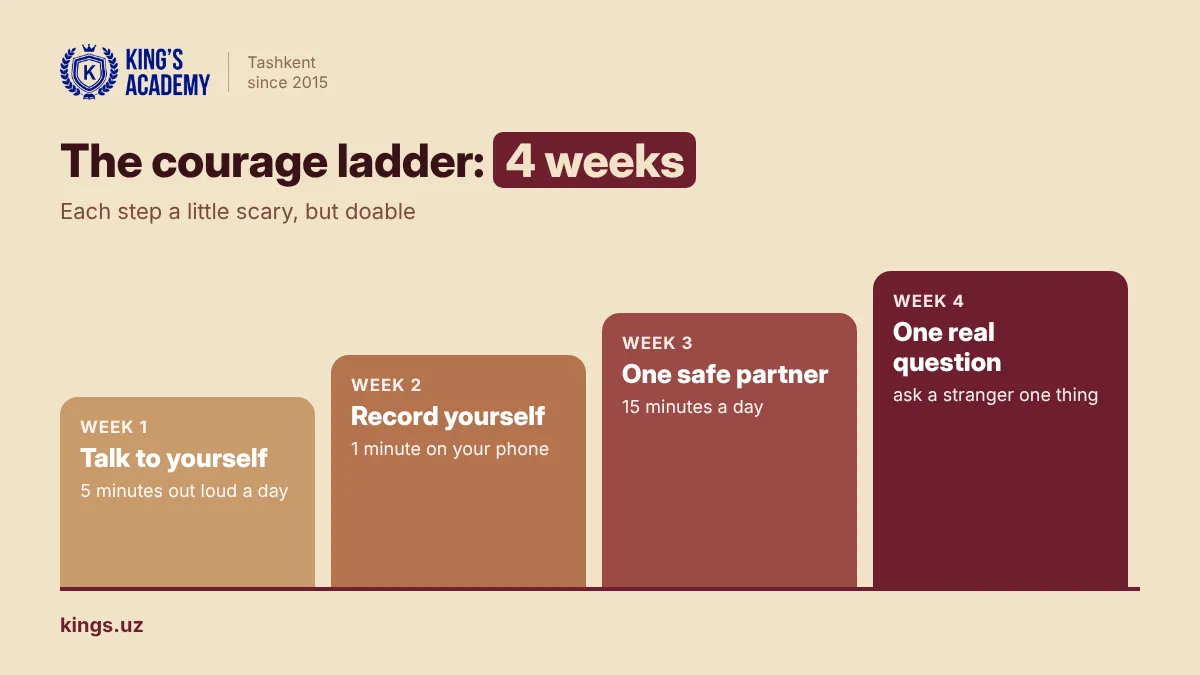
The courage ladder: a four-week plan
The fear goes the same way a fear of water does: not by jumping off the high board, but step by step from the shallow end. Each step should feel a little scary but doable.
Week 1. Talk to yourself
Play “commentator”: for five minutes a day, describe out loud what you’re doing. “I’m making tea. The water is almost ready. I think I’ll add some lemon.” Nobody can hear you, so you can make as many mistakes as you like. The goal is to get used to the sound of your own voice in English.
Week 2. Record yourself
Every day, record a one-minute answer to a simple question on your phone: “What did you do yesterday?” or “What’s your favourite place in Tashkent?” Don’t delete the bad ones. After a week, listen to the first and the last: the difference usually surprises people.
Week 3. One safe partner
Find one person: a friend, a classmate or a colleague. Agree to speak only English for 15 minutes a day, even if it’s just voice messages. One rule: don’t correct each other, only ask again when you don’t understand.
Week 4. One small real conversation
Ask one question in English where it feels natural: to a visitor at work, a tourist, or your teacher after class. One question is enough. What matters is doing it and noticing that nothing terrible happened.
Phrases that get you through
The fear often hits at the moment a word is missing. Learn a few “rescue” phrases in advance, and a pause stops being a disaster:
- Let me think for a second.
- How do you say … in English?
- Sorry, could you say that again, please?
- What I mean is…
- It’s a kind of… (when you’ve forgotten the exact word)
What to avoid: memorising long ready-made answers. They sound unnatural and fall apart at the first unexpected question. If mistakes are what worry you most, read “I am agree” and 9 more mistakes that give us away in English, which covers the most common ones and how to drop them.
What not to wait for
The most common trap goes like this: “I’ll learn the grammar first, then I’ll start speaking.” That day never comes. You learn to speak only by speaking, just as you learn to swim only in the water. You can start at A1, with simple sentences.
The second trap is hoping the fear will pass on its own. It passes with experience: the more small conversations end fine, the quieter your inner critic gets. If you need English for work, practise with the typical questions in “Job interview in English: 15 questions and how to answer them”.
Why it gets easier in a group
Many people expect a group to be even scarier. In practice it’s usually the opposite: when everyone around you makes mistakes too and you laugh about them together, the fear quickly loses its power. At King’s Academy groups have no more than 10 students, so everyone speaks in every lesson and nobody gets lost. After class, students often stay in our library and study zone to do homework, read and play board games in English. Speaking there is even easier, because it’s no longer a lesson, just people talking.
If you’re preparing for IELTS and have already taken the test, check your IELTS results online: your Speaking score often shows what to work on next.
Take the first step calmly
Try the free level check or find your course in a minute, then pick a time from the timetable for a General English group. Preparing for IELTS? At CD Mock IELTS the Speaking test is face to face, just like the real exam.
Frequently asked questions
Why can I understand English but not speak it?
Understanding and speaking are different skills. We practise understanding every day when we watch and read, but we rarely practise speaking. Fear of mistakes makes it worse. You need regular speaking practice, even 5–10 minutes a day.
Can I start speaking at A1 level?
Yes. Short, simple sentences are already speaking. There’s no need to wait for a “perfect level”: the earlier you start, the smaller the fear.
Do you lose IELTS marks for an accent?
No, as long as you’re easy to understand. Examiners assess how clear your pronunciation is, not how British or American you sound.
Can I ask the examiner to repeat a question?
Yes. According to the British Council, asking the examiner to repeat or clarify a question does not affect your score.
How long does it take to stop being afraid?
It’s different for everyone, but many people notice a change within a few weeks of regular practice. What counts is small steps every day, not rare acts of bravery.
Sources: Horwitz, Horwitz & Cope (1986), Foreign Language Classroom Anxiety, The Modern Language Journal · British Council — IELTS Speaking tips · IDP IELTS — Examiner approved tips for the Speaking test
What's next?
Take the first step — it's free or takes 2 minutes:
Other articles
Daily useful articles

Computer-Delivered IELTS: How the Exam Works
How CD IELTS works in Tashkent: the screen layout, notes, word counter, the typing speed you need and how it differs from paper-based IELTS.

Tashkent Universities: IELTS, Fees and Scholarships 2026
15 universities in Tashkent compared: minimum IELTS, 2026/27 tuition in UZS and USD, scholarships and deadlines — plus what each IELTS band opens.

IELTS Matching Headings in 4 Steps: How to Stop Losing 5 Marks in Passage 3
IELTS Matching Headings strategy in 4 steps: read the headings first, find the main idea, cross out used headings, manage time. Free 8-minute test.
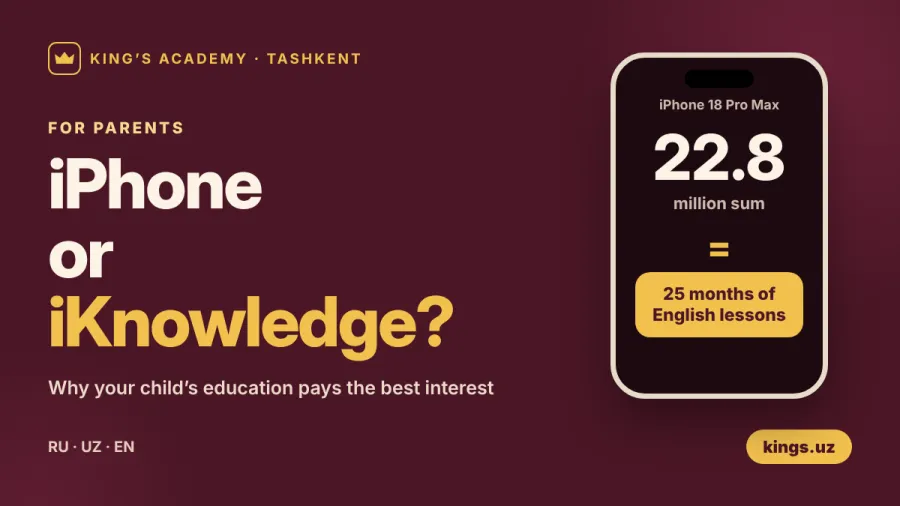
iPhone or iKnowledge? The Best Investment in Your Child
A new iPhone 18 Pro Max costs ~22.8 million sum in Tashkent — two years of English or maths lessons. A personal story about what's really worth investing in.

The True Cost of IELTS 7.5 in Tashkent: How to Plan Your Child’s Education Budget for the Next 5–6 Years
How much does IELTS 7.5 really cost in Tashkent? Real 2026 prices, a planned vs last-minute budget, university fees, a 6-year savings plan and English pay data.

Typing Speed in CD IELTS: The Overlooked Skill That Costs Band Scores
Why typing speed and accuracy matter in computer-delivered IELTS: Listening, spelling, Writing time. Test your speed in 60 seconds and learn touch typing.
Submit a request
Do you want to sign up for classes or become part of our team?
Request submitted
We will contact you within the working day.