


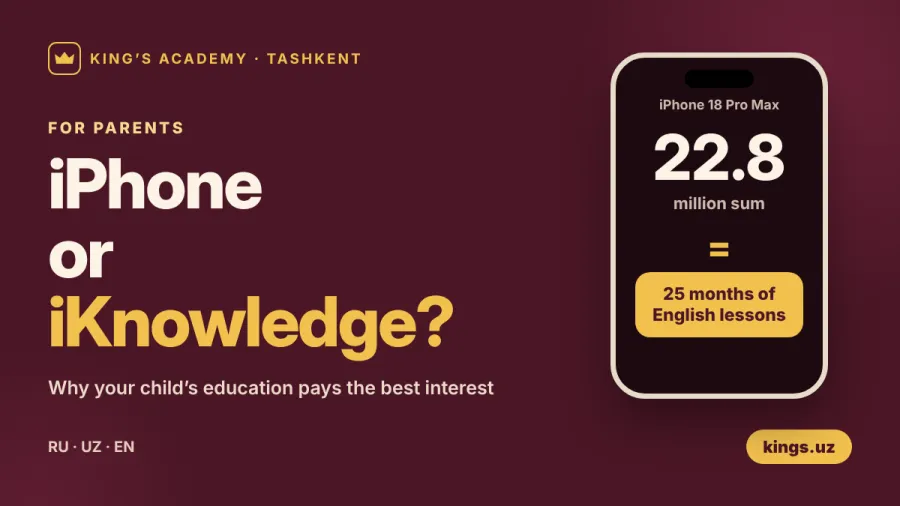
iPhone or iKnowledge? The Best Investment in Your Child

In short
I never had a phone at school. My father spent his money and his time on the best teachers, books, a home computer and, later, a British university. The cars and houses of those years are long gone. The education is what kept my family afloat in the hardest times. A new iPhone 18 Pro Max costs about 22.8 million sum in Tashkent — roughly two years of English or maths lessons. Here is the honest maths, and the honest story.
The boy without a phone
I went to International House lyceum in Tashkent in the early 2000s. My classmates were not the poorest children in the country. Some arrived in cars with drivers. Many had the newest Nokia or Motorola in their pockets.
I had no phone. My father never bought me one, and he never apologised for it.
I wore my older brother’s jackets and trousers. So did most of us in those years, and nobody at home thought it was a tragedy. My father couldn’t care less what label was on my clothes or what gadget was in my hand.
But there was one thing he always had time for: finding the best teachers in town. A strong maths teacher? He would find out who it was, where they taught and how to get me into their class. A good English tutor? Same. He was a busy man, yet he never seemed too busy for that.
And there was one “gadget” he did buy, very early: a computer at home. Not for games, not for killing time. For typing, for making documents, for learning how things work. In the late 1990s I connected it to the internet through a dial-up modem. Anyone who remembers that sound — the screeching, beeping, alien-spaceship noise before a page slowly appeared — knows it felt like opening a door to another planet. In a way, it was.
Then he did the biggest thing of all. He sent me to study in the United Kingdom, at the University of York. It cost a fortune. People around us, I am sure, thought there were better ways to spend that money.
What the cars and houses couldn’t do
Think about what families in our circle spent money on in those years. Expensive cars. Big houses. Gold, furniture, celebrations the whole mahalla remembered.
Where are they now? The cars are scrap or museum pieces. Some houses were sold, some lost, some simply outdated. Most of that wealth has quietly disappeared.
What did not disappear was what my father put into my head.
When our family went through its darkest, most difficult years, no car or house could save us. What saved us was knowledge: the English, the maths, the habit of study, the experience of living and learning abroad. That is what let me work, earn, build a school and pull my brothers and our whole family out of a very deep hole — and then go much further.
That was my father’s real investment. Not in things. In a person.
“An investment in knowledge pays the best interest.”
A line often attributed to Benjamin Franklin. I didn’t read it in a book. I lived it.
The parents with the $10,000 watches
Fast forward to my years as a teacher. I have lost count of the times this scene happened.
A parent parks an expensive car outside. Their child walks in with a $10,000 watch, designer clothes and the newest iPhone. We talk about the course. I say the fee is, let’s say, $100 a month. And the parent rolls their eyes and asks for a discount.
I am not exaggerating. It happened again and again.
The first few times, I felt humiliated. Then I felt something closer to disgust. Not because of the money — asking about a discount is normal — but because of what the scene said about priorities. Ten thousand dollars on the child’s wrist. A sigh over one hundred dollars for the child’s mind.
In English we have a saying: they can’t see the wood for the trees. These parents were looking at the shiny trees — the watch, the phone, the brand — and missing the whole forest: their child’s future.
At today’s rate, that watch is about 118 million sum. That is roughly eleven years of English lessons at our main branch. On one wrist.
The numbers: one iPhone vs two years of lessons
The iPhone 18 Pro Max (256 GB) costs 22,799,000 sum at an official Apple reseller in Tashkent. The iPhone 18 Pro starts at 19,999,000 sum, and the top 1 TB Pro Max is 33,339,000 sum. In launch week, sellers at the Malika market were asking 41–45 million sum for the same phones.
Here is what the price of one Pro Max buys at King’s Academy (lessons 3 times a week, 90 minutes each, groups of up to 10):
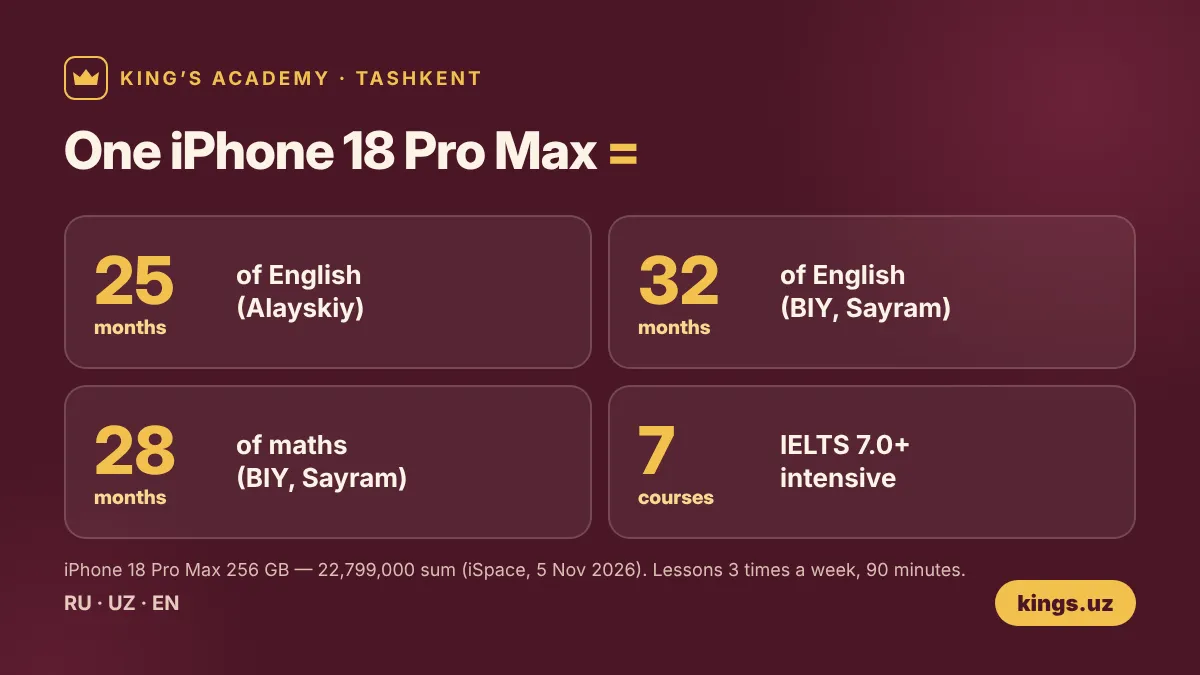
| 22.8 million sum spent on… | What your child gets |
|---|---|
| General English, Alayskiy branch (900,000 sum/month) | 25 months of lessons |
| General English, BIY or Sayram (700,000 sum/month) | 32 months of lessons |
| Maths for lyceum and university entry, Alayskiy (900,000 sum/month) | 25 months of lessons |
| Maths, BIY or Sayram (800,000 sum/month) | 28 months of lessons |
| IELTS 7.0+ intensive (3,200,000 sum for the full course) | 7 full courses |
| CD Mock IELTS exam (150,000 sum, each next one 50,000 cheaper, 4th free) | 302 mock exams |
iPhone prices: iSpace, 5 Nov 2026. Course prices: kings.uz prices page (updated 22 Oct 2026).
Twenty-five months is about 300 lessons — roughly 450 hours with a qualified teacher. That is the difference between “my child knows some English” and “my child can study at a university abroad.”
Now add time. A new iPhone comes out every September. A family that upgrades every year for five years spends about 114 million sum on phones. That is more than ten years of English or maths lessons. Five phones, all of them outdated today. Or ten years of learning that never expires.
One more difference. A phone starts losing value the day you open the box. Education does the opposite. A World Bank review of 50 years of studies finds that each extra year of schooling raises earnings by about 10% — every year, for a whole working life. No phone, watch or car has ever paid that kind of interest.
The real price of the phone isn’t on the tag
If the iPhone only cost money, this would be a simple budget question. It costs much more than that: it costs attention.
A modern smartphone is a slot machine that fits in a pocket. Every app on it is built by very clever people whose job is to keep your child scrolling for one more minute. Too often, it is not the child using the phone. It is the phone using the child.
The evidence is now hard to ignore:
- In the OECD’s PISA 2022 study, 65% of 15-year-olds across OECD countries said their own phones and devices distract them in maths lessons.
- Students distracted by classmates’ devices in at least some maths lessons scored 15 points lower in maths. That is a big gap — close to what many countries lost during the pandemic.
- Social psychologist Jonathan Haidt, in The Anxious Generation (2024), links the move to a “phone-based childhood” with the sharp rise in teenage anxiety and depression since the early 2010s.
An 11-year-old with a smartphone is not “modern.” They are fighting, alone, against the world’s best engineers of distraction. Most adults lose that fight. Why would we expect a child to win it?
So when a child says they need the new iPhone or their life is over, remember: that is FOMO talking — the fear of missing out, carefully grown by advertising and by other children who are just as hooked. It is not a need. It is a craving. And learning to manage cravings is exactly what childhood is for.
What the people who build the gadgets do at home
Here is what surprises most parents: the people who know these devices best are often the strictest with their own children. And the best example of all comes from our own land.
Steve Jobs
The man behind the iPhone and iPad. Asked by a New York Times journalist in 2010 whether his children loved the iPad, he said: “They haven’t used it. We limit how much technology our kids use at home.” His biographer Walter Isaacson described dinners about books and history — “No one ever pulled out an iPad or computer.”
Bill Gates
Told the Mirror in 2017 that his children did not get phones until they were 14, and that phones were banned at the dinner table.
Warren Buffett
One of the richest people in history still lives in the Omaha house he bought in 1958 for $31,500. His favourite advice: the best investment you can make is in yourself.
Muhammad al-Khwarizmi
Born in Khwarazm, he gave the world algebra (from his book al-Jabr) and the word “algorithm” (from his own name). Every phone runs on algorithms. The rich men of his time are forgotten; he is with us every time we unlock a screen.
Mirzo Ulugh Beg
The ruler of Samarkand lost his throne and his life, and his palaces did not survive. But his madrasa still stands on the Registan, and his star catalogue was so accurate that Oxford printed it in 1665 — two centuries after his death.
That is the pattern of history: things fade, knowledge lasts.
“But everyone in my class has one!”
There will be tears. There will be slammed doors. There may be a grandmother who says, “Just buy the child a phone — what will people say?” — odamlar nima deydi?
I understand that pressure. In our culture, how a family looks to others matters a lot. But be honest with yourself: the people who will judge you for your child’s phone will not pay for your child’s university. They will not help when times get hard. They will not be there in twenty years. Your child will.
Here is what works, from my experience as a teacher, a school director and now a father:
- Say yes to something bigger. Not “no phone,” but “yes to a course, a summer camp, a trip, a big stack of books.” Children accept a no much better when it comes with a bigger yes.
- Show them the table above. Older children understand numbers. Ask them: one phone, or two years of English that could take you to study abroad? Let them do the maths.
- Give a simple phone for safety. A basic phone for calls and messages solves the “I need to reach you” problem without a slot machine in the pocket.
- Find two or three other parents. Pressure works on one family at a time. When a few families in the same class agree on “no smartphone until high school,” the “everyone has one” argument collapses. Jonathan Haidt calls these “new norms”: no smartphones before high school, no social media before 16, phone-free schools, and more real-world independence.
- Be the example. If we scroll at dinner, our children will too. Put your own phone away first.
- Wait out the storm. The tantrum lasts a week. The habits last a lifetime. A child is allowed to be upset; a parent is not allowed to give away the future to stop the noise.
A child doesn’t really want the phone. They want to belong, to feel valued, to have something of their own. Give them something real to be proud of: a language they speak, a problem they can solve, a goal they are working towards.
The best gift my father gave me
Today I am the father of a little girl. One day she will come to me and say that everyone in her class has the newest phone. I already know my answer, because my father gave it to me more than twenty years ago, without saying a word.
He didn’t give me the newest things. He gave me the best teachers. He gave me a computer for work, not play. He gave me the UK. He gave me a foundation that no crisis could take away, and a reason to aim high.
That is what our children need from us: not the gadget everyone has, but the knowledge few have. Not a status symbol for one year, but a goal for a lifetime.
Every September there is a new iPhone. Every September there is also a new school year. One of them will be out of date in twelve months. The other will still be paying your child back when they are forty, fifty, sixty — and when they are raising children of their own.
Choose iKnowledge. Your child may not thank you this year. They will thank you for the rest of their life. I know, because I still thank my father.
Where to start — this week
Take our free English level test, see the group schedule or pick a course: General English and maths. The first trial lesson on any course is free.
Frequently asked questions
How much does a new iPhone cost in Tashkent?
As of 5 November 2026, an official Apple reseller sells the iPhone 18 Pro from 19,999,000 sum, the iPhone 18 Pro Max (256 GB) for 22,799,000 sum and the 1 TB Pro Max for 33,339,000 sum. In the first weeks of sales, market prices reached 41–59 million sum.
At what age should a child get a smartphone?
Bill Gates gave his children phones at 14. Psychologist Jonathan Haidt recommends no smartphone before high school (around 14) and no social media before 16. For a younger child, a basic phone is enough to stay in touch.
How much are English and maths courses at King’s Academy?
General English is 900,000 sum a month at the Alayskiy branch and 700,000 sum at BIY and Sayram. Maths is 900,000 and 800,000 sum. Lessons run 3 times a week for 90 minutes, and the first lesson is free.
What if my child is the only one in class without a phone?
Agree on shared rules with the parents of two or three classmates, give a basic phone for calls, and offer something your child can be proud of instead: a course, a camp, a trip, a goal. Peer pressure weakens when not everyone has one.
My child has taken IELTS. How do we check the result?
We explain step by step how to check the official result online on our “Check your IELTS results” page.
Sources: iSpace — iPhone 18 Pro / Pro Max prices (05.11.2026) · Afisha Tashkent — iPhone 18 Pro Max on sale in Tashkent (18.09.2026) · Education Week — PISA 2022: digital distractions and lower performance · World Bank — 50 years of returns to education studies · Business Insider — Steve Jobs was a low-tech parent · BGR — Bill Gates: no phones for his kids until 14 · J. Haidt — The Anxious Generation: four norms
What's next?
Take the first step — it's free or takes 2 minutes:
Other articles
Daily useful articles

IELTS Writing Task 1 Line Graph: Write a Band 7 Overview and Never Misread a Number
IELTS Writing Task 1 line graph: the 4-paragraph plan, a 2-sentence overview formula, the margin check for numbers, trend verbs and a Band 7.5+ sample.
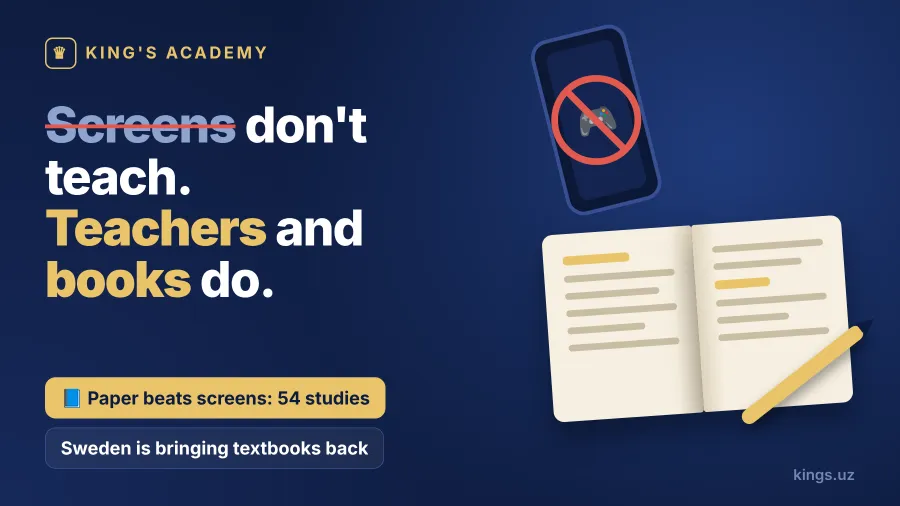
Screens Don’t Teach. Teachers and Books Do.
Books vs Apps: Why Paper Still Wins in Learning | King’s Academy Sweden is buying textbooks back, Uzbekistan and Brazil restrict phones in schools. What research says about…

Tashkent Universities: IELTS, Fees and Scholarships 2026
15 universities in Tashkent compared: minimum IELTS, 2026/27 tuition in UZS and USD, scholarships and deadlines — plus what each IELTS band opens.

Private or State School in Tashkent: Which Is Better for Your Child?
An honest comparison of private and state schools in Tashkent: class size, teachers, languages, cost, admission. With a table and a family-fit tool.
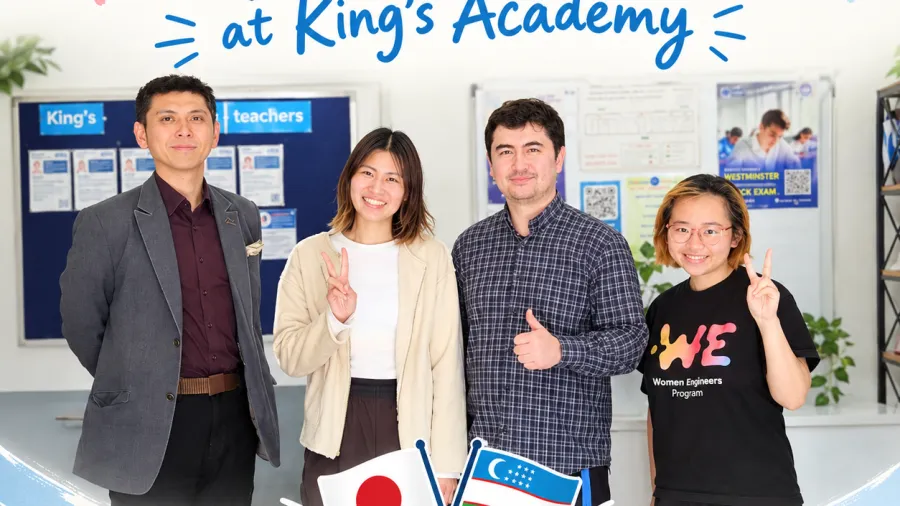
Building Global Bridges: Japanese students studying at King’s Academy
King’s Academy in Tashkent exemplifies modern, globally integrated education through its robust international partnerships, active institutional ties with JICA and the…
Corporate English for Employees: Why Companies Should Invest in It — A Guide for HR and Business Leaders
How corporate English (ESP, Business English) improves employee loyalty, growth and efficiency: formats, launching a programme in 6 steps, KPIs for HR and real client feedback for…
Submit a request
Do you want to sign up for classes or become part of our team?
Request submitted
We will contact you within the working day.