


“I am agree” and 9 more mistakes that give us away in English

In short
Most mistakes that Uzbek and Russian speakers make in English are not “bad English”. They are the mother tongue, translated word for word. There are about ten of them, and they are very predictable. Find your own three or four, catch them on purpose, and in two weeks your English will sound noticeably cleaner.
If I had a thousand sums for every “I am agree” I’ve heard in more than ten years of teaching and working as an IELTS Speaking examiner, I would probably have opened another branch by now. I’m joking, but only half. A2 beginners say it. B2 students say it. School pupils and heads of department say it. And almost nobody notices it in their own speech.
The reason is simple. In Uzbek we say “men roziman”, in Russian “я согласен”. In both languages “agree” behaves like a describing word, not an action. So the brain translates honestly: I am agree. It isn’t laziness or weak grammar. It is your first language quietly whispering from behind your shoulder.
Below are the ten mistakes I see most often. For each one: what people say, what is correct, and why it happens. If you recognise three of them in yourself, that’s already a good start.
Grammar: things our languages don’t have
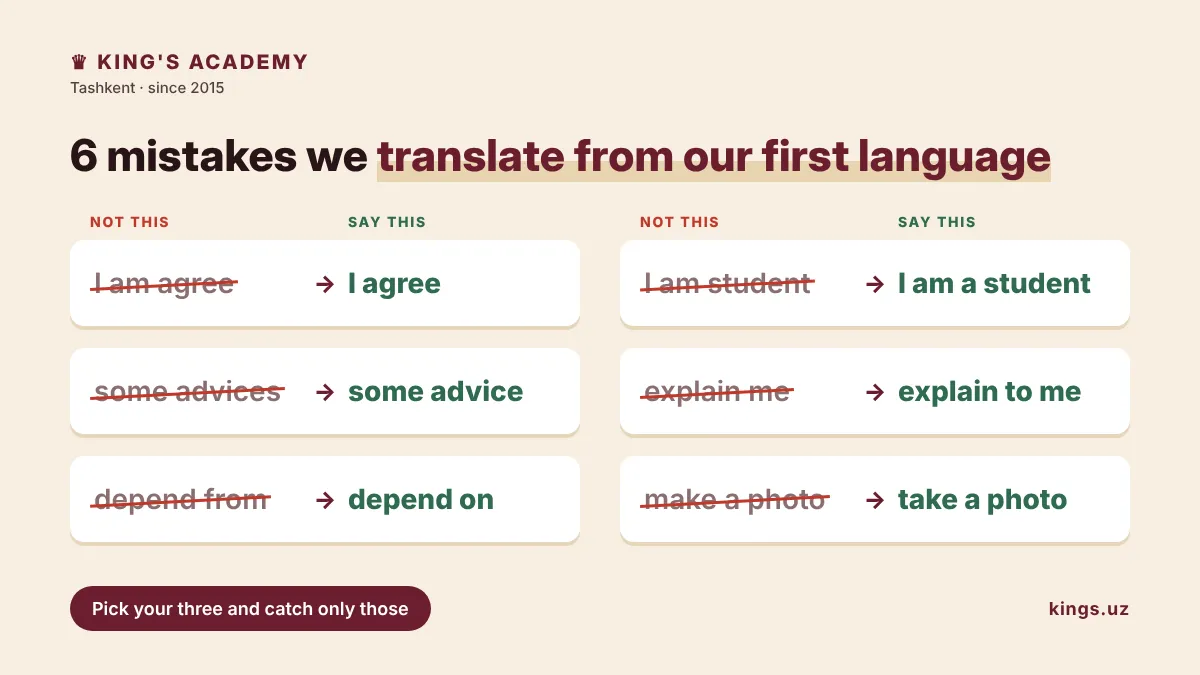
1. I am agree → I agree
In English, agree is a verb, not an adjective. It doesn’t need am, just as we don’t say I am like tea. Correct: I agree, I don’t agree, Do you agree?
2. Articles: I am student → I am a student
Neither Uzbek nor Russian has articles, so a and the are the first words to disappear. A simple rule to start with: when you name a job or “one of many”, use a: She is a doctor. I have a sister. When you and the listener both know exactly which thing you mean, use the: Close the door, please.
3. Advices, informations, homeworks
Advice, information, homework, news, furniture and luggage are uncountable in English: they have no plural. You can see the full list in the British Council LearnEnglish grammar reference. So: some advice, a piece of advice, The news is good (not are).
4. He or she? A classic for Uzbek speakers
In Uzbek, one word, “u”, means both “he” and “she”. That’s why a story about someone’s mother suddenly contains he, and the listener gets lost. Russian speakers do it less, but in fast speech it happens to everyone. The only cure is attention: before you answer a question about a person, say “she” or “he” to yourself first.
5. I live here since 2020 → I have lived here since 2020
In Uzbek and Russian, “I live here since 2020” is in the present tense. In English, when something started in the past and is still true now, you need the present perfect: I have lived in Tashkent since 2020, I have known him for five years.
Verbs and prepositions: the word-for-word trap
6. Explain me, say me → explain to me, tell me
“Menga tushuntiring”, “объясни мне”, and the hand writes explain me, say me. But explain needs to: Can you explain to me how it works? When you give information to a person, use tell: Tell me your name. Say works without the person: She said it was late.
7. Depend from → depend on
Russian “зависит от” pulls in from; Uzbek “…ga bogʻliq” sometimes produces depend to. There is only one correct version: It depends on the weather. The same family: married with → married to.
8. Make a photo → take a photo
Our “qilmoq” and “делать” fit almost everything, but in English each action has its own verb. The Cambridge Dictionary team looks at exactly these mistakes: take a photo, have a party, do research, make a mistake, take an exam. Learn these pairs together, like one word.
Words that trick you
9. Actual, sympathetic, accurate
If you know Russian, these are “false friends”: they look like Russian words but mean something else.
- actual means “real”, not “актуальный” (relevant now). For that, say current or relevant.
- sympathetic means “showing that you care about someone’s problems”, not “симпатичный”. A pleasant person is nice or friendly; for looks, say attractive.
- accurate means “correct, exact”, not “аккуратный”. A tidy person is neat or tidy.
- fabric is cloth, while a фабрика is a factory; a magazine is something you read, not a shop.
The Cambridge Dictionary blog on false friends explains several of these in more detail.
Word order
10. Where you work? I very like it.
In Uzbek the verb comes at the end, and a question is often made just by adding “-mi”. English questions need a helper verb: Where do you work?, Why are you late? (not Why you are late?).
And one more: “я очень люблю” or “menga juda yoqadi” should not become I very like. Say I really like it or I like it very much.
How to break the habit in three weeks
Reading about mistakes is useful, but a habit only goes away with practice. Here is what works for my students:
- Choose your three. Not ten. Three mistakes you clearly recognised in yourself. Write the correct version on a sticky note and put it on your laptop or mirror.
- One minute out loud, every day. Record yourself talking about your day for one minute. Listen back and count your “three”. After a week there will be fewer, and you will hear it yourself.
- Ask your teacher to correct only those. When everything is underlined in red, you remember nothing. When only your three are marked, it works.
- Write short sentences with the correct form. Five sentences with depend on or I have lived each morning takes two minutes, and the effect is real.
As a former examiner, I’ll be honest: one of these mistakes won’t “break” your IELTS score. But when they repeat from answer to answer, it shows in the Grammatical Range and Accuracy criterion. If you have already taken the test and want to see your scores, you can check your IELTS results on our website. And for more ideas for daily practice, read our article on how to learn English on your own every day.
Find out which mistakes are holding you back
Take our free level test and a teacher will tell you where to start. Preparing for an exam? Try a weekend CD Mock IELTS. See the schedule and prices on our website.
Frequently asked questions
Why do I keep making the same mistakes when I know the rule?
Knowing a rule and using it in live speech are two different skills. When you speak fast, the brain takes the familiar road, which is your first language. Only regular practice of those exact forms, out loud, really helps.
What is the most common mistake for Uzbek and Russian speakers?
In my experience, articles and “I am agree”. Both come from the way our own languages work.
Do these mistakes lower an IELTS score a lot?
One random mistake changes almost nothing. Repeated mistakes matter, because the examiner looks at how accurately you speak and write overall.
How long does it take to get rid of a mistake?
If you work on one to three mistakes every day, you will usually notice the first changes within one or two weeks. Regular practice matters more than long sessions.
Can I fix my mistakes on my own?
Partly, yes: recording your voice and short exercises help a lot. But it is hard to hear your own mistakes, so a teacher’s outside view saves a lot of time.
Sources: British Council LearnEnglish — Uncount nouns · Cambridge Dictionary — Common errors with collocations · Cambridge Dictionary — Avoiding common false friends
What's next?
Take the first step — it's free or takes 2 minutes:
Other articles
Daily useful articles

Learning English After 30: Not Too Late, Right on Time
Think it’s too late to learn English after 30? Science says no. 6 reasons to start, common adult fears, and evening, online and company groups.

IELTS Myths Busted on Kun.uz: Eldor Sattorov and the British Council
On Kun.uz, Eldor Sattorov (King’s Academy) and Andrey Maksakov (British Council) explain how IELTS works and bust common myths. Watch the interview.

How to Get IELTS 8.0: A Complete Guide to Successful IELTS Preparation in Tashkent
How can you get IELTS 8.0? How long does IELTS preparation take? What should you do every day? Is an IELTS course really necessary? How important is typing speed for…

WIUT Academic Lyceum in Tashkent: How to Prepare for the Entrance Exam Without Burnout (2027 Guide)
WIUT Academic Lyceum admission in Tashkent: 2026 places, dates and tests, English certificate rules and a calm 6-month maths and English plan for Grade 9.

IELTS Writing Task 1 Line Graph: Write a Band 7 Overview and Never Misread a Number
IELTS Writing Task 1 line graph: the 4-paragraph plan, a 2-sentence overview formula, the margin check for numbers, trend verbs and a Band 7.5+ sample.

U.S. Ambassador Jonathan Henick Visits King’s Academy in Tashkent: ESP, Youth Internships and U.S.–Uzbekistan Education Ties
U.S. Ambassador Jonathan Henick visited King’s Academy in Tashkent to discuss English for Specific Purposes (ESP), teaching standards and youth internships with American Councils.…
Submit a request
Do you want to sign up for classes or become part of our team?
Request submitted
We will contact you within the working day.