


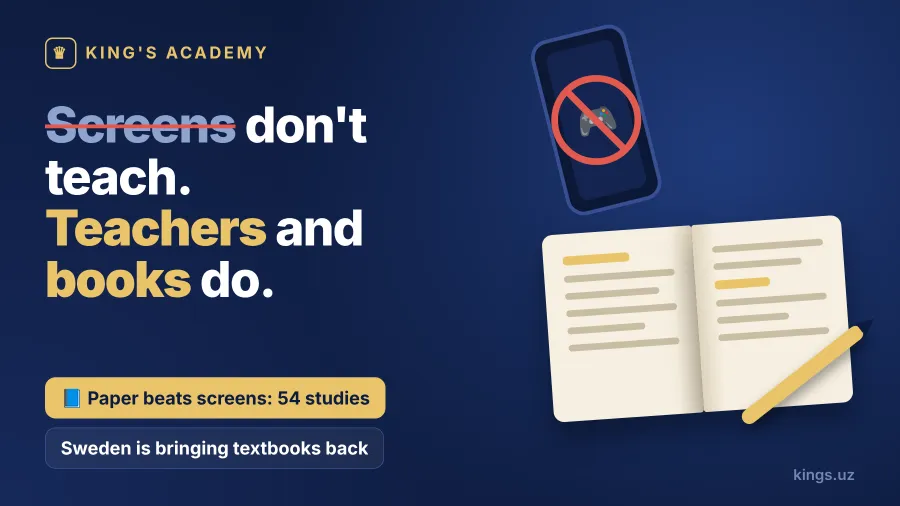
Screens Don’t Teach. Teachers and Books Do.

The “modern” classroom that isn’t working
You have probably seen the ads. A smiling child taps through colourful exercises on a phone. No notebook, no textbook, no homework on paper. “Learning has never been this easy.” Many learning centres in Tashkent now sell exactly this: tablets instead of books, apps instead of notebooks, screens instead of a teacher’s attention.
It looks modern. Parents feel their child is keeping up with the future. And at home, the child is on the phone for hours, “doing homework”.
Here is the uncomfortable truth: the countries that went furthest with screens in schools are now going back. Sweden, one of the most digital education systems in the world, is spending millions to put printed textbooks back on every desk. Governments from Brazil to Kazakhstan to the Netherlands have restricted phones in classrooms. Here in Uzbekistan, the authorities ordered strict control of phones in schools in 2024 and are now discussing limits on social media for children under 16.
The question is simple: if education ministries are moving away from screen-first learning, why are some learning centres still selling it as the future?
What the research actually says
This is not nostalgia. The evidence has been building for more than a decade.
1. People understand more when they read on paper. A meta-analysis of 54 studies with over 171,000 participants (Delgado et al., Educational Research Review, 2018) found a clear advantage for reading on paper over reading on screens. The gap was biggest for informational texts and timed reading, which is exactly what students face in exams. Even more striking: the advantage of paper grew between 2000 and 2017. Growing up with screens did not make young people better screen readers.
2. Writing by hand builds the brain in a way typing does not. Researchers at the Norwegian University of Science and Technology recorded brain activity of students writing by hand and typing (Frontiers in Psychology, 2024). Handwriting created far more widespread connections between brain regions, the patterns linked to memory and learning. Typing did not.
3. More screen time at school does not mean better results. The OECD’s report Students, Computers and Learning (2015) found that students who use computers very frequently at school perform worse, and countries that invested heavily in classroom technology saw no noticeable improvement in reading, maths or science.
4. Devices distract, and distraction costs marks. In PISA 2022, students who were distracted by classmates’ devices in maths lessons scored 15 points lower, about three-quarters of a year of schooling. Students who used devices for leisure up to one hour a day scored 49 points higher than those on them for five to seven hours.
5. UNESCO says: technology only when it helps learning. UNESCO’s Global Education Monitoring Report 2023 warned that there is little robust evidence that digital technology adds value to education by itself, and recommended removing smartphones from schools. It noted that a phone nearby can pull attention away, and that students can need up to 20 minutes to refocus after a distraction.
Put simply: the screen is not neutral. It changes how deeply children read, how well they remember, and how long they can concentrate.
The world is quietly going back to books
This is not one country’s experiment. Rich and developing countries alike are rethinking screens in learning.
| Country | What changed |
|---|---|
| Sweden | After years of digital-first schooling and falling reading scores, the government decided in 2023 to bring back printed textbooks, funding a physical textbook for every student in every subject and moving towards phone-free schools. |
| Uzbekistan | In January 2024, the Presidential Administration ordered strict control of phones in schools: phones go into boxes before lessons, parents are notified of repeated violations. In June 2026, the Ministry of Preschool and School Education said it is preparing a law to limit social media for children under 16. |
| Kazakhstan | A 2024 law signed by President Tokayev prohibits pupils from using mobile devices during lessons. |
| Brazil | A national law signed in January 2025 restricts smartphones in classrooms and corridors from primary to high school. |
| Netherlands | Phones banned from classrooms since January 2024. A government survey of 317 secondary schools found three-quarters saw better concentration and a third saw better results. |
| Worldwide | By 2023, about one in four countries had full or partial phone bans in schools, according to UNESCO, including Bangladesh, Singapore and France. |
When governments with very different budgets and politics reach the same conclusion, it is worth listening.
“No paperwork needed” is not a selling point. It’s a warning.
When a course advertises that your child “won’t need notebooks or books”, read it as a warning sign, not a benefit.
- No writing means less remembering. New words, grammar and spelling stick when children write them by hand, cross out, and write again. Tapping the right answer on a screen is recognition, not production. In a real exam, and in real life, you have to produce the language yourself.
- No book means no deep reading. A textbook lets a child go back, compare pages, make notes in the margin and see how a topic is built. An app moves them to the next screen.
- “Homework on the phone” rarely stays homework. One notification, one game, one video, and twenty minutes of learning turns into two hours on the phone. Parents see a child busy with a device and assume the work is done.
- Apps are designed for engagement, not learning. Streaks, points and animations keep children clicking. Clicking feels like progress, but it is not the same as being able to speak, read or write.
Learning is physical. Children learn by holding a pen, turning a page, speaking out loud to a classmate and getting immediate correction from a teacher. Technology is moving at an incredible speed. The human brain is not.
This is why, in our experience, most parents who come to King’s Academy now ask us directly: “Do you use books? Will my child write by hand? Can we keep phones out of it?” Many of them tried app-based courses first.
Our approach: books first, technology as an assistant
At King’s Academy we made a deliberate choice, and we are keeping it. Since 2015, as a British Council partner, we have taught more than 15,000 students, and our lessons are built around printed textbooks, notebooks and a teacher in the room.
What this looks like in practice:
- 📘 Every student works from a printed textbook and keeps a paper notebook for vocabulary, grammar and writing.
- ✍️ Writing is done by hand in General English, so spelling and grammar become automatic.
- 📵 Phones stay away during lessons unless the teacher asks for them for a specific task.
- 🗣 Speaking happens face to face, with classmates and a teacher who corrects in real time.
Where we do use technology, on purpose:
- 💻 Computer-delivered IELTS practice. In Uzbekistan IELTS is taken on computer, so older students practise in our computer lab in the real exam format.
- 🤖 AI tools as an assistant, for example quick feedback on a draft, always checked by a teacher.
- 🎧 Audio and video for listening practice.
Technology serves the lesson. The lesson does not serve the technology. That is the difference between using a tool and depending on it.
To be fair: technology is not the enemy
We are not against technology. A good listening recording, a well-designed vocabulary app used for ten minutes, a computer-based mock exam: all of these help. Research also shows that moderate, purposeful use can support learning. The problem is not the tool. The problem is replacing the book, the notebook and the teacher with a screen, and calling it progress.
A quick checklist before you choose a course:
- Does every student have a printed textbook?
- Do children write by hand in class and at home?
- Where are phones during the lesson?
- How much of the lesson is the teacher talking with students, not a screen talking at them?
- Is technology used for a clear reason (exam format, listening, feedback), or is it the whole course?
- Can the centre show you real results, not just an app?
If the answers are mostly “no”, the course may look modern but teach less.
Frequently Asked Questions
Isn’t book-based learning old-fashioned? No. Sweden, one of the most digitally advanced countries in Europe, has just spent millions putting printed textbooks back into schools. Research shows people understand and remember more from paper.
My child is already good with phones. Won’t they fall behind without apps? Children learn to use apps quickly on their own. What they cannot learn from an app is focus, deep reading and writing by hand. Those are the skills that decide exam results.
Do you use any technology at King’s Academy? Yes, with a purpose: computer-based IELTS practice in our computer lab, audio and video for listening, and AI tools for feedback, always checked by a teacher.
Are phones allowed in your lessons? Only when the teacher asks for them for a specific task. The rest of the time they stay away.
Is homework done on paper? Most of it, yes. Students write in their notebooks and workbooks. Some listening or vocabulary practice may be online.
What about IELTS, which is taken on computer? We prepare for it in the real format: students practise on computers before the exam. But the language skills behind it are built with books, notebooks and a teacher.
What age groups do you teach? Children, teenagers and adults, from beginner level to IELTS 7.0+.
Visit us
Come and see a real lesson: books, notebooks, a teacher and focused students.
- Alayskiy: Kashgar C-4, behind Ardus / Credit-Asia, near Abdulla Qodiriy metro. +998 90 900 79 66 · Yandex Maps · Google Maps
- Buyuk Ipak Yuli: Buyuk Ipak Yuli 77. +998 94 413 09 00 · Yandex Maps
- Yunusabad-19 (Sayram): Yangi Yunusobod 44. +998 99 225 88 88 · Yandex Maps
Telegram: @kingsacademy_uz · Website: kings.uz/en/
Instagram | Telegram | YouTube | LinkedIn | Website | Facebook | TikTok
Sources
Research
- Delgado, P. et al. (2018). Don’t throw away your printed books: A meta-analysis on the effects of reading media on reading comprehension. Educational Research Review, 25, 23–38.
- Van der Weel, F. R. & Van der Meer, A. L. H. (2024). Handwriting but not typewriting leads to widespread brain connectivity. Frontiers in Psychology.
- OECD (2015). Students, Computers and Learning: Making the Connection (summary, eSchool News).
- OECD (2023). PISA 2022 results press release.
- UNESCO (2023). Global Education Monitoring Report: Technology in education (summary, Deseret News).
News
- Sweden goes back to basics, swapping screens for books in the classroom — Ars Technica, 2026
- Mobile phone rules in Uzbek schools — Xalq ta’limi Info, 2024
- Uzbekistan looks to legally restrict social media for children under 16 — Kun.uz, 2026
- Kazakhstan: students legally prohibited from using smartphones during classes — 2024
- New law in Brazil restricts smartphones in schools — Euronews, 2025
- Study finds smartphone bans in Dutch schools improved focus — Reuters via Malay Mail, 2025
Already taken IELTS? Check your IELTS results →
What's next?
Take the first step — it's free or takes 2 minutes:
Other articles
Daily useful articles

Mock IELTS in Tashkent: Computer-Delivered Practice | King’s Academy
Take a computer-delivered mock IELTS at King’s Academy, official British Council partner in Tashkent. Full feedback on all four skills and an audio recording of your exam.
How to Choose an English Teacher in Tashkent: Beyond IELTS Scores
How to choose an English teacher in Tashkent: what IELTS scores don’t show, whether age matters, trial lessons, real results and red flags.

IELTS Reading True/False/Not Given: Simple Strategy, Common Traps and 6 Practice Questions
How to answer IELTS Reading True/False/Not Given: the difference between FALSE and NOT GIVEN, a 5-step method, 8 traps and a free 6-question practice test.
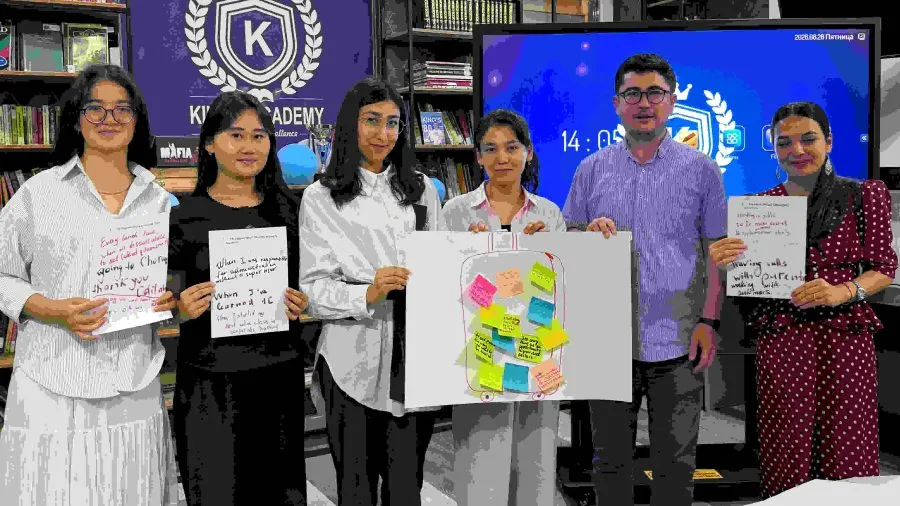
King’s Academy and American Councils YPIP: Five Years of Launching Young Professionals in Uzbekistan
What Is the American Councils Young Professional Internships Program (YPIP)? The Young Professional Internships Program (YPIP) is run by American Councils for International…
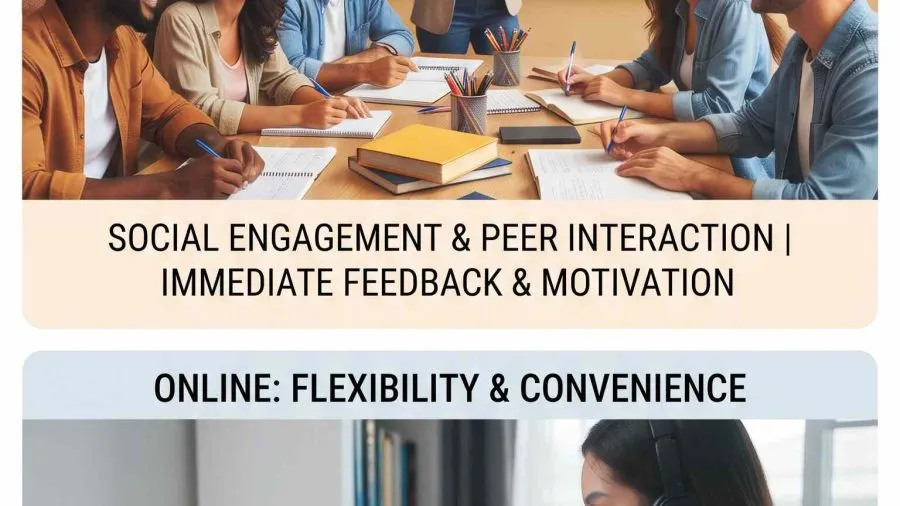
Offline vs Online IELTS Preparation: Why a Real Classroom Still Wins in 2026
Offline or online IELTS preparation? See the honest comparison, a step-by-step plan, and why Tashkent students reach 7.0+ in class at King’s Academy.

IELTS 5.5 to 7.0: How Long Does It Take, and Can You Do It in 2 Months?
How long does it take to go from IELTS 5.5 to 7.0? Realistic timelines, an 8-week plan and an intensive course with Eldor Sattorov in Tashkent.
Submit a request
Do you want to sign up for classes or become part of our team?
Request submitted
We will contact you within the working day.