


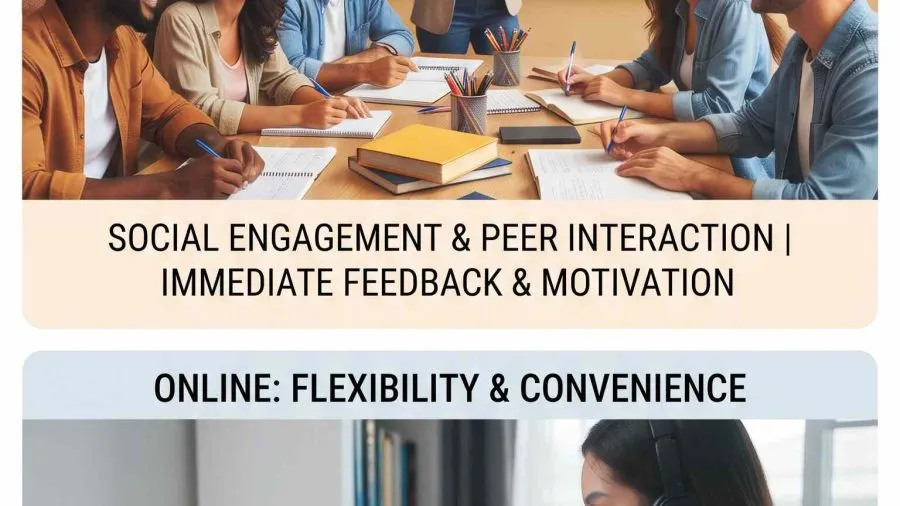
Offline vs Online IELTS Preparation: Why a Real Classroom Still Wins in 2026

Quick answer: Online IELTS courses are cheaper and flexible, but most students who start them never finish. Offline preparation with a qualified instructor gives you live feedback on Writing and Speaking, fixed deadlines, and real exam conditions — the three things that move a band score from 6.0 to 7.0+. Online works best as a supplement, not a replacement.
IELTS is now the key to universities, scholarships and jobs abroad for young people in Uzbekistan. Since July 2025, IELTS in Uzbekistan is delivered on computer only, with Speaking still a face-to-face interview with an examiner (Kun.uz). That makes two things essential: practice on the real computer format, and practice speaking to a real person. Both are far easier in a classroom.
This guide compares the two options honestly, explains when each one makes sense, and gives you a step-by-step plan you can start this week.
Offline vs online IELTS preparation: side-by-side
| Factor | Offline (classroom) | Online (self-study / video course) |
|---|---|---|
| Writing feedback | Teacher marks your essay against the 4 official criteria and explains each error | Often none, or automated/AI scores without explanation |
| Speaking practice | Live conversation, follow-up questions, real nerves — like the real interview | Recording yourself or talking to an app; no human pressure |
| Discipline | Fixed schedule, attendance, homework checks | Depends 100% on your self-motivation |
| Completion | Group and teacher keep you going | Typical online course completion is low — Penn’s Coursera courses averaged about 4% (EdWeek) |
| Exam simulation | Full mock under timed, invigilated, computer-delivered conditions | Practice tests at home, with pauses and distractions |
| Peer learning | Hear how others answer, compare ideas, learn from their mistakes | Isolated |
| Cost and flexibility | Higher fee, fixed times | Cheaper, study anytime |
| Best for | Students aiming 6.5–8.0 who need structure and feedback | Strong self-learners topping up vocabulary or listening |
Bottom line: online materials are good for input (listening, reading, vocabulary). The skills that most often hold students back — Writing and Speaking — need a human examiner’s eye and ear. That is where offline preparation pays for itself.
Why an instructor and a classroom matter for each IELTS skill
IELTS bands are decided by examiners using published criteria. An instructor who knows those criteria shows you exactly what separates a 6.0 answer from a 7.0 one — something a video lesson cannot do for your answer.
- Writing: Task 1 and Task 2 are scored on Task Achievement/Response, Coherence and Cohesion, Lexical Resource, and Grammatical Range and Accuracy (IELTS scoring in detail). Most students plateau at 6.0 because they repeat the same mistakes. A teacher spots the pattern after two or three essays.
- Speaking: the real exam is a face-to-face interview. Practising with a live teacher trains fluency under pressure, natural follow-up answers and pronunciation that apps miss. Examiners score Fluency and Coherence, Lexical Resource, Grammar, and Pronunciation (IDP: Speaking band descriptors).
- Listening and Reading: a teacher teaches strategy — skimming, scanning, spotting distractors, time management on the computer screen — and explains why an answer is wrong.
- Classroom atmosphere: a group creates healthy competition and accountability. You hear stronger answers from classmates, notice your gaps faster, and you do not skip lessons when others are counting on you.
- Motivation: most online learners drop out mid-course; research on MOOC dropout links it to weak instructor engagement and fading motivation (NCERT study). A teacher who knows your name and target score keeps you on track.
Your step-by-step IELTS preparation plan (offline)
- Know your starting band. Take a full computer-delivered mock IELTS before you choose a course. Guessing your level wastes weeks.
- Set a realistic target and deadline. Moving up 0.5 band usually takes 6–10 weeks of steady work; 1.0 band often takes 3 months or more.
- Choose the right format. Small group for structure and speaking practice; individual lessons if you have a close deadline or one weak skill.
- Write two essays a week and get them marked. Rewrite each one using the teacher’s comments — the rewrite is where the band goes up.
- Speak English daily. In class, with classmates, and at least one timed Speaking Part 2 a day.
- Use online tools as a supplement. Free official practice from British Council and IELTS by IDP for listening and reading at home.
- Re-test every 3–4 weeks. A mock under real conditions shows if your plan is working and where to adjust.
- Book the real test only when your mock scores are stable at or above your target.
Why prepare for IELTS offline at King’s Academy, Tashkent
King’s Academy is an official partner of the British Council and has prepared students for IELTS in Tashkent since 2015. More than 10,000 students have graduated from our courses, and thousands have scored 7.0 or higher. Our founder, Eldor Sattorov, spoke alongside the British Council’s Head of Exams Business Development about IELTS in Uzbekistan in a Kun.uz interview.
What you get:
- CD IELTS Academic preparation — you train on the same computer-delivered format you will sit, so exam day feels familiar.
- Small groups or individual lessons — every student is seen, heard and corrected. Choose a group for structure and speaking practice, or one-to-one for a tight deadline.
- Professional instructors who teach to the official band criteria and mark your Writing and Speaking in detail.
- Weekly mock IELTS exams — full 4-skill, computer-delivered mocks every weekend, with detailed feedback on each skill. Register for the next mock IELTS here.
- Commitment to results — we track your mock scores, adjust your plan and tell you honestly when you are ready to book the real test.
Student first, not a factory. Some centres run IELTS like a conveyor belt: big classes, fixed fees, no follow-up. We do the opposite. Our reputation is built on results, so our teachers know each student’s target, weak skill and deadline — and we say “not yet” when booking the exam would waste your money.
Contact: kings.uz · +998 90 900 79 66 · Telegram @kingsacademy_uz
FAQs
Offline vs online IELTS preparation
Is offline or online IELTS preparation better? For most students, offline is better for Writing and Speaking because a teacher marks your work and talks with you live. Online is useful for extra listening, reading and vocabulary practice. The strongest plan combines a classroom course with online practice at home.
Can I get 7.0+ in IELTS by studying online only? Yes, if you are very disciplined and already strong in Writing and Speaking. Most students plateau around 6.0–6.5 without expert feedback on essays and live speaking practice.
Why do so many students quit online IELTS courses? There is no fixed schedule, no teacher checking homework and no classmates. Large studies of online courses show completion rates often below 10%.
Is IELTS in Uzbekistan on paper or on computer? Since July 2025, IELTS in Uzbekistan is delivered on computer; the Speaking test is still face-to-face with an examiner. Results arrive within a few working days.
How long does IELTS preparation take? Roughly 6–10 weeks to improve by 0.5 band and 3 months or more for a full band, depending on your starting level and weekly study hours.
King’s Academy IELTS courses
What IELTS courses does King’s Academy offer? CD IELTS Academic preparation in small groups and individual (one-to-one) lessons, plus weekly computer-delivered mock IELTS exams with detailed feedback.
Is King’s Academy a British Council partner? Yes. King’s Academy is an official partner of the British Council and has prepared students for IELTS in Tashkent since 2015.
How do I check my current IELTS level? Take our weekly mock IELTS — a full 4-skill, computer-delivered exam with feedback. Register here.
Do you offer individual IELTS lessons? Yes. One-to-one lessons suit students with a close exam date or one weak skill, such as Writing Task 2 or Speaking.
Why King’s Academy stands out
What makes King’s Academy different from other IELTS centres in Tashkent? Over 10 years of IELTS experience, 10,000+ graduates, thousands of 7.0+ scores, British Council partnership, small groups and weekly mocks. Most importantly, we focus on each student’s result, not on filling classrooms.
Why should I prepare for IELTS offline at King’s Academy? You get professional instructors, real CD exam practice every week, honest feedback and a plan built around your target band — in a classroom where you are known by name.
Start today
Not sure where you stand? Take a weekend mock IELTS at King’s Academy, get your band for every skill, and leave with a clear plan. Register for a mock IELTS or message us on Telegram @kingsacademy_uz.
Sources and useful links
- IELTS scoring in detail — ielts.org
- Understanding the IELTS Speaking band descriptors — IDP
- British Council: Take IELTS
- IELTS in Uzbekistan shifts to computer-only format — Kun.uz
- How the British Council supports IELTS success in Uzbekistan — Kun.uz
- Student persistence low in MOOCs — Education Week
- Why do MOOCs fail on completion rate? — NCERT
Already taken IELTS? Check your IELTS results →
What's next?
Take the first step — it's free or takes 2 minutes:
Other articles
Daily useful articles

IELTS One Skill Retake in Uzbekistan (2026): Rules, Cost, How to Register
IELTS One Skill Retake in Uzbekistan: who can retake one skill, the 60-day rule, cost, how to register with the British Council or IDP, and what happens to your TRF.
How to Choose an English Teacher in Tashkent: Beyond IELTS Scores
How to choose an English teacher in Tashkent: what IELTS scores don’t show, whether age matters, trial lessons, real results and red flags.

First-Grade Enrolment in Tashkent 2027: How to Apply on my.gov.uz
First-grade enrolment in Tashkent 2027: age rule, dates, documents, catchment area and the my.gov.uz application step by step, with an age checker.

U.S. Ambassador Jonathan Henick Visits King’s Academy in Tashkent: ESP, Youth Internships and U.S.–Uzbekistan Education Ties
U.S. Ambassador Jonathan Henick visited King’s Academy in Tashkent to discuss English for Specific Purposes (ESP), teaching standards and youth internships with American Councils.…
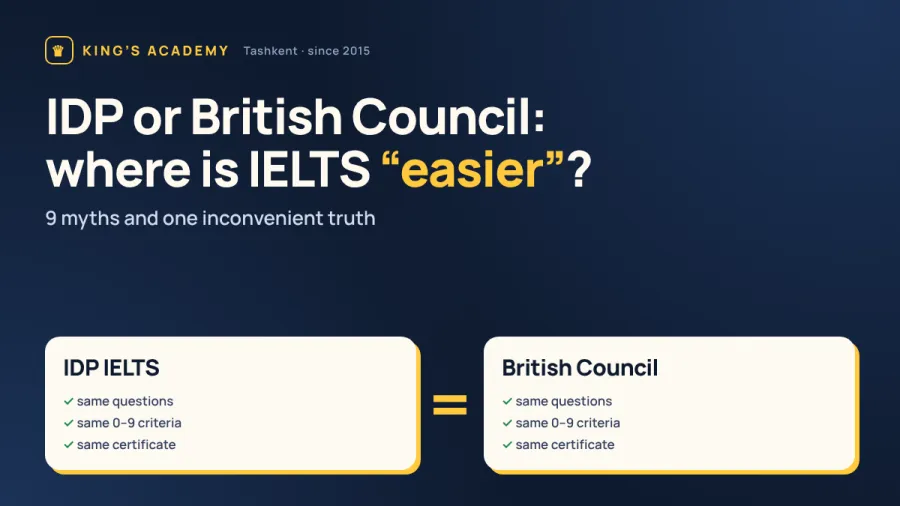
IDP or British Council: Where Is IELTS “Easier”? 9 Myths and One Inconvenient Truth
IDP or British Council — where is IELTS easier and the score higher? We check 9 popular myths (Speaking, “nines”, winter vs summer) against official IELTS sources and explain how…
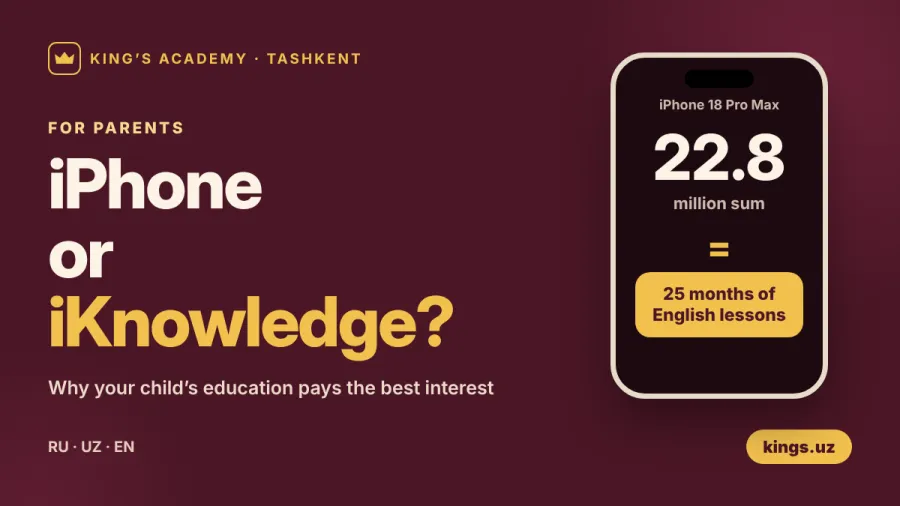
iPhone or iKnowledge? The Best Investment in Your Child
A new iPhone 18 Pro Max costs ~22.8 million sum in Tashkent — two years of English or maths lessons. A personal story about what's really worth investing in.
Submit a request
Do you want to sign up for classes or become part of our team?
Request submitted
We will contact you within the working day.